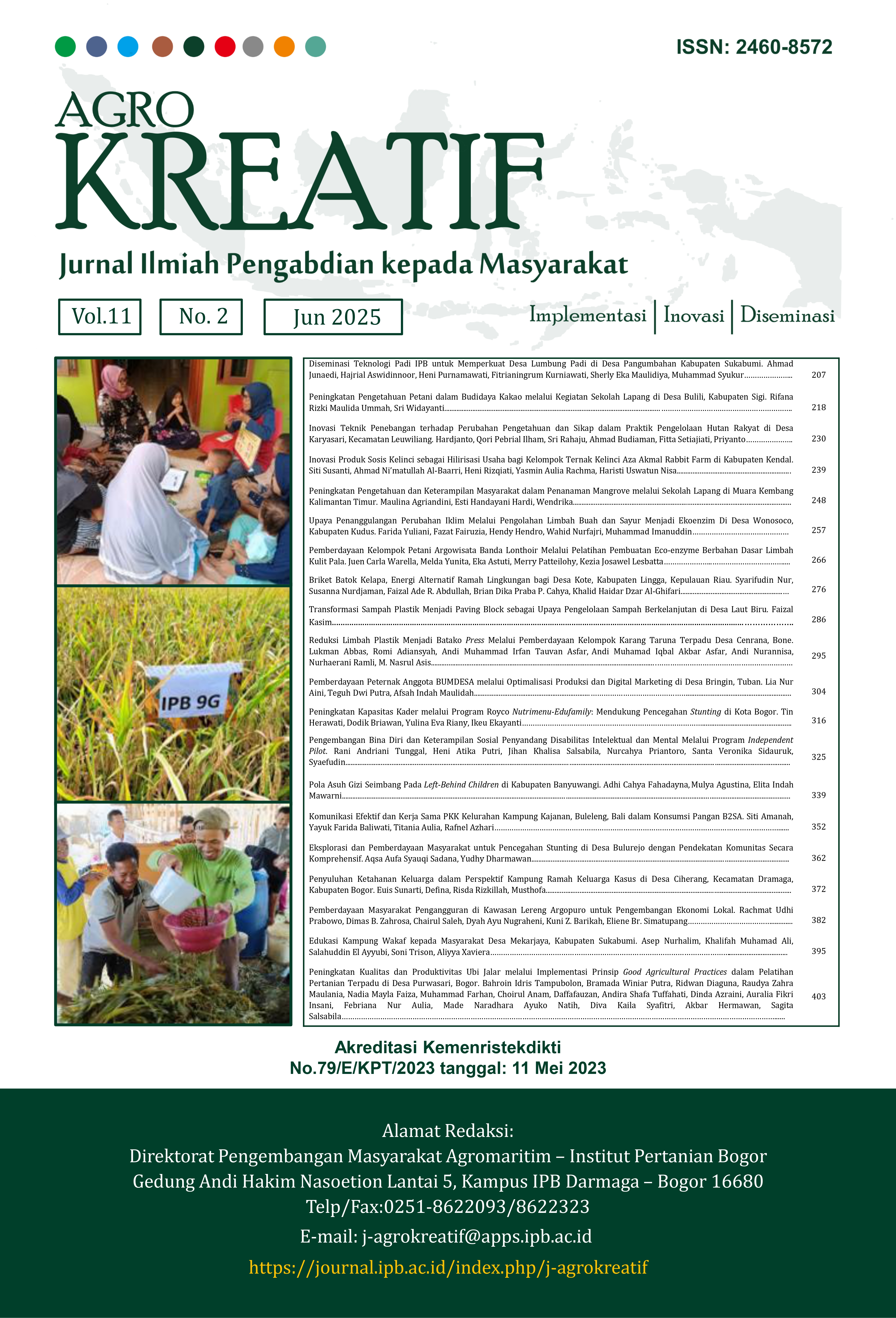
Briket Batok Kelapa, Energi Alternatif Ramah Lingkungan bagi Desa Kote, Kabupaten Lingga, Kepulauan Riau
DOI:
https://doi.org/10.29244/agrokreatif.11.2.276-285Keywords:
coconut shell briquettes, Riau Islands, sustainable energy, waste utilizationAbstract
Kote Village, located on Singkep Island in Riau Islands Province, has the potential to utilize coconut shell briquettes as a sustainable alternative energy source. Singkep Island is known for its extensive coconut trees and is a key component of the local economy. A considerable amount of coconut shell waste remains unutilized. Much of this waste is either discarded or burned without use. This underutilized potential offers an opportunity for briquette production, providing a sustainable energy solution for the village community. This community service initiative aims to reduce a region's dependence on conventional energy sources by converting coconut shell waste into briquettes. The implementation method included prototyping a pyrolysis device in Bandung, reconstructing the equipment in Kote Village, and conducting a workshop for the local community. The results show that the briquettes produced are of good quality and have a high calorific value, and the resulting liquid smoke can be used as a natural fish preservative. This initiative analyzes the environmental and economic benefits of coconut shell briquettes, demonstrating that they offer an efficient alternative energy source that can reduce environmental impact and enhance local energy resilience. Furthermore, it emphasizes the potential for local production, empowering villagers to achieve energy independence while supporting the regional economy. This method helps minimize waste while offering a replicable solution for other villages.
Downloads
References
Arni LHM, Nismayanti A. 2014. Studi Uji Karakteristik Fisis Briket Bioarang sebagai Sumber Energi Alternatif. Online Jurnal of Natural Science. 3(March): 89–98.
Balong S, Isa I, Iyabu H. 2016. Karakterisasi Biobriket dari Eceng Gondok (Eichornia crassipes) sebagai Bahan Bakar Alternatif. Jurnal Entropi Inovasi Penelitian, Pendidikan Dan Pembelajaran Sains. 11(2): 1–6.
Budi RS, Napid S, Warsodirejo PP. 2022. Pemanfaatan Sampah Tumbuh-Tumbuhan Menjadi Briket Arang Sehat Di Desa Mitra Uisu Desa Pematang Kuala Kecamatan Teluk Mengkudu Kabupaten Serdang Bedagai. Jurnal Pengabdian Mitra Masyarakat (JURPAMMAS). 1(2): 7–13. https://doi.org/10.30743/jurpammas.v1i2.5111
Darvell LI, Jones JM, Gudka B, Baxter XC, Saddawi A, Williams A, Malmgren A. 2010. Combustion properties of some power station biomass fuels. Fuel. 89(10): 2881–2890. https://doi.org/10.1016/j.fuel.2010.03.003
Fauzun H, Nurdin H, Lapisa R, Riski S, Primandari P. 2024. Studi Nilai Kalor Briket Cangkang Kelapa Sawit Sebagai Bahan Bakar Padat. Vomek. 6(3): 297–302. https://doi.org/10.24036/vomek.v6i3.714
Gandhi BA. 2010. Pengaruh Varian Jumlah Campuran Perekat Terhadap Karakteristik Briket Arang Tongkol Jagung. Profesional. 8(1): 1‒12.
Halim A, Rante M. 2024. Pengaruh Dua Jenis Perekat Terhadap Briket Arang Tempurung Kelapa. Journal Of Social Science Research. 4(1): 11408–11418.
Jenkins BM, Baxter LL, Miles TR, Miles TR. 1998. Combustion properties of biomass. Fuel Processing Technology. 54:(1–3): 17–46. https://doi.org/10.1016/S0378-3820(97)00059-3
Magdziarz A, Wilk M, Zajemska M. 2011. Modelling of pollutants concentrations from the biomass combustion process. Chemical and Process Engineering-Inzynieria Chemiczna i Procesowa. 32(4): 423–433. https://doi.org/10.2478/v10176-011-0034-2
Muarif A, Hakim L, Ginting Z, Mulyawan R. 2024. Pengaruh Variasi Jenis dan Volume Perekat (Tepung Tapioka dan Air Tebu) terhadap Kualitas Briket dari Pelepah Kelapa Sawit (Elaeis Guenensis Jacq). Jurnal Inovasi Teknik Kimia. 9(2): 136–143.
Purwaningsih P, Saragih EW, Santoso B. 2024. Diseminasi Pemanfaatan Limbah Pelepah Kelapa Sawit dan Kotoran Sapi menjadi Briket Arang sebagai Bahan Bakar Alternatif di Kampung Majemus Distrik Masni Kabupaten Manokwari. Jurnal ABDINUS : Jurnal Pengabdian Nusantara. 8(1): 172–183. https://doi.org/10.29407/ja.v8i1.19031
Rifdah R, Herawati N, Dubron F. 2017. Pembuatan Biobriket dari Limbah Tongkol Jagung Pedagang Jagung Rebus dan Rumah Tangga sebagai Bahan Bakar Energi Terbarukan dengan Proses Karbonisasi. Jurnal Distilasi. 2(2): 39‒46. https://doi.org/10.32502/jd.v2i2.1202
Salawali RT, Zainuddin IM, Mandasini M, Yani S. 2018. Kinetika Reaksi Pembakaran Biobriket Campuran Batubara Dengan Biomassa. Journal Of Chemical Process Engineering. 2(2): 7‒11. https://doi.org/10.33536/jcpe.v2i2.156
Siregar IN. 2017. Pembuatan Dan Pengujian Briket Campuran Eceng Gondok-Batubara. Bandung: Politeknik Bandung.
Suhartoyo, Sriyanto. 2017. Effektifitas Briket Biomassa. Prosiding SNATIF Ke-4. Hal: 623–627.
Tamrin M, Dunggio S, Abdussamad S. 2024. Peran Briket Limbah Batok Kelapa dalam Meningkatkan Kesejahteraan Ekonomi Masyarakat Desa. EMPIRIS: Jurnal Pengabdian Pada Masyarakat (EJPPM). 2(1): 8–18. https://doi.org/10.59713/ejppm.v2i1.1093
Wilk M, Magdziarz A, Kalemba I, Gara P. 2016. Carbonisation of wood residue into charcoal during low temperature process. Renewable Energy. 85: 507–513. https://doi.org/10.1016/j.renene.2015.06.072
Downloads
Published
Issue
Section
License
Copyright (c) 2025 Syarifudin Nur, Susanna Nurdjaman, Faizal Abdullah, Brian Cahya, Khalid Al-Ghifari (Author)

This work is licensed under a Creative Commons Attribution-NonCommercial 4.0 International License.

This work is licensed under a Creative Commons Attribution-NonCommercial 4.0 International License.