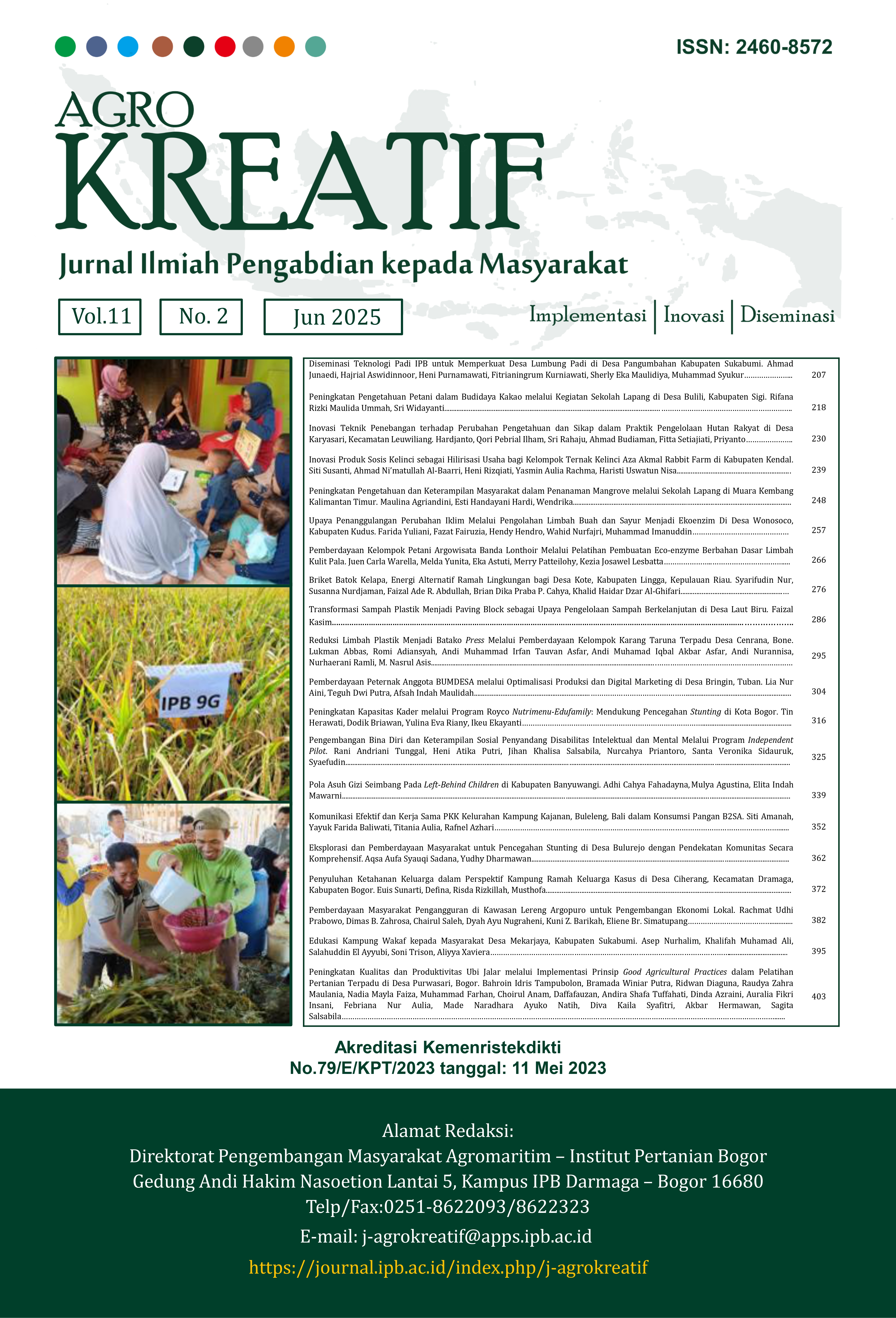
Pemberdayaan Masyarakat Pengangguran di Kawasan Lereng Argopuro untuk Pengembangan Ekonomi Lokal
DOI:
https://doi.org/10.29244/agrokreatif.11.2.382-394Keywords:
Panti Village, slopes of mount Argopuro, unemployedAbstract
The slopes of Mount Argopuro are naturally rich in inactive volcanoes in Indonesia. The surrounding community uses this area as a place for economic livelihoods. One of the dominant economic sectors in which the surrounding community chooses to meet its living needs is the agricultural sector, particularly the livestock sector. Community empowerment activities aim to 1) Increase understanding of business innovation to increase the added value of managing livestock waste; 2) Build pioneering business institutions through Community Business Groups; and 3) Initiate business marketing and sustainability. The method of implementing community empowerment includes socialization and training with four criteria: 1) Providing material on the importance of institutions; 2) Product diversity as a requirement for developing livestock waste processing businesses; 3) Business Development Practices; and 4) Strengthening business management. Community empowerment activities are equipped with activity evaluation methods through surveys that provide pre-test and post-test treatments to the unemployed community in Panti Village. The results of the Community Service show that the unemployed community in Panti Village can understand the benefits of strengthening institutions based on business legality and the creation of AD/ART as a basic requirement for the formation of institutions. The unemployed community can know, understand, and develop skills in the diversity of livestock waste processing that have not been utilized either economically or ecologically. An unemployed community can create packaging designs, promotions, networking, social media accounts, product trust concepts, and management to improve business performance. To improve the sustainability of the program and product absorption, the community empowerment team cooperates based on business transparency with the business incubator of the Faculty of Economics and Business Laboratory, University of Jember to improve networking and product expansion in the future.
Downloads
References
Awasthi AK, Cheela VRS, D’Adamo I, Iacovidou E, Islam MR, Johnson M, Miller TR, Parajuly K, Parchomenko A, Radhakrishan L, Zhao M, Zhang C, Li J. 2021. Zero waste approach towards a sustainable waste management. Resources, Environment and Sustainability. 3: 100014. https://doi.org/10.1016/j.resenv.2021.100014 DOI: https://doi.org/10.1016/j.resenv.2021.100014
Budler M, Župič I, Trkman P. 2021. The development of business model research: A bibliometric review. Journal of Business Research. 135: 480–495. https://doi.org/10.1016/j.jbusres.2021.06.045 DOI: https://doi.org/10.1016/j.jbusres.2021.06.045
Buitrago R, R E, Barbosa Camargo MI. 2021. Institutions, institutional quality, and international competitiveness: Review and examination of future research directions. Journal of Business Research. 128: 423–435. https://doi.org/10.1016/j.jbusres.2021.02.024 DOI: https://doi.org/10.1016/j.jbusres.2021.02.024
Farida I, Setiawan D. 2022. Business Strategies and Competitive Advantage: The Role of Performance and Innovation. Journal of Open Innovation: Technology, Market, and Complexity. 8(3): 163. https://doi.org/10.3390/joitmc8030163 DOI: https://doi.org/10.3390/joitmc8030163
Hakim R. 2015. Jalur Panti: Hutan Lindung yang Tak Terlindungi. [Internet]. [Diunduh 2023 Nov 25] Tersedia pada: Https://Www.Kompasiana.Com/Acacicu/5528c370f17e610f058b45b8 /Jalur-Panti-Hutan-Lindung-Yang-Tak-Terlindungi.
Ife JW, Ife, J, Tesoriero F. 2006. Community Development: Community-based Alternatives in an Age of Globalisation. Pearson Education Australia. [Internet]. [Diunduh 2023 Nov 25] Tersedia pada: https://books.google.co.id/books?id=ePnePQAACAAJ
Kerdlap P, Low JSC, Ramakrishna, S. 2019. Zero waste manufacturing: A framework and review of technology, research, and implementation barriers for enabling a circular economy transition in Singapore. Resources, Conservation and Recycling. 151: 104438. https://doi.org/10.1016/j.resconrec.2019.104438 DOI: https://doi.org/10.1016/j.resconrec.2019.104438
Li W, Shuai C, Shuai Y, Cheng X, Liu Y, Huang, F. 2020. How Livelihood Assets Contribute to Sustainable Development of Smallholder Farmers. Journal of International Development. 32(3): 408–429. https://doi.org/10.1002/jid.3461 DOI: https://doi.org/10.1002/jid.3461
McGaughey SL, Kumaraswamy A, Liesch, PW. 2016. Institutions, entrepreneurship and co-evolution in international business. Journal of World Business. 51(6): 871–881. https://doi.org/10.1016/j.jwb.2016.07.003 DOI: https://doi.org/10.1016/j.jwb.2016.07.003
Prabowo RU, Nafi’ A, Ridjal JA. 2022. Implementasi Reposisi Green Economy : Peningkatan Kapasitas Usaha Rintisan Masyarakat Sekitar Taman Nasional Meru Betiri. Jurnal AGRIBIOS. 20(1): 129-134. https://doi.org/10.36841/agribios.v20i1.1653 DOI: https://doi.org/10.36841/agribios.v20i1.1653
Prabowo RU, Nugraheni DA, Virlianna Sari C, Hanifur Rizqi R, Salsabila S, Rohmatul Izza SV, Istiq Faris U, Nur Andini, SF . 2023. Akselerasi Smart Labeling Agroindustri Keripik Singkong Kecamatan Jombang Kabupaten Jember. Jurnal Al-Khidmah. 3(1): 71–78. https://doi.org/10.56013/jak.v3i1.2195 DOI: https://doi.org/10.56013/jak.v3i1.2195
Prabowo RU, Zahrosa DB, Nurhidayati R, Rohib M, Kurniawan A, Alimusaffa F, Khalimah ZN. 2023. Tinjauan Distorsi Pupuk Bersubsidi Terhadap Perilaku Petani Di Kabupaten Jember (Studi Kasus di Desa Lojejer Kecamatan Wuluhan). Jurnal AGRIBIOS. 21(1): 109–116. https://doi.org/10.36841/agribios.v21i1.2972 DOI: https://doi.org/10.36841/agribios.v21i1.2972
Shams R, Chatterjee S, Chaudhuri R. 2024. Developing brand identity and sales strategy in the digital era: Moderating role of consumer belief in brand. Journal of Business Research. 179: 114689. https://doi.org/10.1016/j.jbusres.2024.114689 DOI: https://doi.org/10.1016/j.jbusres.2024.114689
Shukla P, Singh J, Wang W. 2022. The influence of creative packaging design on customer motivation to process and purchase decisions. Journal of Business Research. 147: 338–347. https://doi.org/10.1016/j.jbusres.2022.04.026 DOI: https://doi.org/10.1016/j.jbusres.2022.04.026
Yang Z, Su C. 2014. Institutional theory in business marketing: A conceptual framework and future directions. Industrial Marketing Management. 43(5): 721–725. https://doi.org/10.1016/j.indmarman.2014.04.001 DOI: https://doi.org/10.1016/j.indmarman.2014.04.001
Downloads
Published
Issue
Section
License

This work is licensed under a Creative Commons Attribution-NonCommercial 4.0 International License.