
How do Tourists Perceive Risk and Develop Travel Preparedness? Influence of Destination Attributes and Knowledge

Article Sidebar
-
travel preparedness, perceived risk, disaster knowledge, destination attributes, tourist resilience
Abstract
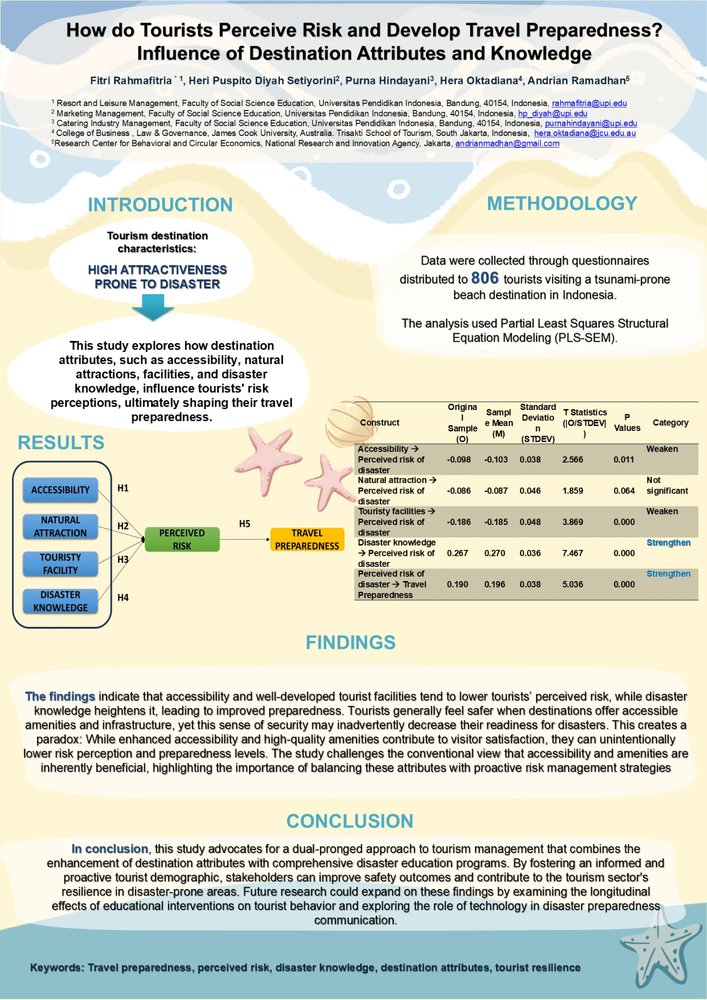
This study explores how destination attributes, such as accessibility, natural attractions, facilities, and disaster knowledge, influence tourists' risk perceptions, ultimately shaping their travel preparedness. Data were collected through questionnaires distributed to 806 tourists visiting a tsunami-prone beach destination in Indonesia. Partial Least Squares Structural Equation Modeling (PLS-SEM) was implemented in the analysis. The findings indicate that accessibility and well-developed tourist facilities tend to lower tourists’ perceived risk, while disaster knowledge heightens it, leading to improved preparedness. Tourists generally feel safer when destinations offer accessible amenities and infrastructure, yet this sense of security may inadvertently decrease their readiness for disasters. This situation creates a paradox: While enhanced accessibility and high-quality amenities contribute to visitor satisfaction, they can unintentionally lower risk perception and preparedness levels. The study challenges the conventional view that accessibility and amenities are inherently beneficial, highlighting the importance of balancing these attributes with proactive risk management strategies. Destination providers, destination management organizations (DMOs), and governments should enhance tourists’ disaster awareness through well-crafted guidelines, educational campaigns, and community engagement programs; these efforts help equip tourists with the necessary knowledge to respond effectively in emergency situations. At the same time, they contribute to the development of safer and more enjoyable tourist destinations.
Full text article
References
Appleby-Arnold, S., Brockdorff, N., Jakovljev, I., & Zdravković, S. (2021). Disaster preparedness and cultural factors: A comparative study in Romania and Malta. Disasters, 45(3), 664–690. https://doi.org/10.1111/disa.12433
Bakeman, R., & Gottman, J. M. (1997). Observing interaction an introduction to sequential analysis. Cambridge University Press.
Barber, N., Taylor, D., & Strick, S. (2009). Environmental knowledge and attitudes: Influencing the purchase decisions of wine consumers. International CHRIE Conference-Refereed Track 2009, Paper 16. Retireved from http://scholarworks.umass.edu/refereed/Sessions/Wednesday/16/
Boguszewicz-Kreft, M., Kuczamer-Kłopotowska, S., & Kozłowski, A. (2022). The role and importance of perceived risk in medical tourism. Applying the theory of planned behaviour. PLoS ONE, 17(1), Article e0262137. https://doi.org/10.1371/journal.pone.0262137
Bujang, M. A., Ghani, P. A., Bujang, M. A., Zolkepali, N. A., & Adnan, T. H. (2012). A comparison between convenience sampling versus systematic sampling in getting the true parameter in a population: Explore from a clinical database: The audit diabetes control management (ADCM) registry in 2009. In 2012 international conference on statistics in science, business and engineering (pp. 1–5). IEEE. https://doi.org/10.1109/ICSSBE.2012.6396615
Bulut, U., Kocak, E., & Suess, C. (2020). The effect of freedom on international tourism demand: Empirical evidence from the top eight most visited countries. Tourism Economics, 26(8), 1358–1373. https://doi.org/10.1177/1354816619896957
Cheung, K. S., & Yiu, C. Y. (2022). Public perception of flood hazards in the housing market: A revealed preference study of affect heuristics and availability heuristics. International Journal of Disaster Risk Reduction, 75, Article 102977. https://doi.org/10.1016/j.ijdrr.2022.102977
Coombs, W. T. (2007). Protecting organization reputations during a crisis: The development and application of situational crisis communication theory. Corporate Reputation Review, 10(3), 163–176. https://doi.org/10.1057/palgrave.crr.1550049
Cui, F., Liu, Y., Chang, Y., Duan, J., & Li, J. (2016). An overview of tourism risk perception. Natural Hazards, 82(1), 643–658. https://doi.org/10.1007/s11069-016-2208-1
Dağıstan, S. Y., Sevim, B., Arici, H. E., & Köseoglu, M. B. S. M. A. (2023). Perceived risk in hospitality and tourism scholarship: A systematic review and future research agenda. Journal of Travel & Tourism Marketing, 40(9), 863–877. https://doi.org/10.1080/10548408.2023.2296640
Dikara, R., Taofiqurohman, A., & Iskandar, I. (2022). Penilaian kuantitatif risiko wisata di kawasan wisata Pantai Pangandaran. Buletin Oseanografi Marina, 11(1), 77–85. https://doi.org/10.14710/buloma.v11i1.34095
Domingues, R., Costas, S., Jesus, S., & Ferreira, Ó. (2017). Sense of place, risk perceptions and preparedness of a coastal population at risk (Faro Beach, Portugal): A qualitative content analysis. Journal of Spatial and Organizational Dynamics, 5(3), 163–175.
Floyd, M. F., Gibson, H., & Pennington-Gray, L. (2004). The effect of risk perceptions on intentions to travel in the aftermath of September 11, 2001. Journal of Travel & Tourism Marketing, 15(2–3), 19–38. https://doi.org/10.1300/J073v15n02_02
Hair, J. F., Sarstedt, M., Hopkins, L., & Kuppelwieser, V. G. (2014). Partial least squares structural equation modeling (PLS-SEM): An emerging tool in business research. European Business Review, 26(2), 106–121. https://doi.org/10.1108/EBR-10-2013-0128
Hair, J. F., Tomas, G., Hult, M., Ringle, C. M., & Sarstedt, M. (2016). A primer on partial least squares structural equation modeling (PLS-SEM). SAGE Publications
Hajibaba, H., Gretzel, U., Leisch, F., & Dolnicar, S. (2015). Crisis-resistant tourists. Annals of Tourism Research, 53, 46–60. https://doi.org/10.1016/j.annals.2015.04.001
Hao, J., Tang, H., Hao, J., Ma, Y., & Jiang, X. (2022). Impacts of risk perception, disaster knowledge, and emotional attachment on tourists’ behavioral intentions in Qinling Mountain, China. Frontiers in Earth Science, 10, Article 880912. https://doi.org/10.3389/feart.2022.880912
Heimisdóttir, Þ., Sæþórsdóttir, A. D., & Gísladóttir, G. (2019). The sublime attraction of active volcanoes: An exploration of tourists’ experiences during a long-distance hiking route in Iceland. Tourist Studies, 19(2), 258–275. https://doi.org/10.1177/1468797619832306
Hinsberg, K. L., & Lamanna, A. J. (2024). Crisis communication in construction: Organizational strategies for worksite fatalities. Journal of Safety Research, 88, 145–160. https://doi.org/10.1016/j.jsr.2023.11.002
Huan, T.-C., Beaman, J., & Shelby, L. (2004). No-escape natural disaster: Mitigating Impacts on Tourism. Annals of Tourism Research, 31(2), 255–273. https://doi.org/10.1016/j.annals.2003.10.003
Hughes, M., & Morrison-Saunders, A. (2003). Visitor attitudes toward a modified natural attraction. Society & Natural Resources, 16(3), 191–203. https://doi.org/10.1080/08941920309160
Jamin, A., Rahmafitria, F., & Nurazizah, G. R. (2020). Rebuilding health tourism destination image after Covid-19: The case of Malaysia and Indonesia. In IEEE Region 10 Humanitarian Technology Conference R10-HTC (pp. 1–6). IEEE. https://doi.org/10.1109/R10-HTC49770.2020.9357057
Jonas, A., Mansfeld, Y., Paz, S., & Potasman, I. (2011). Determinants of health risk perception among low-risktaking tourists traveling to developing countries. Journal of Travel Research, 50(1), 87–99. https://doi.org/10.1177/0047287509355323
Joshi, A., Kale, S., Chandel, S., & Pal, D. K. (2015). Likert scale: Explored and explained. British Journal of Applied Science and Technology, 7(4), 396–403. https://doi.org/10.9734/BJAST/2015/14975
Karl, M., Muskat, B., & Ritchie, B. W. (2020). Which travel risks are more salient for destination choice? An examination of the tourist’s decision-making process. Journal of Destination Marketing and Management, 18, Article 100487. https://doi.org/10.1016/j.jdmm.2020.100487
Kock, N. (2018). Minimum sample size estimation in PLS-SEM: An application in tourism and hospitality research. In F. Ali, S. M. Rasoolimanesh, & C. Cobanoglu (Eds.), Applying partial least squares in tourism and hospitality research (pp. 1–16). Emerald Publishing Limited. https://doi.org/10.1108/978-1-78756-699-620181001
Kozak, M., & Rimmington, M. (1998). Benchmarking: Destination attractiveness and small hospitality business performance. International Journal of Contemporary Hospitality Management, 10(5), 184–188. https://doi.org/10.1108/09596119810227767
Lazo, J. K., Bostrom, A., Morss, R. E., Demuth, J. L., & Lazrus, H. (2015). Factors affecting hurricane evacuation intentions. Risk Analysis, 35(10), 1837–1857. https://doi.org/10.1111/risa.12407
Lee, C.-F., & King, B. (2019). Determinants of attractiveness for a seniors-friendly destination: a hierarchical approach. Current Issues in Tourism, 22(1), 71–90. https://doi.org/10.1080/13683500.2016.1250725
Lepp, A., & Gibson, H. (2003). Tourist roles, perceived risk and international tourism. Annals of Tourism Research, 30(3), 606–624. https://doi.org/10.1016/S0160-7383(03)00024-0
Likert, R. (1932). A technique for the measurement of attitudes. In R. S. Woodworth (Ed.), Archives of psychology (pp. 5–55). Columbia University.
Ma, H., Chiu, Y. H., Tian, X., Zhang, J., & Guo, Q. (2020). Safety or travel: Which is more important? The impact of disaster events on Tourism. Sustainability, 12(7), Article 3038. https://doi.org/10.3390/su12073038
Maksim Godovykh, A. P., & Bahja, F. (2021). Antecedents and outcomes of health risk perceptions in tourism, following the COVID-19 pandemic. Tourism Review, 76(4), 737–748. https://doi.org/10.1108/TR-06-2020-0257
Marincioni, F., Casareale, C., & Byrne, K. (2019). Beautiful and safe landscapes for sustainable disaster risk reduction. In J. Kendra, S. Knowles, & T. Wachtendorf (Eds.), Disaster research and the second environmental crisis (pp. 105–116). Springer, Cham. https://doi.org/10.1007/978-3-030-04691-0_5
Marwa, S., & Rahmafitria, F. (2018). A factor analysis of visitors’ motivation in visiting the geology museum of Bandung. IOP Conference Series: Earth and Environmental Science, 145, Article 012084. https://doi.org/10.1088/1755-1315/145/1/012084
Najar, A. H., & Rather, A. H. (2023). Assessing the relationship of perceived risks with destination image and destination loyalty: a tourist’s perspective visiting volatile destinations. Journal of Hospitality and Tourism Insights, 6(3), 1357–1379. https://doi.org/10.1108/JHTI-03-2022-0100
Nijman, V. (2021). Tourism developments increase tsunami disaster risk in Pangandaran, West Java, Indonesia. International Journal of Disaster Risk Science, 12, 764–769. https://doi.org/10.1007/s13753-021-00365-3
Ng, S. L. (2022). Effects of risk perception on disaster preparedness toward typhoons: An application of the extended theory of planned behavior. International Journal of Disaster Risk Science, 13, 100–113. https://doi.org/10.1007/s13753-022-00398-2
Oktariadi, O. (2009). Penentuan peringkat bahaya tsunami dengan metode analytical hierarchy process (Studi kasus: Wilayah pesisir Kabupaten Sukabumi). Indonesian Journal on Geoscience, 4(2), 103–116. https://doi.org/10.17014/ijog.vol4no2.20093
Park, K., & Reisinger, Y. (2010). Differences in the perceived influence of natural disasters and travel risk on international travel. Tourism Geographies, 12(1), 1–24. https://doi.org/10.1080/14616680903493621
Park, S., & Tussyadiah, I. P. (2017). Multidimensional facets of perceived risk in mobile travel booking. Journal of Travel Research, 56(7), 854–867. https://doi.org/10.1177/0047287516675062
Perpiña, L., Camprubí, R., & Prats, L. (2019). Destination image versus risk perception. Journal of Hospitality & Tourism Research, 43(1), 3–19. https://doi.org/10.1177/1096348017704497
Pratt, S., & Tolkach, D. (2022). Stupidity in tourism. Tourism Recreation Research, 47(1), 3–16. https://doi.org/10.1080/02508281.2020.1828555
Putra, F. D., Yovi, E. Y., & Kuncahyo, B. (2024). Heat-resilient workforce: Unveiling the relationships between heat-related knowledge, risk perception, and precautionary behavior in Indonesian pine forest workers. European Journal of Forest Engineering, 10(1), 67–77. https://doi.org/10.33904/ejfe.1374811
Rahmafitria, F., Sukmayadi, V., Purboyo, H. (2020). The real and actual accessibility in protected area. IOP Conference Series: Earth and Environmental Science, 501, Article 012047. https://doi.org/10.1088/1755-1315/501/1/012047
Rahmafitria, F., Dirgahayani, P., Putro, H. P. H., Rosyidie, A., & Hudalah, D. (2023). Tourism accessibility in protected islands: The case of the Komodo National Park, Indonesia. Tourism Review, 78(3), 966–985. https://doi.org/10.1108/TR-03-2022-0110
Rahmafitria, F., & Kaswanto, R. L. (2024). The role of eco-attraction in the intention to conduct low-carbon actions: a study of visitor behavior in urban forests. International Journal of Tourism Cities, 10(2), 881–904. https://doi.org/10.1108/IJTC-07-2023-0138
Rahmafitria, F., Puspito, H., Setiyorini, D., Hindayani, P., & Ramadhan, A. (2024). The role of destination image and risk perception on interest in revisiting disaster-prone coastal destinations. Journal of Environmental Science and Sustainable Development, 7(1), 480–495. https://doi.org/10.7454/jessd.v7i1.1227
Rittichainuwat, B. N., & Chakraborty, G. (2009). Perceived travel risks regarding terrorism and disease: The case of Thailand. Tourism Management, 30(3), 410–418. https://doi.org/10.1016/j.tourman.2008.08.001
Sæþórsdóttir, A. D., Wendt, M., & Ólafsdóttir, R. (2022). Tourism industry attitudes towards national parks and wilderness: A case study from the Icelandic Central Highlands. Land, 11(11), Article 2066. https://doi.org/10.3390/land11112066
Sahadev, S., Chang, K., Malhotra, N., Kim, J. H., Ahmed, T., & Kitchen, P. (2024). Psychological empowerment and creative performance: Mediating role of thriving and moderating role of competitive psychological climate. Journal of Business Research, 170, Article 114310. https://doi.org/10.1016/j.jbusres.2023.114310
Schumacker, R. E., & Lomax, R. G. (2004). A beginner’s guide to structural equation modeling (2nd ed.). Lawrence Erlbaum Associates.
Sharifpour, M., Walters, G., Ritchie, B. W., & Winter, C. (2014). Investigating the role of prior knowledge in tourist decision making: A structural equation model of risk perceptions and information search. Journal of Travel Research, 53(3), 307–322. https://doi.org/10.1177/0047287513500390
Su, L., Chen, H., & Lin, Z. (2023). Rise through coping with service failures in tourism. Annals of Tourism Research, 102, Article 103643. https://doi.org/10.1016/j.annals.2023.103643
Thapa, B., Cahyanto, I., Holland, S. M., & Absher, J. D. (2013). Wildfires and tourist behaviors in Florida. Tourism Management, 36, 284–292. https://doi.org/10.1016/j.tourman.2012.10.011
Tverijonaite, E., Ólafsdóttir, R., & Thorsteinsson, T. (2017). Accessibility of protected areas and visitor behaviour: A case study from Iceland. Journal of Outdoor Recreation and Tourism, 24, 1–10. https://doi.org/10.1016/j.jort.2018.09.001
Utkarsh, & Sigala, M. (2021). A bibliometric review of research on COVID-19 and tourism: Reflections for moving forward. Tourism Management Perspectives, 40, Article 100912. https://doi.org/https://doi. org/10.1016/j.tmp.2021.100912
Wachinger, G., Renn, O., Begg, C., & Kuhlicke, C. (2013). The risk perception paradox–implications for governance and communication of natural hazards. Risk Analysis, 33(6), 1049–1065. https://doi.org/10.1111/j.1539-6924.2012.01942.x
Wahyuningtyas, N., Kodir, A., Idris, I., & Islam, M. N. (2020). Accelerating tourism development by community preparedness on disaster risk in Lombok, Indonesia. Geojournal of Tourism and Geosites , 29(2), 545–553. https://doi.org/10.30892/gtg.29213-488
Wattanacharoensil, W., Lee, J. -S., Fakfare, P., & Manosuthi, N. (2023). The multi-method approach to analyzing motivations and perceived travel risks: Impacts on domestic tourists’ adaptive behaviors and tourism destination advocacy. Journal of Travel & Tourism Marketing, 40(2), 109–130. https://doi.org/10.1080/10548408.2023.2215266
Xu, D., Peng, L., Liu, S., & Wang, X. (2018). Influences of risk perception and sense of place on landslide disaster preparedness in Southwestern China. International Journal of Disaster Risk Science, 9, 167–180. https://doi.org/10.1007/s13753-018-0170-0
Yin, Q., Ntim-Amo, G., Xu, D., Gamboc, V. K., Ran, R., Hu, J., & Tang, H. (2022). Flood disaster risk perception and evacuation willingness of urban households: The case of Accra, Ghana. International Journal of Disaster Risk Reduction, 78, Article 103126. https://doi.org/10.1016/j.ijdrr.2022.103126
Yovi, E. Y., Nastiti, A., & Kuncahyo, B. (2023). Heat-related knowledge, risk perception, and precautionary behavior among Indonesian forestry workers and farmers: Implications for occupational health promotion in the face of climate change impacts. Forests, 14(7), Article 1455. https://doi.org/10.3390/f14071455
Zhang, H., Wu, Y., & Buhalis, D. (2018). A model of perceived image, memorable tourism experiences and revisit intention. Journal of Destination Marketing and Management, 8, 326–336. https://doi.org/10.1016/j.jdmm.2017.06.004
Zhang, J., Xie, C., Liu, Y., Li, W., & Hwuang, Q. (2024). Identification of tourists’ dynamic risk decision-making: A crisis communication lifecycle perspective. Current Issues in Tourism, 1–18. https://doi.org/10.1080/13683500.2024.2439386
Authors
Copyright (c) 2025 Jurnal Manajemen Hutan Tropika

This work is licensed under a Creative Commons Attribution 4.0 International License.
Jurnal Manajemen Hutan Tropika is an open access journal which means that all contents is freely available without charge to the user or his/her institution. Users are allowed to read, download, copy, distribute, print, search, or link to the full texts of the articles in this journal without asking prior permission from the publisher or the author. This is in accordance with the Budapest Open Access Initiative (BOAI) definition of open access.Article Details
How to Cite




