
Allometric Model for Estimating Above-ground Biomass and Carbon Stock of Bambusa vulgaris var. striata

Article Sidebar
-
carbon accounting, climate change mitigation, yellow bamboo, non-timber forest productt
Abstract
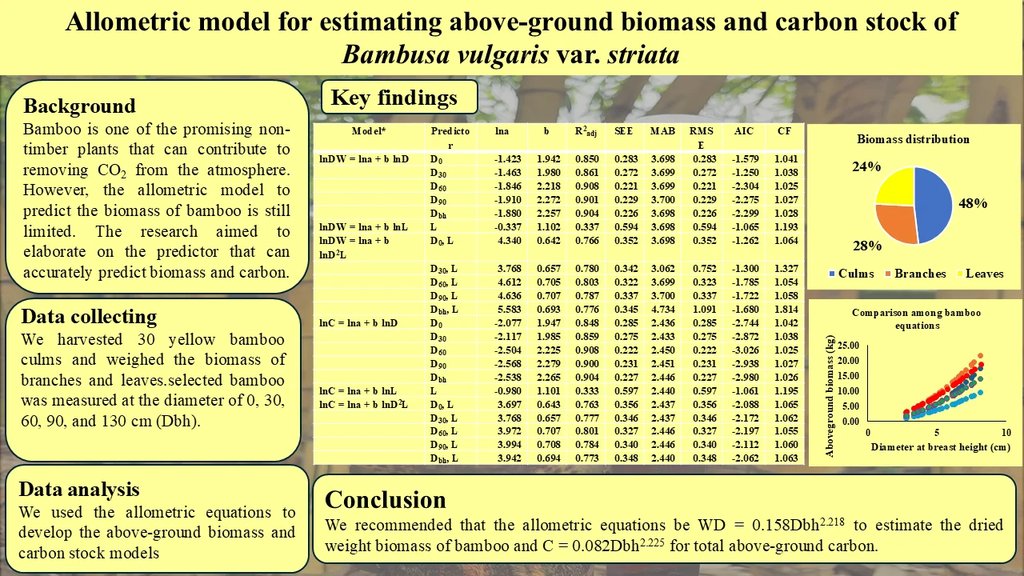
Bamboo, one of the non-timber forest products, is promising in climate change mitigation strategy due to its ability to remove CO2 from the atmosphere through photosynthesis. However, the allometric model to estimate the biomass and carbon of bamboo is still limited. The research aimed to develop the allometric model using the diameter as the predictor. The materials for destructive sampling were 30 culms of yellow ampel bamboo (Bambusa vulgaris var. striata). A power model was used to analyze data in order to develop an allometric model. Furthermore, data validation was used to leave one out cross-validation (LOOCV), and assessing the difference between predicted and observed values used t-test. The results showed that bamboo biomass was allocated in culms, branches, and leaves at 48.14, 27.66, and 24.20%, respectively. Moreover, the percentage carbon content of culms, branches, and leaves was 55.64%, 50.67%, and 48.48%, respectively. The best allometric model to estimate total biomass was lnWD = -1.846 + 2.218 lnD and to estimate carbon stock was lnC = -2.504 + 2.225 lnD. In conclusion, the diameter at 60 cm from the base (D60) was the best predictor, and adding the predictor length of culm did not improve the allometric model significantly. Moreover, the predictor D0 – Dbh (1.3 m) did not differ significantly in estimating above-ground biomass and carbon stock. Furthermore, for practical purpose, the Dbh is recommended for use in measuring bamboo diameter in the field.
Full text article
References
Ahmad, Z., Upadhyay, A., Ding, Y., Emamverdian, A., & Shahzad, A. (2021). Bamboo: Origin, habitat, distributions and global prospective. Z. Ahmad, Y. Ding, & A. Shahzad (Eds.), Biotechnological Advances in Bamboo (pp. 1–31). Springer Nature. https://doi.org/10.1007/978-981-16-1310-4_1
Altanzagas, B., Luo, Y., Altansukh, B., Dorjsuren, C., Fang, J., & Hu, H. (2019). Allometric equations for estimating the above-ground biomass of five forest tree species in Khangai, Mongolia. Forests, 10(8), Article 661. https://doi.org/10.3390/f10080661
Amoah, M., Assan, F., & Dadzie, P. K. (2020). Above-ground biomass, carbon storage and fuel values of Bambusa vulgaris, Oxynanteria abbyssinica and Bambusa vulgaris var. vitata plantations in the Bobiri Forest Reserve of Ghana. Journal of Sustainable Forestry, 39(2), 113–136. https://doi.org/10.1080/10549811.2019.1608452
Badan Pusat Statistik Kabupaten Sleman. (2021). Kecamatan Pakem dalam angka 2020. Sleman: Badan Pusat Statistik.
Camargo García, J. C., Arango Arango, A. M., & Trinh, L. (2023). The potential of bamboo forests as a carbon sink and allometric equations for estimating their above-ground biomass. Environment, Development and Sustainability, 26, 20159–20187. https://doi.org/10.1007/s10668-023-03460-1
Chave, J., Réjou-Méchain, M., Búrquez, A., Chidumayo, E., Colgan, M. S., Delitti, W. B. C., Duque, A., Eid, T., Fearnside, P. M., Goodman, R. C., Henry, M., Martínez-Yrízar, A., Mugasha, W. A., Muller-Landau, H. C., Mencuccini, M., Nelson, B. W., Ngomanda, A., Nogueira, E. M., Ortiz-Malavassi, ..., & Vieilledent, G. (2014). Improved allometric models to estimate the aboveground biomass of tropical trees. Global Change Biology, 20(10), 3177–3190. https://doi.org/10.1111/gcb.12629
Clark, L. G., Londono, X., & Ruiz-Sanchez, E. (2015). Bamboo taxonomy and habitat. In W. Liese & M. Kohl (Eds.), Bamboo: The plant and its uses (p. 365). Springer. https://doi.org/10.1007/978-3-319-14133-6_7
Damayanti, R., Jasni, Sulastiningsih, I. M., Djarwanto, Suprapti, S., Pari, G., Basri, E., Komarayati, S., & Abdurahman. (2019). Atlas bambu Indonesia 1. Bogor: IPB Press.
Gao, X., Jiang, Z., Guo, Q., Zhang, Y., Yin, H., He, F., Qi, L., & Shi, L. (2015). Allometry and biomass production of Phyllostachys edulis across the whole lifespan. Polish Journal of Environmental Studies, 24(2), 511–517.
Gurmessa, F., Gemechu, T., Soromessa, T., & Kelbessa, E. (2016). Allometric equations to estimate the biomass of Oxytenanthera abyssinica (A. Rich.) Munro. (Ethiopian lowland bamboo) in Dicho Forest, Oromia Region, Western Ethiopia. International Journal of Research Studies in Biosciences, 4(12), 34–48. https://doi.org/10.20431/2349-0365.0412005
Huy, B., Thanh, G. T., Poudel, K. P., & Temesgen, H. (2019). Individual plant allometric equations for estimating above-ground biomass and its components for a common bamboo species (Bambusa procera A. Chev. and A. Camus) in tropical forests. Forests, 10(4), Article 316. https://doi.org/10.3390/f10040316
Inoue, A., Koshikawa, K., Sato, M., & Shima, H. (2019). Allometric equations for predicting the above-ground biomass of square bamboo, Chimonobambusa quadrangularis. Journal of Forest Research, 4(6), 376–381.
Kaam, R., Tchamba, M., Nfornkah, B. N., & Chimi Djomo, C. (2023). Allometric equations and carbon stocks assessment for Bambusa vulgaris Schrad. ex J.C.Wendl. in the bimodal rainfall forest of Cameroon. Heliyon, 9, Article e21251. https://doi.org/10.1016/j.heliyon.2023.e21251
Kaam, R., Tchamba, M., Nfornkah, B. N., & Djomo, C. C. (2024). Remote sensing, allometry, and carbon stocks of Phyllostachys aurea in the Western Highlands of Cameroon. Advances in Bamboo Science, 6, Article 100055. https://doi.org/10.1016/j.bamboo.2023.100055
Kaushal, R., Islam, S., Tewari, S., Tomar, J. M. S., Thapliyal, S., Madhu, M., Trinh, T. L., Singh, T., Singh, A., & Durai, J. (2022). An allometric model-based approach for estimating biomass in seven Indian bamboo species in western Himalayan foothills, India. Scientific Reports, 12, Article 7527. https://doi.org/10.1038/s41598-022-11394-3
Kementerian Lingkungan Hidup dan Kehutanan. (2021). Petunjuk teknis inventarisasi bambu pada KPH. Jakarta: Direktorat Inventarisasi dan Pemantauan Sumber Daya Hutan, Kementerian Lingkungan Hidup dan Kehutanan Republik Indonesia.
Li, L. E., Lin, Y. J., & Yen, T. M. (2016). Using allometric models to predict the above-ground biomass of thorny bamboo (Bambusa stenostachya) and estimate its carbon storage. Taiwan Journal of Forest Science, 31(1), 37–47.
Li, L. E., Yen, T. M., & Lin, Y. J. (2024). A generalized allometric model for predicting above-ground biomass across various bamboo species. Biomass and Bioenergy, 184, Article 107215. https://doi.org/10.1016/j.biombioe.2024.107215
Montelatto, M. B., Villamagua-Vergara, G. C., de Brito, C. M., Castanho, F., Sartori, M. M., de Almeida Silva, M., & Guerra, S. P. S. (2021). Bambusa vulgaris leaf area estimation on short-rotation coppice. Scientia Forestalis, 49(129), Article e3394. https://doi.org/10.18671/SCIFOR.V49N129.14
Mulyana, B., & Reorita, R. (2022a). Culm characteristics of yellow bamboo (Bambusa vulgaris var. striata) from private forest in Sleman Regency, Yogyakarta. Journal of Sylva Indonesiana, 5(2), 103–112. https://doi.org/10.32734/jsi.v5i02.7536
Mulyana, B., & Reorita, R. (2022b). Mathematical expression of internode charactarestics of yellow ampel bamboo (Bambusa vulgaris var. striata). Bulletin of the Transilvania University of Brasov, Series II: Forestry, Wood Industry, Agricultural Food Engineering, 15(64)(1), 43–56. https://doi.org/10.31926/but.fwiafe.2022.15.64.1.4
Mulyana, B., Soeprijadi, D., & Purwanto, R. H. (2020). Allometric model of wood biomass and carbon for Gliricidia (Gliricidia sepium (Jacq.) Kunth Ex Walp.) at bioenergy plantation in Indonesia. Forestry Ideas, 26(1), 153–164.
Ordóñez-Prado, C., Tamarit-Urias, J. C., Nava-Nava, A., & Rodríguez-Acosta, M. (2024). Additive equations system to estimate above-ground biomass by structural component and total of three giant bamboo species in Mexico. Cerne, 30, Article e103267. https://doi.org/10.1590/01047760202430013267
Prayogo, C., Muthahar, C., & Ishaq, R. M. (2021). Allometric equation of local bamboo for estimating carbon sequestration of bamboo riparian forest. IOP Conference Series: Earth and Environmental Science, 905, Article 012002. https://doi.org/10.1088/1755-1315/905/1/012002
Sadono, R., Wardhana, W., Wirabuana, P.Y.A.P., & Idris, F. (2021). Allometric equations for estimating aboveground biomass of Eucalyptus urophylla S.T. Blake in East Nusa Tenggara. Jurnal Manajemen Hutan Tropika, 27(1), 24–31. https://doi.org/10.7226/jtfm.27.1.24
Sadono R, Wardhana, W., Idris, F., & Wirabuana, P.Y.A.P. (2022). Allometric equations for estimating energy production of Eucalyptus urophylla in dryland ecosystem at East Nusa Tenggara. Jurnal Manajemen Hutan Tropika, 28(1), 32–39. https://doi.org/10.7226/jtfm.28.1.32
Singnar, P., Sileshi, G. W., Nath, A., Nath, A. J., & Das, A. K. (2021). Modelling the scaling of belowground biomass with above-ground biomass in tropical bamboos. Trees, Forests and People, 3, Article 100054. https://doi.org/10.1016/j.tfp.2020.100054
Stas, S. M., Rutishauser, E., Chave, J., Anten, N. P. R., & Laumonier, Y. (2017). Estimating the above-ground biomass in an old secondary forest on limestone in the Moluccas, Indonesia: Comparing locally developed versus existing allometric models. Forest Ecology and Management, 389, 27–34. https://doi.org/10.1016/j.foreco.2016.12.010
Widjaja, E. A., Ervianti, D., & Kusumaningtyas, H. (2020). Buku saku identifikasi bambu. Jakarta: Direktorat Inventarisasi dan Pemantauan Sumber Daya Hutan, Kementerian Lingkungan Hidup dan Kehutanan Republik Indonesia.
Wirabuana, P. Y. A. P., Mulyana, B., Meinata, A., Idris, F., & Sadono, R. (2021). Allometric equation for estimating merchantable wood and above-ground biomass of community forest tree species in Jepara District. Forestry Ideas, 27(2), 496–515.
Wirabuana, P.Y. A. P., Mulyana, B., Baral, H., Hendrati, R. L., Nurtjahjaningsih, I. L. G., Mashudi, Setiadi, D., Pudjiono, S., Sumardi, & Baskorowati, L. (2024). Energy storage of Indonesian community forest tree species employing allometry equations for designing the next strategies. Frontiers in Forest and Global Change, 7, Article 1373683. https://doi.org/10.3389/ffgc.2024.1373683
Xayalath, S., Hirota, I., Tomita, S., & Nakagawa, M. (2019). Allometric equations for estimating the above-ground biomass of bamboos in northern Laos. Journal of Forest Research, 24(2), 115–119. https://doi.org/10.1080/13416979.2019.1569749
Yebeyen, D., Nemomissa, S., Sileshi, G. W., Zewdie, W., Hailu, B. T., Rodríguez, R. L., Desalegne, F. H., & Woldie, T. M. (2022). Allometric scaling, biomass accumulation and carbon stocks in natural highland bamboo (Oldeania alpina (K. Schum.) Stapleton) stands in Southwestern Ethiopia. Carbon Management, 13(1), 482–496. https://doi.org/10.1080/17583004.2022.2130090
Yen, T. M. (2016). Culm height development, biomass accumulation and carbon storage in an initial growth stage for a fast-growing moso bamboo (Phyllostachy pubescens). Botanical Studies, 57, Article 10. https://doi.org/10.1186/s40529-016-0126-x
Yen, T. M., & Lee, J. S. (2011). Comparing above-ground carbon sequestration between moso bamboo (Phyllostachys heterocycla) and China fir (Cunninghamia lanceolata) forests based on the allometric model. Forest Ecology and Management, 261, 995–1002. https://doi.org/10.1016/j.foreco.2010.12.015
Yuen, J. Q., Fung, T., & Ziegler, A. D. (2017). Carbon stocks in bamboo ecosystems worldwide: Estimates and uncertainties. Forest Ecology and Management, 393, 113–138. https://doi.org/10.1016/j.foreco.2017.01.017
Zhang, H., Zhuang, S., Sun, B., Ji, H., Li, C., & Zhou, S. (2014). Estimation of biomass and carbon storage of moso bamboo (Phyllostachys pubescens Mazel ex Houz.) in southern China using a diameter-age bivariate distribution model. Forestry, 87, 674–682. https://doi.org/10.1093/forestry/cpu028
Authors
Copyright (c) 2025 Jurnal Manajemen Hutan Tropika

This work is licensed under a Creative Commons Attribution 4.0 International License.
Jurnal Manajemen Hutan Tropika is an open access journal which means that all contents is freely available without charge to the user or his/her institution. Users are allowed to read, download, copy, distribute, print, search, or link to the full texts of the articles in this journal without asking prior permission from the publisher or the author. This is in accordance with the Budapest Open Access Initiative (BOAI) definition of open access.Article Details



