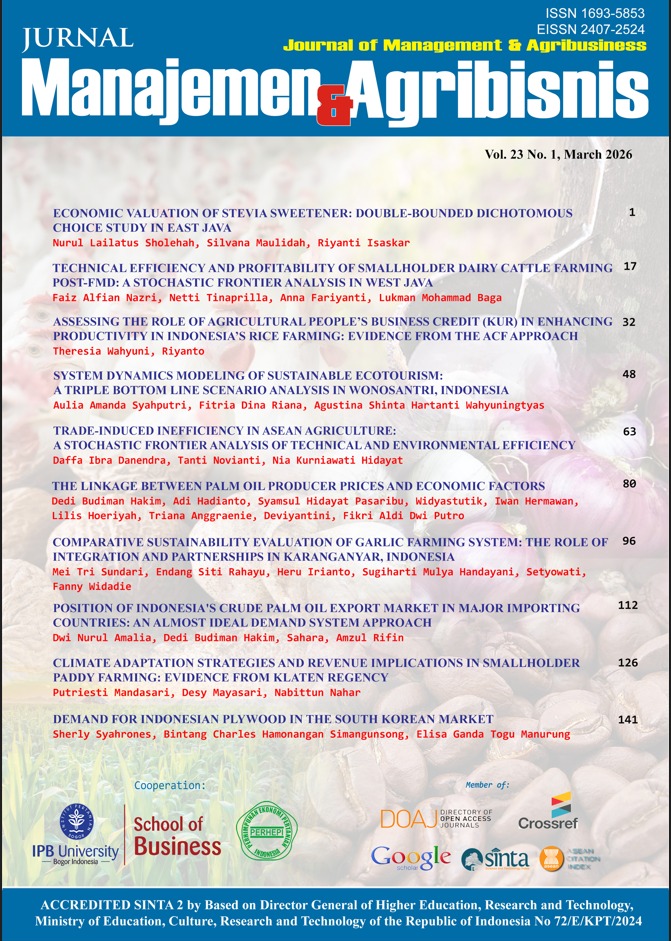
Climate Adaptation Strategies and Revenue Implications in Smallholder Paddy Farming: Evidence From Klaten Regency
DOI:
https://doi.org/10.17358/jma.23.1.126Abstract
Background: Climate variability increasingly affects paddy production, exposing smallholder farmers to revenue instability. This challenge is also evident in Klaten Regency, Central Java, Indonesia. Although climate adaptation strategies are widely adopted, evidence on their revenue implications remains limited.
Purpose: This study examines the adoption rates of climate adaptation strategies (shifting planting dates, constructing ridges, and income diversification), compares log farm revenue between adopters and non-adopters, and evaluates whether differences persist after controlling for farmer, farm, and district characteristics.
Design/methodology/approach: Using primary survey data from 271 paddy farmers, adoption patterns are described using summary statistics and the mean comparison test (Welch’s t-test). Revenue associations with adaptation strategies are estimated using ordinary least squares (OLS) with three specifications. First, a baseline model that only considers adaptation indicators. Second, an OLS model with control variables (farmer and farm characteristics). Third, an OLS model with control variables and fixed effects (land tenure categories and district) to explain institutional arrangements and spatial heterogeneity.
Findings/Results: Farmers who shift planting dates tend to have higher revenue. Mean comparisons indicate higher log revenue among farmers who shift planting dates and lower log revenue among ridge users. These t-test results align with the OLS results. However, once controls are included in the OLS model, the estimated coefficients become smaller and statistically weaker, suggesting that revenue differences partly reflect farmer sorting and contextual conditions rather than direct causal effects.
Conclusion: Revenue implications are heterogeneous and context-dependent.
Originality/value (State of the art): This study contributes to the limited empirical evidence on climate adaptation in smallholder paddy farming by jointly analyzing adaptation strategies and farm revenue outcomes. By applying a multivariate regression framework, this study provides insights into how adaptation strategies relate to revenue under varying farmer and contextual conditions. The findings offer implications for policymakers in designing context-specific climate adaptation support.
Keywords: climate adaptation, farm revenue, paddy farming, smallholder, Indonesia
Downloads
Downloads
Published
Issue
Section
License
Authors who publish with this journal agree to the following terms:
- Authors retain copyright and grant the journal right of first publication with the work simultaneously licensed under a Creative Commons Attribution License that allows others to share the work with an acknowledgement of the work's authorship and initial publication in this journal.
- Authors are able to enter into separate, additional contractual arrangements for the non-exclusive distribution of the journal's published version of the work (e.g., post it to an institutional repository or publish it in a book), with an acknowledgement of its initial publication in this journal.
- Authors are permitted and encouraged to post their work online (e.g., in institutional repositories or on their website) prior to and during the submission process, as it can lead to productive exchanges, as well as earlier and greater citation of published work (See The Effect of Open Access).
.png)