Artificial intelligence in the halal industry: a PRISMA-guided systematic review and bibliometric mapping of Scopus literature (2017–March 2025)
DOI:
https://doi.org/10.29244/hass.2.3.17-25Keywords:
Artificial intelligence, Halal authentication, Halal industry, Systematic Literature Review, PRISMAAbstract
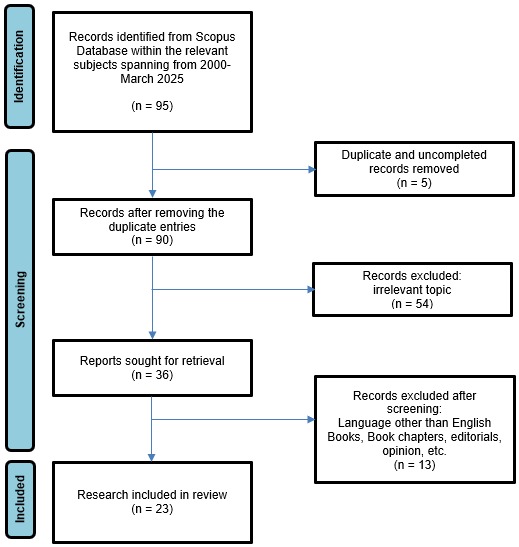
The research and application of artificial intelligence (AI) in the halal industry were mapped through the adoption of the PRISMA-guided Systematic Literature Review (SLR) to derive a Shariah-compliant research agenda for Halal Industry 4.0. This was achieved by searching Scopus (TITLE–ABS–KEY) for relevant publications from 2000 to March 2025. The records obtained were screened using predefined inclusion/exclusion criteria followed by the analysis of the selected articles through descriptive bibliometrics, inductive thematic coding, and keyword co-occurrence mapping (VOSviewer). The screening showed that 23 out of the 95 records initially identified met the eligibility criteria and were published from 2017 to March 2025 as a reflection of the recency and rapid growth of the AI–halal research field. The analysis also showed that AI such as computer vision/OCR, spectroscopy-data analytics, and AI–blockchain/Internet of Things (IoT) architectures was most frequently used for halal authentication and traceability, efficiency and decision support in certification and supply chains, data-driven applications in halal tourism, fintech, and consumer analytics. However, the evidence remains fragmented due to limited real-world validation, inconsistent reporting of data provenance and model transparency, as well as an underdeveloped conceptual bridge between AI governance and Shariah/maqasid al-sharı‘ah requirements. Future research should prioritise explainable and auditable AI for halal assurance, interoperable standards for cross-border digital certification, and practical small and medium scale enterprise (SME) adoption pathways through shared infrastructure and regulatory sandboxes.
References
Abdullah M, Sulong Z, Chowdhury MAF. Explainable deep learning model for stock price forecasting using textual analysis. Expert Systems with Applications. 2024;249(Pt C):123740. https://doi.org/10.1016/j.eswa.2024.123740
Abozaid A. Financial applications of artificial intelligence: Shariah issues and maqasid considerations. In: Islamic Finance in the Digital Age. 2024. p. 165-189. https://doi.org/10.4337/9781035322954.00020
Ahmad T, Zhang D, Huang C, Zhang H, Dai N, Song Y, Chen H. Artificial intelligence in the sustainable energy industry: status quo, challenges and opportunities. J Clean Prod. 2021;289:125834. https://doi.org/10.1016/j.jclepro.2021.125834
Ahmad Z, Soroya SH, Mahmood K. Bridging social capital through the use of social networking sites: a systematic literature review. J Hum Behav Soc Environ. 2023;33(4):473-489. https://doi.org/10.1080/10911359.2022.2064025
Al-Bahri M, Yankovsky A, Kirichek R, Borodin A. Smart system based on DOA IoT for products monitoring anti-counterfeiting. In: 2019 4th MEC International Conference on Big Data and Smart City, ICBDSC 2019. 2019. https://doi.org/10.1109/ICBDSC.2019.8645610
Alshaer B. Artificial intelligence applications in financial markets from a Shari'ah perspective. Manch J Transnatl Islam Law & Pract. 2024;20(4).
Andreini D, Bettinelli C. Systematic literature review. In: Business Model Innovation: From Systematic Literature Review to Future Research Directions. 2017. p. 1-23. https://doi.org/10.1007/978-3-319-53351-3_1
Aniqoh NAFA, Hanastiana MR. Halal food industry: challenges and opportunities in Europe. J Digit Mark Halal Ind. 2020;2(1):43-54. https://doi.org/10.21580/jdmhi.2020.2.1.5799
Arief A, Kartiwi M, Jaswir I. Data analytics of fourier-transform infrared spectroscopy (FTIR) for halal and non-halal adulterations. In: 2020 8th International Conference on Cyber and IT Service Management, CITSM 2020. 2020. https://doi.org/10.1109/CITSM50537.2020.9268816
Ashiq M, Jabeen F, Mahmood K. Transformation of libraries during Covid-19 pandemic: a systematic review. J Acad Librariansh. 2022;48(4):102534. https://doi.org/10.1016/j.acalib.2022.102534
Ashraf D. Digital finance and artificial intelligence: Islamic finance challenges and prospects. In: Islamic Finance, FinTech, and the Road to Sustainability: Reframing the Approach in the Post-Pandemic Era. 2023. p. 241-258. https://doi.org/10.1007/978-3-031-13302-2_11
Azam MSE, Abdullah MA. Global halal industry: realities and opportunities. Int J Islam Bus Ethics. 2020;5(1):47-59. https://doi.org/10.30659/ijibe.5.1.47-59
Azwar A, Usman AH. Artificial intelligence in the halal industry: trends and global research opportunities. Int J Halal Ind. 2025;1(1):46-67. https://doi.org/10.20885/IJHI.vol1.iss1.art4
Azwar A, Usman AH, Abdullah MFR. The opportunities and challenges of the halal food industry in Indonesia: some notes from Quranic and economic perspectives: peluang dan cabaran industri makanan halal di Indonesia: beberapa catatan daripada perspektif al-Quran dan ekonomi. Al-Irsyad J Islam Contemp Issues. 2022;7(1):807-818. https://doi.org/10.53840/alirsyad.v7i1.270
Battour M, Mady K, Elsotouhy M, Salaheldeen M, Elbendary I, Marie M, Elhabony I. Artificial intelligence applications in halal tourism to assist Muslim tourist journey. In: Lecture Notes in Networks and Systems. 2022;322:861-872. https://doi.org/10.1007/978-3-030-85990-9_68
Battour M, Mady K, Salaheldeen M, Elsotouhy M, Elbendary I, Boğan E. AI-enabled technologies to assist Muslim tourists in halal-friendly tourism. J Islam Mark. 2023;14(5):1291-1309. https://doi.org/10.1108/JIMA-01-2022-0001
Battour M, Mady K, Salaheldeen M, Ratnasari RT, Sallem R, Al Sinawi S. Halal tourism and ChatGPT: an overview of current trends and future research directions. J Islam Mark. 2024;15(12):3464-3483. https://doi.org/10.1108/JIMA-11-2023-0379
Bouchetara M, Zerouti M, Zouambi AR. Leveraging artificial intelligence (AI) in public sector financial risk management: innovations, challenges, and future directions. EDPACS. 2024;69(9):124-144. https://doi.org/10.1080/07366981.2024.2377351
Braun V, Clarke V. Using thematic analysis in psychology. Qual Res Psychol. 2006;3(2):77-101. https://doi.org/10.1191/1478088706qp063oa
Chandra GR, Liaqat IA, Sharma B. Blockchain redefining: the halal food sector. In: Proceedings of the 2019 Amity International Conference on Artificial Intelligence, AICAI 2019. 2019. p. 349-354. https://doi.org/10.1109/AICAI.2019.8701321
DinarStandard. State of the Global Islamic Economy Report 2024/25. 2025.
Ellahi RM, Wood LC, Khan M, Bekhit AE-DA. Integrity challenges in halal meat supply chain: potential Industry 4.0 technologies as catalysts for resolution. Foods. 2025;14(7):1-32. https://doi.org/10.3390/foods14071135
Fadhilah H, Djamal EC, Ilyas R, Najmurrokhman A. Non-halal ingredients detection of food packaging image using convolutional neural networks. In: Proceeding of the 2018 International Symposium on Advanced Intelligent Informatics: Revolutionize Intelligent Informatics Spectrum for Humanity, SAIN 2018. 2018. p. 131-136. https://doi.org/10.1109/SAIN.2018.8673376
Feizollah A, Ainin S, Anuar NB, Abdullah NAB, Hazim M. Halal products on Twitter: data extraction and sentiment analysis using stack of deep learning algorithms. IEEE Access. 2019;7:83354-83362. https://doi.org/10.1109/ACCESS.2019.2923275
Furqan M, Nasir AFA. Big data approach to sentiment analysis in machine learning-based microblogs: perspectives of religious moderation public policy in Indonesia. Journal of Applied Engineering and Technological Science. 2024;5(2):955-965. https://doi.org/10.37385/jaets.v5i2.4498
Hamadou I, Yumna A, Hamadou H, Jallow MS. Unleashing the power of artificial intelligence in Islamic banking: a case study of Bank Syariah Indonesia (BSI). Modern Finance. 2024;2(1):131-144. https://doi.org/10.61351/mf.v2i1.116
Harun MS, Aziz MRA, Nazri MA, Ananda RF, Rahmadhani S. Artificial intelligence implications in Islamic banks: potential and challenges. Epibaf. 2024;11(1):471-483. https://doi.org/10.33102/vvbgcv35
Hendayani R, Febrianta MY. Technology as a driver to achieve the performance of family businesses supply chain. Journal of Family Business Management. 2020;10(4):361-371. https://doi.org/10.1108/JFBM-10-2019-0070
Hidayati L, Sucipto S, Cheumar MT, Juliana J. Integrating halal assurance and quality management: a strategic framework for sustainable growth in the food industry. Industria: Jurnal Teknologi dan Manajemen Agroindustri. 2024;13(2). https://doi.org/10.21776/ub.industria.2024.013.02.8
Julian FA, Rachmayani N, Aufi I. Blockchain and AI integration in halal supply chains: toward a trusted digital ecosystem. RIGGS: Journal of Artificial Intelligence and Digital Business. 2025;4(3):3229-3238. https://doi.org/10.31004/riggs.v4i3.2451
Kamarudin NS, Hadi NA, Ahmad A, Hashim AJCM, Rasedee AFN, Hishamudin MZ, Dzolkarnaini N. Robo-advisor can play a role in promoting financial knowledge within society. Journal of Advanced Research in Applied Sciences and Engineering Technology. 2025;53(1):197-208. https://doi.org/10.37934/araset.53.1.197208
Khairuddin MMB, Rahman NAAA. Technology adoption in the halal industry: a review. In: Technologies and Trends in the Halal Industry. 2023. p. 41-52. https://doi.org/10.4324/9781003368519-6
Kurniawati DA, Cakravastia A. A review of halal supply chain research: sustainability and operations research perspective. Cleaner Logistics and Supply Chain. 2023;6.
Kurniawati DA, Vanany I, Kumarananda DD, Rochman MA. Toward halal supply chain 4.0: MILP model for halal food distribution. Procedia Computer Science. 2024;232:1446-1458. https://doi.org/10.1016/j.procs.2024.01.143
Kusumaningrum DN, Wardhana DK, Lestari WA. Artificial intelligent application in discovering the Japanese manufacturing market for Indonesia's policy. IOP Conference Series: Earth and Environmental Science. 2021;717(1). https://doi.org/10.1088/1755-1315/717/1/012042
Marlinda AP, Cipto B, Al-Fadhat F, Jubba H. The influence of artificial intelligence to support halal tourism policy in South Korea. IOP Conference Series: Earth and Environmental Science. 2021;717(1). https://doi.org/10.1088/1755-1315/717/1/012027
Moher D, Liberati A, Tetzlaff J, Altman DG. Preferred reporting items for systematic reviews and meta-analyses: the PRISMA statement. International Journal of Surgery. 2010;8(5):336-341. https://doi.org/10.1016/j.ijsu.2010.02.007
Moher D, Shamseer L, Clarke M, Ghersi D, Liberati A, Petticrew M, Shekelle P, Stewart LA, Group PP. Preferred reporting items for systematic review and meta-analysis protocols (PRISMA-P) 2015 statement. Systematic Reviews. 2015;4:1-9. https://doi.org/10.1186/2046-4053-4-1
Nawaz A, Afzal A, Khatibi A, Shankar A, Madan H, Faisal HS, Shahbaz A, Usman I, Zulfiqar N, Saeed F, Ahmed A, Imran A, Afzaal M, Karni A, Ahmed F, Akram N, Rasheed M, Islam F. Role of artificial intelligence in halal authentication and traceability: a concurrent review. Food Control. 2025;169. https://doi.org/10.1016/j.foodcont.2024.111003
Parums DV. Editorial: review articles, systematic reviews, meta-analysis, and the updated preferred reporting items for systematic reviews and meta-analyses (PRISMA) 2020 guidelines. Medical Science Monitor. 2021;27. https://doi.org/10.12659/MSM.934475
Qadri HMD. The Global Halal Industry: A Research Companion. 2024. https://doi.org/10.4324/9781003441540
Rahim NF. Rapid scoping review of blockchain adoption in halal industry supply chain. In: AIP Conference Proceedings. 2023;2827(1). https://doi.org/10.1063/5.0166546
Rahman MM. Ensuring halal compliance in AI-driven healthcare solutions: balancing innovation and faith. In: Federated Learning and AI for Healthcare 5.0. 2023. p. 298-320. https://doi.org/10.4018/979-8-3693-1082-3.ch015
Rahman MM. Halal Industry 4.0 and knowledge management: technological integration and sustainability. In: Innovative Ventures and Strategies in Islamic Business. 2025. p. 221-246. https://doi.org/10.4018/979-8-3693-3980-0.ch010
Rahman NAAA, Mahroof K, Hassan A. Technologies and Trends in the Halal Industry. 2023.
Rasyidah AN, Azizi AQ, Kholis N. Digital ecosystems in supporting global trade of halal products: innovation and challenges. ADPEBI International Journal of Business and Social Science. 2025;5(2):1-11.
Riandari F, Defit S. Artificial intelligence approach for smart sharia tourism: a review. Journal of Theoretical and Applied Information Technology. 2022;100(13):4932-4940.
Ridho A. Integrating artificial intelligence and blockchain to improve the accuracy of halal certification. Journal of Halal Review. 2025;1(1):12-22. https://doi.org/10.70764/gdpu-jhr.2025.1(1)-02
Ridzuan NN, Masri M, Anshari M, Fitriyani NL, Syafrudin M. AI in the financial sector: the line between innovation, regulation and ethical responsibility. Information. 2024;15(8):432. https://doi.org/10.3390/info15080432
Safdar M, Batool SH, Mahmood K. Relationship between self-efficacy and knowledge sharing: systematic review. Global Knowledge, Memory and Communication. 2021;70(3):254-271. https://doi.org/10.1108/GKMC-11-2019-0139
Sarea A, Rabbani MR, Alam MS, Atif M. Artificial intelligence (AI) applications in Islamic finance and banking sector. In: Artificial Intelligence and Islamic Finance. 2021. p. 108-121. https://doi.org/10.4324/9781003171638-8
Sulong Z, Abdullah M, Chowdhury MAF. Halal tourism demand and firm performance forecasting: new evidence from machine learning. Current Issues in Tourism. 2023;26(23):3765-3781. https://doi.org/10.1080/13683500.2022.2145458
Sumarliah E, Al-hakeem B. The effects of digital innovations and sustainable supply chain management on business competitive performance post-COVID-19. Kybernetes. 2023;52(7):2568-2596. https://doi.org/10.1108/K-09-2022-1326
Sunmola F, Baryannis G, Tan A, Co K, Papadakis E. Holistic framework for blockchain-based halal compliance in supply chains enabled by artificial intelligence. Systems. 2025;13(1):21. https://doi.org/10.3390/systems13010021
Surjandari I, Maulina NR, Bahri C. Efficiency analysis of halal certification bodies in Indonesia: a hybrid data envelopment analysis and machine learning approach. Quality and Quantity. 2024. https://doi.org/10.1007/s11135-024-02006-5
Tan MII, Fezarudin FZ, Yusof FM, Rosman AS, Husny ZJM. Review article on potentials of big data in the halal industry. Pertanika Journal of Social Sciences and Humanities. 2017;25:65-75.
Tarannum S, Jalal MS, Huda MN. HALALCheck: a multi-faceted approach for intelligent halal packaged food recognition and analysis. IEEE Access. 2024;12:28462-28474. https://doi.org/10.1109/ACCESS.2024.3367983
Tennin KL, Ray S, Sorg JM. Cases on AI ethics in business. 2024. https://doi.org/10.4018/979-8-3693-2643-5
Yusof R, Arfa R, Yunus MRM, Muhammad NAAN, Rosli NR, Ismail N. Image segmentation and verification based on machine learning for vision inspection of chicken slaughtering. Journal of Physics: Conference Series. 2020;1447(1). https://doi.org/10.1088/1742-6596/1447/1/012024
Zafar MB, Abu-Hussin MF, Ali H. Mapping the research on halal industry: a retrospective analysis. Journal of Islamic Marketing. 2024.
Downloads
Published
Issue
Section
License
Copyright (c) 2025 Azwar Azwar, Abur Hamdi Usman, Gunawan Baharuddin, Humaira Ahmad, Mutsalim Khareng

This work is licensed under a Creative Commons Attribution-ShareAlike 4.0 International License.
How to Cite