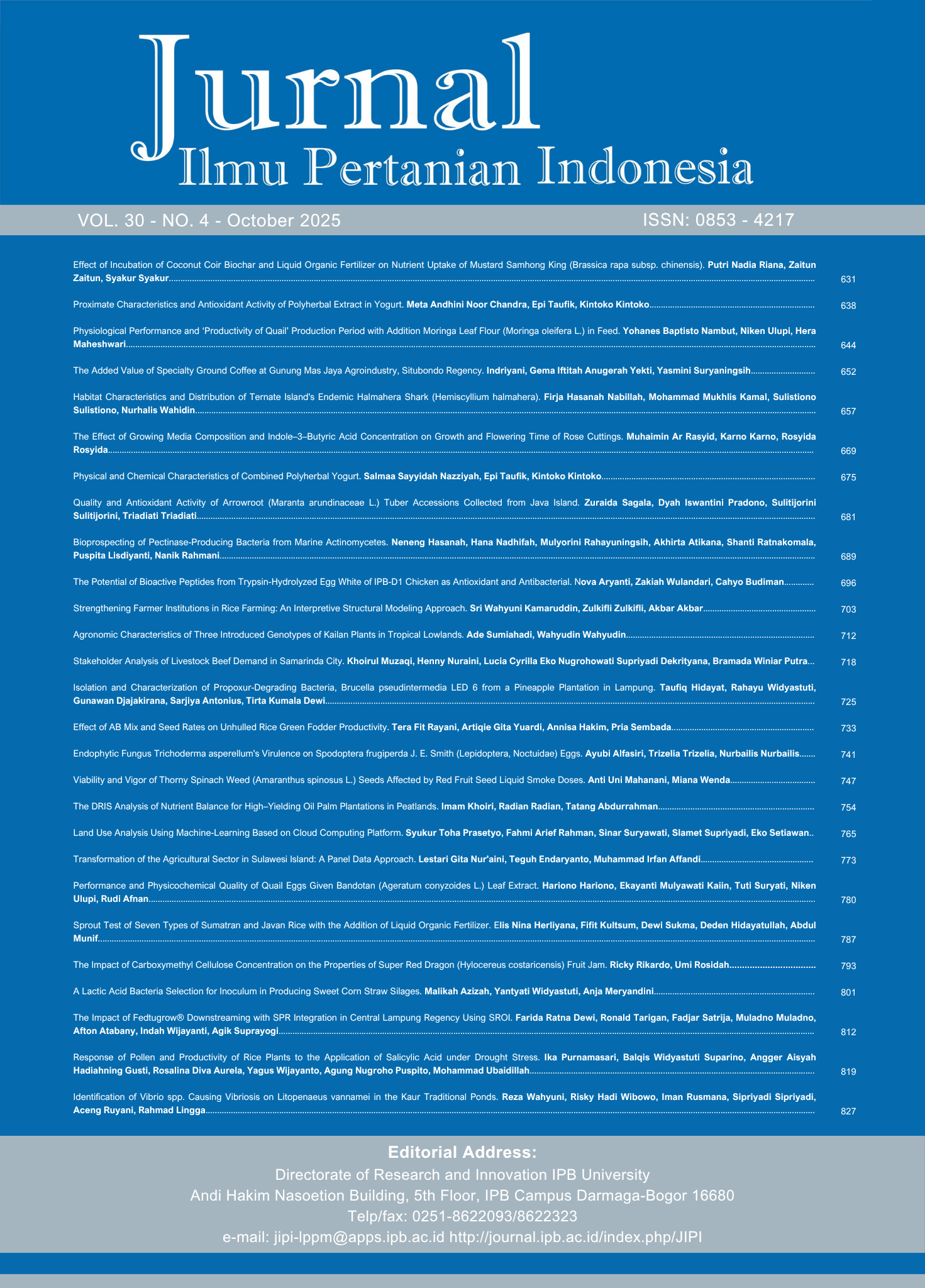
The Impact of Carboxymethyl Cellulose Concentration on the Properties of Super Red Dragon (Hylocereus costaricensis) Fruit Jam
DOI:
https://doi.org/10.18343/jipi.30.4.793Abstract
The purpose of this study was to assess the physical, chemical, and sensory features of super red dragon fruit jam using a completely randomized design (CRD) with one factor and six treatments in triplicates. The treatment was CMC concentration (0%, 0.1%, 0.2%, 0.3%, 0.4%, and 0.5%). Physical factors (viscosity and spreadability), chemical properties (total soluble solids, pH, and moisture content), and sensory properties (hedonic texture test) were all evaluated, using analysis of variance (ANOVA). Treatments with a significant effect (p < 0.05) were further tested using the Honest Significant Difference (HSD) test for physical and chemical characteristics, and the Tukey test for sensory characteristics (p < 0.05). CMC concentration significantly impacted (p < 0.05) viscosity, spreadability, total dissolved solids, pH, moisture content, and hedonic texture test findings. The 0.3% CMC treatment had the highest sensory score (3.48), viscosity (63.60 Pa·s), spreadability (21.37 cm), and chemical properties (total soluble solids 65.20 °Brix, pH 3.44, moisture content 31.57%). The total soluble solids and pH values in the 0.3% CMC treatment of super red dragon fruit jam met the SNI 3746-2008 requirements. This study suggests ways to increase the economic value of super red dragon fruit through jam processing, potentially reducing farmer losses and expanding the usage of CMC with other fruit varieties to diversify fruit jam products.
Keywords: carboxymethyl cellulose, Fruit jam, red dragon fruit
Downloads
References
Aprilia A, Wiyono AE, Rusdianto AS. 2022. Characteristics of ethanol extract of red dragon fruit pigment (Hylocereus polyrhizus) with blanching treatment. Journal of Food Engineering. 1(1): 8–18. https://doi.org/10.25047/jofe.v1i1.3074 DOI: https://doi.org/10.25047/jofe.v1i1.3074
Arifin MZ, Maharani S, Widiaputri SI. 2020. Testing the physicochemical and organoleptic properties of Indonesian Panorama Ngeboon yogurt drink. Edufortech, 5(1): 71–78. https://doi.org/10.17509/edufortech.v5i1.23924 DOI: https://doi.org/10.17509/edufortech.v5i1.23924
Barus WBJ, Nuh M. 2019. The effect of the ratio of dragon fruit pulp (Hylocereus polyrhizus) to sugar and carboxymethyl cellulose (CMC) on the quality of spreadable jam. Wahana Inovasi. 8(1): 28–31.
Daniel LZ, Yusraini E. 2017. The effect of carboxymethyl cellulose percentage and sugar percentage on the quality of corn jam. Journal of Food and Agricultural Engineering. 5(1): 66–72.
Dwiloka B, Latifah A, Pranomo YB. 2024. Spreadability, viscosity, texture, and color of beetroot jam (Beta vulgaris L.) with the addition of carrageenan as a thickening agent. Journal of Food and Nutrition. 14(1): 1–11.
Ferdiansyah MK, Marseno DW, Pranoto Y. 2016. Study of the characteristics of carboxymethyl cellulose (CMC) from oil palm fronds as an effort to diversify halal food additives. Journal of Food Technology Applications. 5(4): 1–7.
Food and Drug Supervisory Agency [BPOM]. 2017. Food production for household industries: fruit jam. Jakarta (ID): Directorate of Food Safety Surveillance and Education, Food and Drug Supervisory Agency of the Republic of Indonesia.
Hadiwijaya Y, Kusumiyati K, Munawar AA. 2020. Prediction of total soluble solids in golden melon fruit (Cucumis melo L.) using VIS–SWNIRs and multivariate analysis. Journal of Science and Technology Research. 25(2): 103–114. https://doi.org/10.21831/jps.v25i2.34487 DOI: https://doi.org/10.21831/jps.v25i2.34487
Harto Y, Rosalina Y, Susanti L. 2016. Physical, chemical, and organoleptic characteristics of sapodilla jam (Achras zapota L.) with the addition of pectin and sucrose. Journal of Agroindustry. 6(2): 88–100. https://doi.org/10.31186/j.agroind.6.2.88-100 DOI: https://doi.org/10.31186/j.agroind.6.2.88-100
Harvyandha A, Kusumawardani M, Abdul R. 2019. Real-time telemetry measurement of acidity using Raspberry Pi. Jartel Journal. 9(4): 519–524. https://doi.org/10.33795/jartel.v9i4.158 DOI: https://doi.org/10.33795/jartel.v9i4.158
Hedyana V, Wachid M, Harini N. 2021. The effect of adding stevia leaf powder and green cincau leaf pectin on the physical, chemical, and organoleptic properties of red dragon fruit jam. Food Technology and Halal Science Journal. 4(1): 66–81. https://doi.org/10.22219/fths.v4i1.15636 DOI: https://doi.org/10.22219/fths.v4i1.15636
Hidayat I, Bekti E, Haryati S. 2018. Physicochemical and organoleptic characteristics of cucumber jam (Cucumis melo var. reticulatus Naudin) with various sugar and CMC concentrations. Journal of Food Technology and Agricultural Products. 33(14): 63–65.
Huriah AN, Noer AH. 2019. Physical, chemical, and organoleptic characteristics of jam at various ratios of red dragon fruit (Hylocereus polyrhizus Britt and Rose) and granulated sugar. Journal of Food Processing. 4(1): 16–25. https://doi.org/10.31970/pangan.v4i1.19 DOI: https://doi.org/10.31970/pangan.v4i1.19
Iman N, Dasir D, Alhanannasir A. 2016. The addition of carboxymethyl cellulose (CMC) to the chemical, physical, and sensory characteristics of pempek sauce. Journal of Food Science and Technology Research. 5(1): 28–33.
Ismawati N, Nurwantoro YB, Pramono. 2016. pH value, total dissolved solids, and sensory properties of yogurt with the addition of beet extract (Beta vulgaris L.). Journal of Food Technology Applications. 5(3): 89–93.
Lapamona O, Saman WR, Ahmad L, Limonu M, Daingo H, Haebun VP, Arwin Huruji. 2023. Organoleptic characteristics of chocolate spread with the addition of corn oil. Journal of Agroindustry Engineering and Management. 11(3): 468–476. https://doi.org/10.24843/JRMA.2023.v11.i03.p14 DOI: https://doi.org/10.24843/JRMA.2023.v11.i03.p14
Linggawati L, Utomo AR, Kuswardani I. 2020. The effect of using CMC (carboxymethyl cellulose) as a gelling agent on the physicochemical and organoleptic properties of kawis jam (Limonia acidissima). Journal of Food Technology and Nutrition. 19(2): 109–113.
Munasari S, Sandri D, Jefriadi J. 2018. Acceptance by panelists and characterization of kepok banana peel jam with the addition of Ambon banana. Journal of Agro–Industrial Technology. 5(1): 10–17. https://doi.org/10.34128/jtai.v5i1.61 DOI: https://doi.org/10.34128/jtai.v5i1.61
Nuraini MNN, Purwayantie S, Hartanti L, Saputri NE. 2023. Effect of carboxymethyl cellulose addition and heating time on the production of keribang barbant jam (Dioscorea alata L.). Journal of Health and Nutrition Research. 2(3): 120–130. https://doi.org/10.56303/jhnresearch.v2i3.136 DOI: https://doi.org/10.56303/jhnresearch.v2i3.136
Palupi PJ, Prasetia R, Pratama MD, Sriwahyuni I. 2021. Physicochemical characteristics of dragon fruit peel jam (Hylocereus polyrhizus) with the addition of varying concentrations of pineapple (Ananas comosus L.). Journal of Agrotechnology. 15(1): 59–66. https://doi.org/10.19184/j-agt.v15i01.20644 DOI: https://doi.org/10.19184/j-agt.v15i01.20644
Paramesti NPLM, Puryana IGPS, Agustini NPA. 2020. Study on the production of guava (Psidium guajava Linn) jam. Journal of Nutrition Science. 9(3): 126–133.
Pramono YB, Rizqiati H, Luthfiyanti E. 2024. The effect of different concentrations of carboxymethyl cellulose addition on chemical and organoleptic characteristics of red guava (Psidium guajava) jam sheets. Food Research. 8(2): 402–406. https://doi.org/10.26656/fr.2017.8(2).193 DOI: https://doi.org/10.26656/fr.2017.8(2).193
Pratama, F. 2018. Sensory Evaluation. 3rd Edition. Palembang (ID): Unsri Pr.
Rahmaningtyas E, Yusa NM, Puspawati NM. 2016. The effect of adding CMC (carboxymethyl cellulose) on the characteristics of Bali salak syrup (Salacca zalacca var. amboinensis) during storage. Journal of Food Science and Technology. 5(2): 1–10.
Rianto, Efendi R, Zalfiatri Y. 2017. The effect of pectin addition on the quality of sweet corn jam (Zea mays.L). Student Online Journal of Agricultural Faculty. 4(1):1–7.
Riswada BAF, Basuki E, Yasa IWS. 2024. The effect of combining red dragon fruit peel (Hylocereus polyrhizus) and soursop fruit (Annona muricata) on jam quality components. Journal of Food Education. 2(1): 35–46.
Setiawati C, Kamsina K, Anova IT, Firdausni F, Diza YH. 2021. The effect of adding carboxymethylcellulose (CMC) and citric acid on the quality and shelf life of corn milk. Indonesian Journal of Industrial Research. 11(2):131–137. https://doi.org/10.24960/jli.v11i2.7399.131-137 DOI: https://doi.org/10.24960/jli.v11i2.7399.131-137
Solichah W, Utomo D, Swasono MAH. 2023. The effect of CMC (carboxymethyl cellulose) concentration and palm sugar on the physicochemical and organoleptic properties of beetroot jam (Beta vulgaris L.) red ginger extract. Journal of Food Technology Yudharta. 14(1): 118–131. https://doi.org/10.35891/tp.v14i1.3784 DOI: https://doi.org/10.35891/tp.v14i1.3784
Srihidayati G. 2017. A comparative study of the viscosity of various brands of chili sauce products. Journal of Sustainable Agriculture. 5(2): 1–6.
Syaifuddin U, Ridho R, Harsanti RS. 2019. The effect of red dragon fruit peel (Hylocereus polyrhizus) and sugar concentration on jam characteristics. Journal of Food Technology and Agricultural Science. 1(1): 27–39.
Downloads
Published
Issue
Section
License
This journal is published under the terms of the Creative Commons Attribution-NonCommercial 4.0 International License. Authors who publish with this journal agree to the following terms: Authors retain copyright and grant the journal right of first publication with the work simultaneously licensed under a Creative Commons Attribution-NonCommercial 4.0 International License. Attribution — You must give appropriate credit, provide a link to the license, and indicate if changes were made. You may do so in any reasonable manner, but not in any way that suggests the licensor endorses you or your use. NonCommercial — You may not use the material for commercial purposes.
How to Cite

























 View JIPI StatsCounter