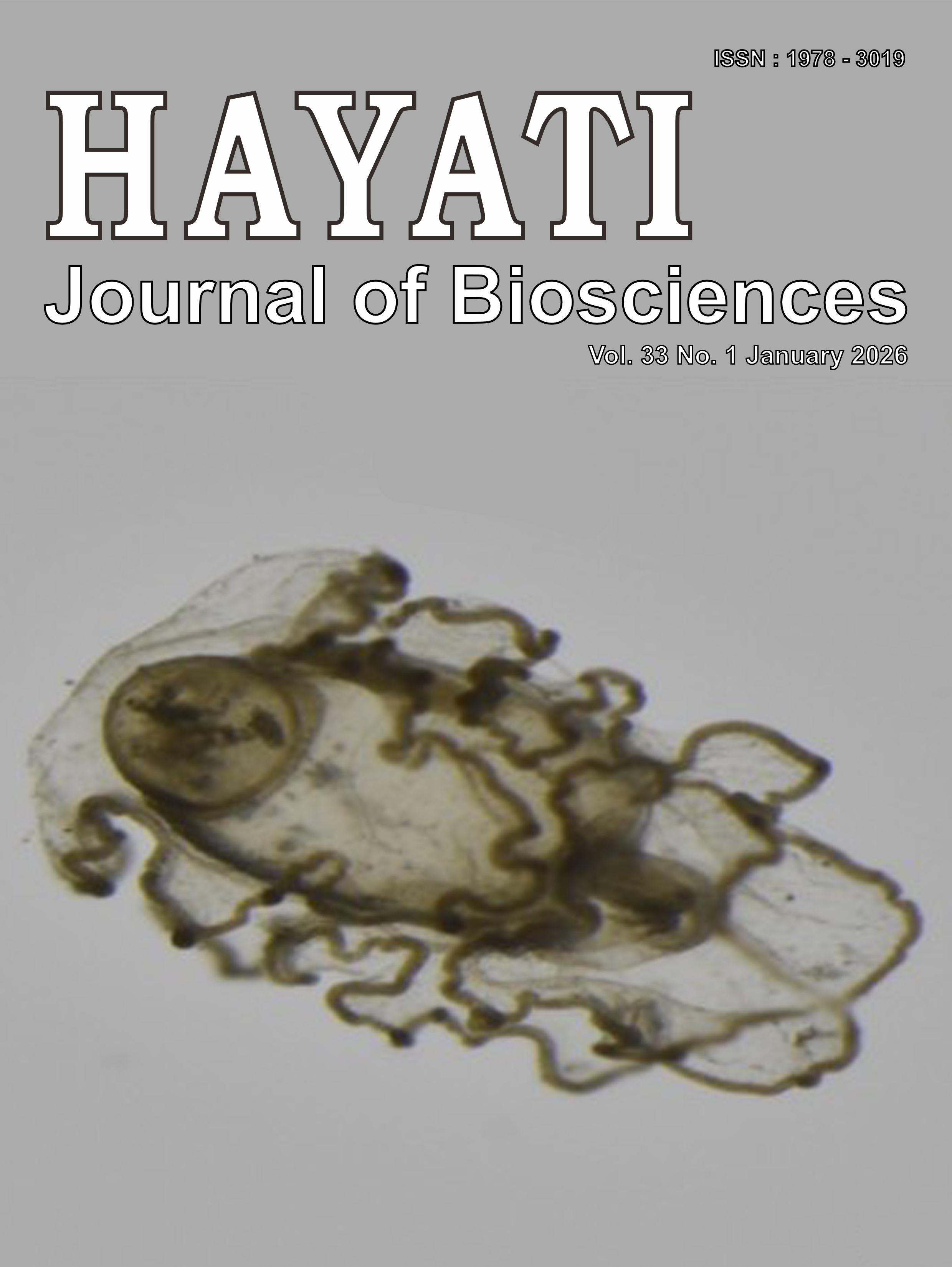
Spatial and Temporal of Meroplankton in a Semi-enclosed Bay: Insights from Ambon Bay
DOI:
https://doi.org/10.4308/hjb.33.1.219-231Abstract
Meroplankton is a temporary planktonic phase of marine organisms. Despite their critical role in the ecosystem, the study of their distribution and dynamics in Ambon Bay is still limited. Therefore, this study aims to investigate the spatial distribution and dynamics of meroplankton in Ambon Bay. Study conducted during the southeast monsoon (August and September) to transition II (October and November) 2022. Meroplankton was captured using a plankton net towed vertically from approximately 20 m, near the bottom, to the surface, and immediately preserved in formaldehyde (final concentration of 4%). A stemple pipette was used for subsamples, and they were observed under a stereo microscope. Thirteen groups of meroplankton were recorded, with three groups (Bryozoa, Phoronida, and Brachiopoda larvae) being newly reported in this area. Bivalvia and Polychaeta larvae had the highest abundance. Meroplankton abundance was consistently higher in the inner Ambon Bay (240.62-3029.02 ind.m-3) than in the outer Ambon Bay (85.63-955.41 ind.m-3), highlighting the ecological significance of this area as a potential spawning and larval nursery ground. Most meroplankton taxa were recorded across all sampling seasons, except for Phoronida and Stomatopoda, which were only observed during the southeast monsoon. In comparison to previous studies, the abundance of Echinodermata peaked during the transition I to the southeast monsoon, whereas Polychaeta exhibited peak abundance during the northwest monsoon. This study offers significant insights into the diversity, spatial distribution, and dynamics of meroplankton in Ambon Bay.
Downloads
Downloads
Published
Issue
Section
License
Copyright (c) 2025 Fismatman Ruli, Sem Likumahua, Gerry Giliant Salamena, Ahmad Romdon

This work is licensed under a Creative Commons Attribution-NonCommercial 4.0 International License.
HAYATI J Biosci is an open access journal and the article's license is CC-BY-NC. This license lets others distribute, remix, tweak, and build upon author's work, as long as they credit the original creation. Authors retain copyright and grant the journal/publisher non exclusive publishing rights with the work simultaneously licensed under a https://creativecommons.org/
How to Cite






















.png) Bogor Agricultural University
Bogor Agricultural University Department of Biology
 The Indonesian Biological Society