Integrated DNA Barcoding and Morphometric Characterization of Palm Weevils (Rhynchophorus spp.) in North Sulawesi
DOI:
https://doi.org/10.4308/hjb.32.5.1260-1272Abstract
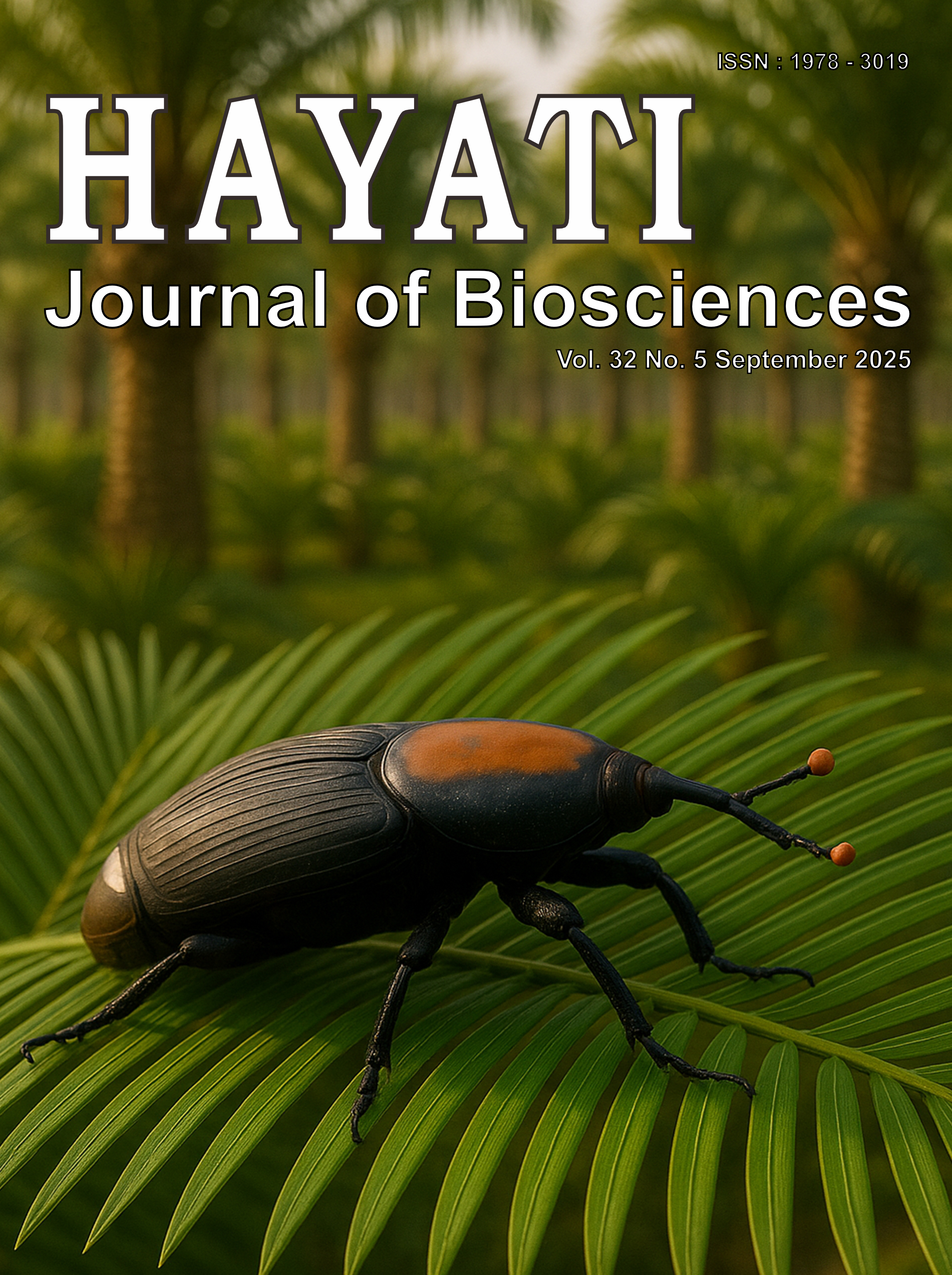
Palm weevils (Rhynchophorus spp.) are significant pests of sago palms worldwide. Yet, the taxonomy and evolutionary lineage of these species in North Sulawesi remain unclear, likely due to geographic isolation driving genetic variation and species differentiation. This study aimed to investigate the genetic diversity and morphological differentiation of Rhynchophorus across distinct geographic regions in North Sulawesi using an integrative approach combining DNA barcoding and morphometric analysis. Morphometric traits from palm weevil specimens collected in Sangihe Island, Minahasa, and Bolaang Mongondow were measured and statistically analyzed using one-way ANOVA, MANOVA, principal component analysis (PCA), and linear discriminant analysis (LDA) to assess interpopulation morphological differences. For molecular identification, the cytochrome oxidase I (COI) gene was amplified and sequenced. Phylogenetic relationships were inferred using the maximum likelihood method, and a DNA barcode gap analysis was conducted to evaluate the separation between intra- and interspecific genetic distances. Morphometric analysis revealed significant size variations among the specimens, particularly in rostrum dimensions, with the EBBM (Bolaang Mongondow) group showing the highest values. COI-gene-based identification confirmed that all specimens were of R. vulneratus. However, phylogenetic analysis showed EBMin (Minahasa) and EBBM forming a distinct subgroup, while EBMan, EBSTS, EBTam, and EBSTU (all from Sangihe Island) clustered separately. Barcode gap analysis demonstrated a clear distinction between intra- and interspecific divergence, validating COI as a reliable marker for species delimitation. This study concludes that integrating morphometric and genetic analyses reveals geographic structuring within R. vulneratus, highlighting the effectiveness of combined methods for accurate identification and population differentiation.
Downloads
Downloads
Published
Issue
Section
License
HAYATI J Biosci is an open access journal and the article's license is CC-BY-NC. This license lets others distribute, remix, tweak, and build upon author's work, as long as they credit the original creation. Authors retain copyright and grant the journal/publisher non exclusive publishing rights with the work simultaneously licensed under a https://creativecommons.org/
How to Cite























.png) Bogor Agricultural University
Bogor Agricultural University Department of Biology
 The Indonesian Biological Society