Islamic finance and the halal economy: A bibliometric review of new study frontiers
DOI:
https://doi.org/10.29244/hass.3.2.1-13Keywords:
Bibliometric, Halal economy, Halal industry, Islamic banking, Islamic financeAbstract
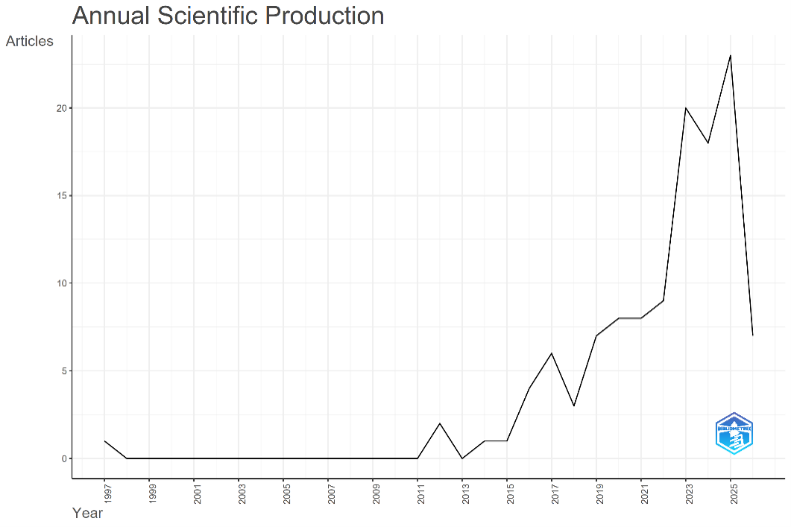
This study aimed to systematically analyze and map the scientific landscape of analyses on Islamic finance and the halal economy through a comprehensive bibliometric approach. Performance analysis and science mapping techniques, including co-authorship analysis, bibliographic coupling, co-citation analysis, keyword co-occurrence networks, and thematic evolution analysis, were applied using118 publications indexed in the Scopus database covering the period from 1997 to 2026. The results showed that the field evolved from a fragmented and marginal study domain into a rapidly expanding, interdisciplinary, and globally recognized area characterized by significant scholarly growth and thematic diversification. Publication trends also reported strong exponential growth, particularly after 2019, driven by the expansion of halal ecosystems, sustainability agendas, digital transformation, and technological innovation. Southeast Asian countries, specifically Indonesia and Malaysia, were recognized as dominant contributors and major intellectual hubs due to advanced halal industry ecosystems and Islamic finance infrastructures. Collaboration analysis showed that scientific cooperation remained relatively decentralized and fragmented despite increasing international participation. Meanwhile, bibliographic coupling and co-citation analyses suggested an increasingly integrated intellectual structure grounded in ethical finance, halal ecosystem development, governance, sustainability, Islamic social finance, and digital innovation. The literature was strongly centered on the integration of Islamic finance and halal industry ecosystems while incorporating themes such as halal tourism, green and blue economy, ESG, fintech, blockchain, digital finance, and Shariah governance. Thematic evolution analysis further showed a transition toward more technology-oriented and sustainability-driven paradigms. Generally, the field entered a more mature, interconnected, and ecosystem-based stage with growing global relevance across contemporary global economic and sustainability development discussions.
References
Abdullah S, Oseni UA. Towards a sharī'ah-compliant equity-based crowdfunding for the halal industry in Malaysia. International Journal of Business and Society. 2017;18(S1):223-240.
Alam MDS, Atem A, Yanur M, Fauzi EA, Anam MS. Comparative analysis of halal certification mechanisms between MUI and BPJPH according to the perspective of Law No. 33 of 2014 concerning Halal Product Guarantee. Asy-Syari'ah. 2023;25(1):33-50. https://doi.org/10.15575/as.v25i1.24313
Ali SN, Jumat ZH. Islamic finance in the age of digital transformation: An introduction. In: Islamic finance in the digital age. Edward Elgar Publishing Ltd.; 2024. p. 1-7. https://doi.org/10.4337/9781035322954.00009
Almunawar MN, Ubaedillah A, Amalia E, Thoha AM. Exploring the halal industry and its business ecosystem prospects. IGI Global; 2025. https://doi.org/10.4018/979-8-3693-8618-7
Alourani A, Khan S. A blockchain and artificial intelligence-based system for halal food traceability. arXiv [Preprint]. 2024. arXiv:2410.07305.
Amalia E, Rahmatullah I, Muslim MB, Fathoni M. Enhancing halal economy ecosystem for strengthening halal business SMEs sector in Indonesia. Journal of Namibian Studies: History Politics Culture. 2023;34:7015-7037.
Aria M, Cuccurullo C. Science mapping analysis: A primer with Biblioshiny. McGraw-Hill; 2026.
Aslikhah A, Faridah A. Strategi penguatan halal supply chain di Indonesia dalam menghadapi global Islamic economy. Jurnal Istiqro. 2021;7(1):95-108. https://doi.org/10.30739/istiqro.v7i1.724
Azam MSE, Abdullah MA. Global halal industry: Realities and opportunities. IJIBE (International Journal of Islamic Business Ethics). 2020;5(1):47-59. https://doi.org/10.30659/ijibe.5.1.47-59
Azwar A. Islamic capital market support in the Indonesian halal industry development: SWOT analysis. Review of Islamic Social Finance and Entrepreneurship. 2024. https://doi.org/10.20885/RISFE.vol3.iss1.art6
Azzahro SF, Indra I. Islamic fintech research worldwide: A bibliometric analysis. IFT. 2024;2(1). https://doi.org/10.58968/ift.v2i1.477
Chartered S. Global Islamic finance assets to surpass USD 7.5 trillion by 2028 [Internet]. 2025. Available from: https://www.sc.com/en/press-release/standard-chartered-global-islamic-finance-assets-to-surpass-usd-7-5-trillion-by-2028/
Dawood H, Al Zadjali DF, Al Rawahi M, Karim DS, Hazik M. Business trends & challenges in Islamic fintech: A systematic literature review. F1000Research. 2022;11. https://doi.org/10.12688/f1000research.109400.1
DinarStandard. State of the Global Islamic Economy Report 2024/25 [Internet]. 2025. Available from: https://salaamgateway.com/specialcoverage/SGIE24
Donthu N, Kumar S, Mukherjee D, Pandey N, Lim WM. How to conduct a bibliometric analysis: An overview and guidelines. Journal of Business Research. 2021;133:285-296. https://doi.org/10.1016/j.jbusres.2021.04.070
Farah AA, Mohamed MA, Ali Farah M, Yusuf IA, Abdulle MS. Impact of Islamic banking on economic growth: A systematic review of Scopus-indexed studies (2009--2024). Cogent Economics and Finance. 2025;13(1). https://doi.org/10.1080/23322039.2025.2490819
Fodol MZ, Aslan H. Mapping the evolution of Islamic finance for sustainability: A bibliometric analysis. Sustainability Accounting, Management and Policy Journal. 2025. https://doi.org/10.1108/SAMPJ-08-2024-0926
Halal Development Corporation Berhad. Halal Industry Masterplan 2030 [Internet]. 2025. Available from: https://hdcglobal.com/halal-industry-master-plan-2030/
Has-Yun Hashim YZ, Ahmad AN, Samsudin N, Abd Lateef MH, Majlan NS. The evolution of halal research: A bibliometric analysis for 1996--2020. Journal of Fatwa Management and Research. 2022;27(3):1-38. https://doi.org/10.33102/jfatwa.vol27no3.443
Hasan A, Abubakar A, Irham M. Integrating maqasid al-shariah into Islamic sustainable banking: A systematic review of halal industry practices and green economy alignment (2020--2024). Banco. 2026;8(1):230-245.
Hassan MK, Alshater MM, Rashid M, Hidayat SE. Ten years of the Journal of Islamic Marketing: A bibliometric analysis. Journal of Islamic Marketing. 2022;13(10):2047-2068. https://doi.org/10.1108/JIMA-10-2020-0322
Ikawati R, Rahman ANB. Awareness and willingness to apply for halal guarantee certification: A study of MSMEs assisted by BAZNAS Yogyakarta. Journal of Halal Science and Research. 2022;3(2):70-78. https://doi.org/10.12928/jhsr.v3i2.6870
Junaidi J. Halal-friendly tourism and factors influencing halal tourism. Management Science Letters. 2020;10(8):1755-1762. https://doi.org/10.5267/j.msl.2020.1.004
Karbhari Y, Alam MK, Rahman MM. Relevance of the application of institutional theory in Shariah governance of Islamic banks. PSU Research Review. 2020;5(1):1-15. https://doi.org/10.1108/PRR-05-2020-0015
Khan T. Reforming Islamic finance for achieving sustainable development goals. Journal of King Abdulaziz University, Islamic Economics. 2019;32(1):3-21. https://doi.org/10.4197/Islec.32-1.1
Lindsey T. Monopolising Islam: The Indonesian Ulama Council and state regulation of the "Islamic economy." Bulletin of Indonesian Economic Studies. 2012;48(2):253-274. https://doi.org/10.1080/00074918.2012.694157
Mart'in JC, Orden-Cruz C, Zergane S. Islamic finance and halal tourism: An unexplored bridge for smart specialization. Sustainability. 2020;12(14):1-15. https://doi.org/10.3390/su12145736
Mohamad Shafi R, Tan YL. Evolution in Islamic capital market: A bibliometric analysis. Journal of Islamic Accounting and Business Research. 2023;14(8):1474-1495. https://doi.org/10.1108/JIABR-04-2022-0106
Muflihin H, Fatchan IN. Halal value chain model in halal ecosystem of Malaysia. Journal of Distribution Science. 2025;23(5):97--112.
Mukherjee D, Lim WM, Kumar S, Donthu N. Guidelines for advancing theory and practice through bibliometric research. Journal of Business Research. 2022;148:101-115. https://doi.org/10.1016/j.jbusres.2022.04.042
Napitupulu RM, Sukmana R, Rusydiana AS. Governance of Islamic social finance: Learnings from existing literature. International Journal of Islamic and Middle Eastern Finance and Management. 2024;17(3):552-571. https://doi.org/10.1108/IMEFM-06-2023-0222
Nasution MDTP, Rini ES, Sembiring BKFS, Silalahi AS, Pahlufi CK. Is it practical to utilize AI-powered chatbots in halal marketing communications? In: Strategies and applications of Islamic entrepreneurship. IGI Global; 2023. p. 34-55. https://doi.org/10.4018/978-1-6684-7519-5.ch003
Noor N. A closer look at halal brand image: Systematic review and future directions. Journal of Islamic Marketing. 2025;16(10):2900-2924. https://doi.org/10.1108/JIMA-06-2024-0259
Nurein SA. Nexus of halal entrepreneurship and Islamic finance for the creation of a strong halal ecosystem. In: Contemporary discourse of halal and Islamic entrepreneurship: Trends and future opportunities. Springer Nature; 2023. p. 133-144. https://doi.org/10.1007/978-981-99-6427-7_9
Oemar H, Prasetyaningsih E, Bakar SZA, Djamaludin D, Septiani A. Awareness and intention to register halal certification of micro- and small-scale food enterprises. F1000Research. 2022;11:170. https://doi.org/10.12688/f1000research.75968.2
Oseni AA, Bamiro NB, Ashafa SA, Olohunlana SD. Sustainable halal financing framework for blue and green economy. In: Green and blue economy frameworks for halal industry sustainability. Springer Nature; 2025. p. 253-273. https://doi.org/10.1007/978-981-96-1729-6_14
Purwatiningsih A, Purnamasari S, Setyawati H, Indriani A, Prawitasari D, Fitria S. Bibliometric analysis of Islamic crowdfunding: A literature review of its journey. F1000Research. 2024;13. https://doi.org/10.12688/f1000research.146797.1
Qadri HMD. The global halal industry: A research companion. Taylor and Francis; 2024. https://doi.org/10.4324/9781003441540
Qoyum A, Fauziyyah NE. The halal aspect and Islamic financing among micro, small, and medium enterprises (MSMEs) in Yogyakarta: Does berkah matter? Journal of Islamic Monetary Economics and Finance. 2019;5(1):215-236. https://doi.org/10.21098/jimf.v5i1.1055
Qurrata VA, Shafiai MHM, Alma'amun S, Wahid H, Ismail AG. Waqf sustainability or sustainable waqf? A bibliometric analysis. Millah: Journal of Religious Studies. 2024;23(1):103-148. https://doi.org/10.20885/millah.vol23.iss1.art4
Rahman M. Halal food safety in the AI era: New horizons for humanitarian action. In: AI for humanitarianism: Fostering social change through emerging technologies. CRC Press; 2025. p. 189-205. https://doi.org/10.1201/9781003479109-15
Restuti DP, Kasdi A, Cahya BT. Economic issues of the halal industry. In: Exploring the halal industry and its business ecosystem prospects. IGI Global; 2025. p. 1-22. https://doi.org/10.4018/979-8-3693-8618-7.ch001
Takhim M, Sonjaya A, Salim Z, Rahman A, Basmar E, Abdullah R, Ali M. The synergy of Islamic banks and Muslim-friendly tourism: Patterns of halal industry development in Indonesia. International Journal of Sustainable Development and Planning. 2023;18(9):2723-2731. https://doi.org/10.18280/ijsdp.180911
Tijjani B, Ashiq M, Siddique N, Khan MA, Rasul A. A bibliometric analysis of quality research papers in Islamic finance: Evidence from Web of Science. ISRA International Journal of Islamic Finance. 2020;13(1):84-101. https://doi.org/10.1108/IJIF-03-2020-0056
Utomo SB, Sekaryuni R, Widarjono A, Tohirin A, Sudarsono H. Promoting Islamic financial ecosystem to improve halal industry performance in Indonesia: A demand and supply analysis. Journal of Islamic Marketing. 2021;12(5):992-1011.
https://doi.org/10.1108/JIMA-12-2019-0259
Van-Eck NJ, Waltman L. VOSviewer manual: Manual for VOSviewer version 1.6.18 [Internet]. Universiteit Leiden & CWTS Meaningful Metrics; 2022. Available from: https://www.vosviewer.com/documentation/Manual_VOSviewer_1.6.18.pdf
Wahyuningsih I, Nurzaman MS. Islamic financial instruments and economic growth: Evidence from Indonesia. In: 2020 6th IEEE International Conference on Information Management (ICIM 2020). IEEE; 2020. p. 46-50. https://doi.org/10.1109/ICIM49319.2020.244668
Wilson R. Islamic finance and ethical investment. International Journal of Social Economics. 1997;24(11):1325-1342. https://doi.org/10.1108/03068299710193624
Zafar MB, Abu-Hussin MF, Ali H. Mapping the research on the halal industry: A retrospective analysis. Journal of Islamic Marketing. 2024. https://doi.org/10.1108/JIMA-08-2024-0348
Zaib SZM, Zainuddin SA, Rahman MSA, Pazil AHM, Husin SS, Nordin N, Nordin N, Abdullah A, Salleh MZM. The role of waqf in enhancing sustainable development for halal entrepreneurs: An Islamic financial perspective. In: Studies in Systems, Decision and Control. Vol. 598. Springer Science and Business Media Deutschland GmbH; 2025. p. 259-267. https://doi.org/10.1007/978-3-031-91424-9_24
Zhang H, Afroz R, Imon RA, Salim K. Islamic finance and its role in fostering sustainable and inclusive economic growth: A bibliometric and content analysis. In: Islamic finance and sustainability: A research companion. Taylor and Francis; 2025. p. 3-26. https://doi.org/10.4324/9781003518617-2
Downloads
Published
Issue
Section
License
Copyright (c) 2026 Azwar Azwar, Abur Hamdi Usman, Mohd Farid Ravi Abdullah, Lilly Suzana Shamsu

This work is licensed under a Creative Commons Attribution-ShareAlike 4.0 International License.
How to Cite