Strategy for Strengthening Indonesia's Economic Cooperation with BRICS to Achieve National Food Security
Downloads
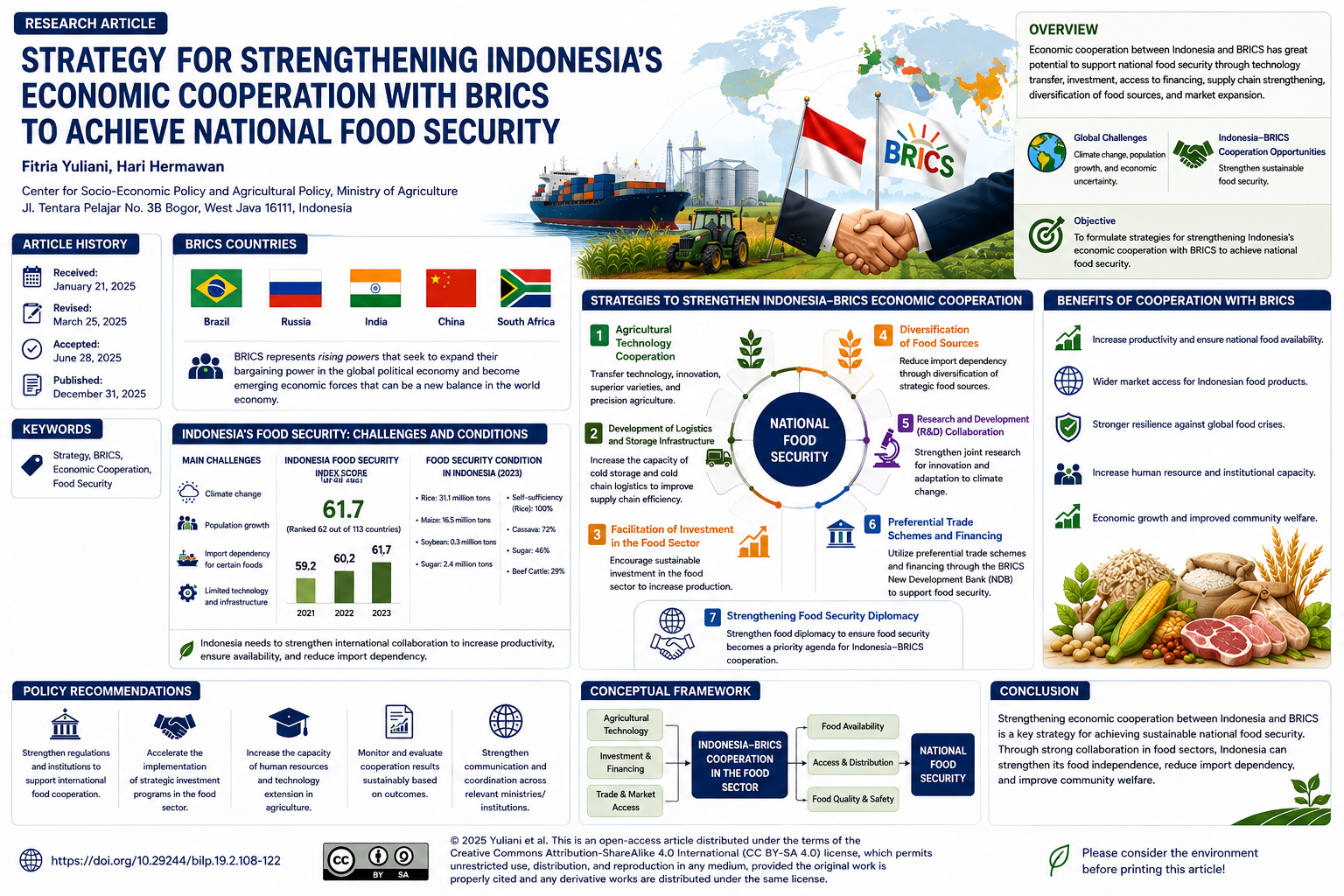
This paper aims to formulate strategies for strengthening Indonesia’s economic cooperation with Brazil, Russia, India, China, and South Africa (BRICS) to achieve national food security. Food security is one of Indonesia’s priority issues, particularly amid growing global challenges such as climate change, population growth, and economic uncertainty. As the most populous country in Southeast Asia and the world’s sixteenth-largest economy, Indonesia needs to ensure food availability, access, quality, nutrition, safety, and affordability for its population. Global trends indicate that international cooperation has become an important instrument for strengthening sustainable food security. Economic cooperation between Indonesia and BRICS in the food sector has the potential to support national food security through technology transfer, increased investment, access to financing, supply chain strengthening, diversification of food sources, and market expansion. This paper recommends several policy strategies, including strengthening cooperation in agricultural technology, developing logistics and storage infrastructure, facilitating investment in the sustainable food sector, diversifying food sources, enhancing research and development (R&D) collaboration, utilizing preferential trade schemes and financing through the New Development Bank (NDB) of BRICS, and strengthening food security diplomacy