The Impact of Indonesian Textile Imports on Employment: Predictive Analysis with Google Trends and News Sentiment
Politeknik Statistika STIS
Downloads
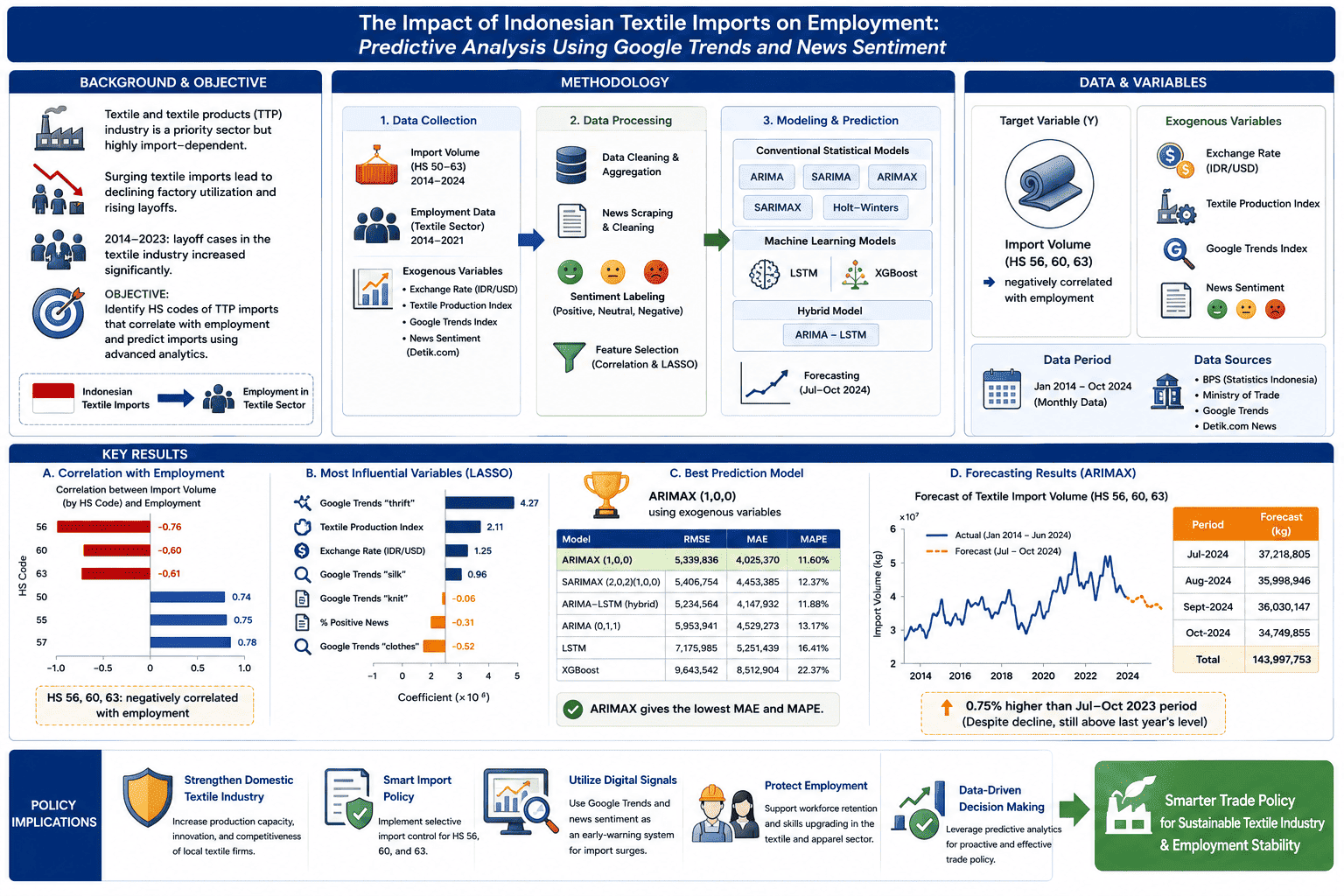
The textile and textile products (TTP) industry in Indonesia is one of the import-dependent sectors. The increase in imports of the textile industry has the potential to reduce the number of workers. This study aims to identify Harmonized System (HS) codes of TTP import that correlate with the number of workers and to predict imports for those HS codes. This research employs conventional statistical methods, including Autoregressive Integrated Moving Average (ARIMA), Seasonal ARIMA, ARIMA with Exogenous (ARIMAX), SARIMAX, and Holt-Winters, as well as machine learning methods such as Long Short-Term Memory (LSTM) and Extreme Gradient Boosting (XGBoost), and ARIMA-LSTM hybrid models. The best model is the ARIMAX model, which has the lowest Mean Absolute Error (MAE) and Mean Absolute Percentage Error (MAPE). This model utilizes the most influential variables: the rupiah exchange rate, textile production index, percentage of news articles with positive sentiment, and Google Trends Index. This study also reveals that the volume of textile imports, as classified under HS codes 56, 60, and 63, is negatively correlated with the number of workers in the textile sector. Therefore, the government should consider import control policies for this product group. This step needs to be accompanied by an increase in the production capacity and competitiveness of the domestic textile industry. Additionally, the use of Google Trends data and news sentiment can serve as an early warning system to predict import surges more quickly and accurately.
Copyright (c) 2026 Buletin Ilmiah Litbang Perdagangan

This work is licensed under a Creative Commons Attribution-ShareAlike 4.0 International License.