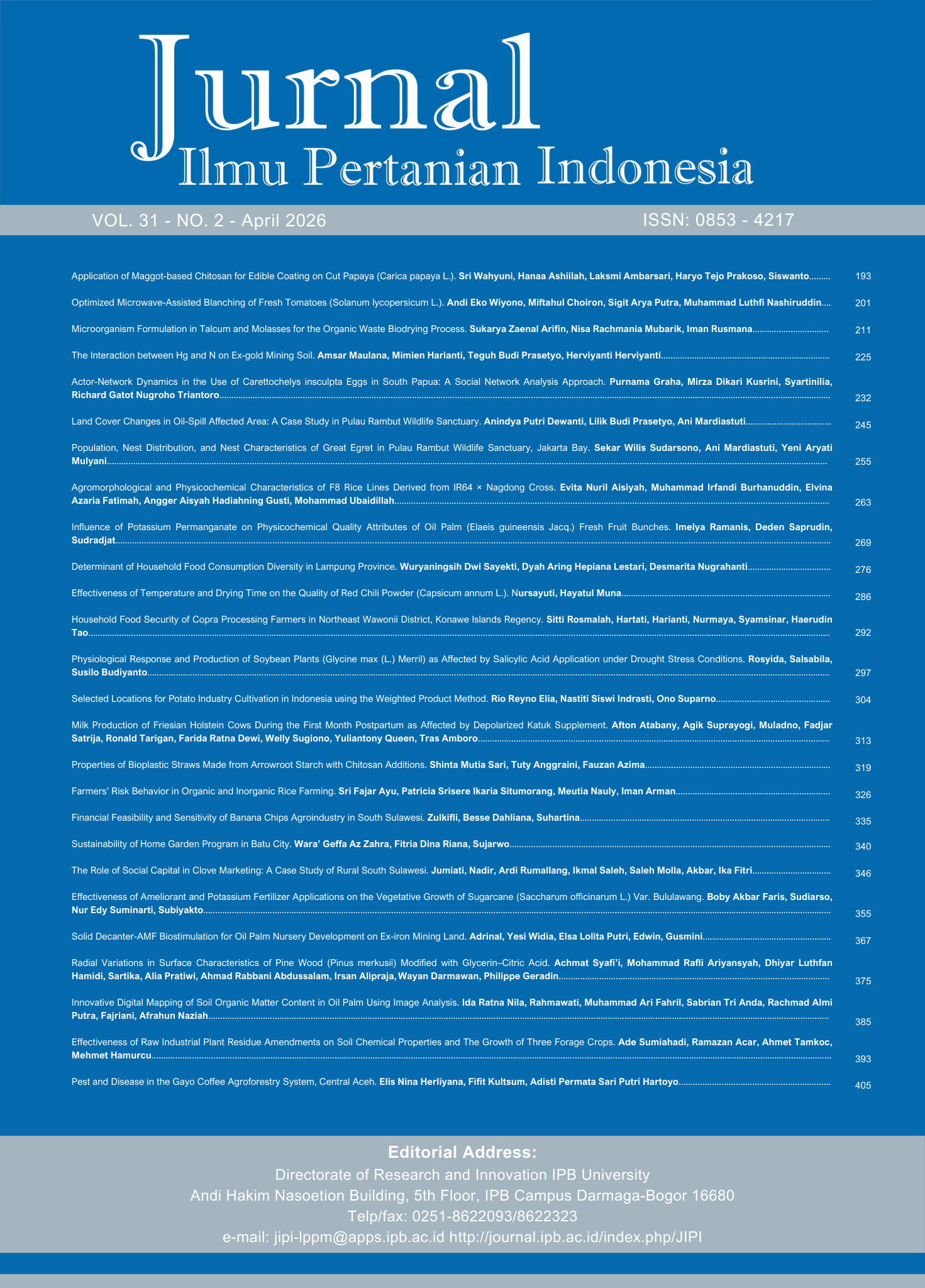
Population, Nest Distribution, and Nest Characteristics of Great Egret in Pulau Rambut Wildlife Sanctuary, Jakarta Bay
DOI:
https://doi.org/10.18343/jipi.31.2.255Keywords:
Ardea alba, nest characteristics, Rhizophora mucronata, waterbirdAbstract
Pulau Rambut, a 45-hectare island in Jakarta Bay, is a major nesting and roosting location for waterbirds, especially the great egret (Ardea alba). This species has faced population constraints due to habitat loss, oil spills, and waste. Bio-ecological data on this species has been lacking. The purpose of this study was to quantify population size, analyze nest tree distribution, investigate nesting associations, and describe nest and egg features during the peak breeding season (March–April 2025). The birds were counted in the morning when they flew away and, in the evening, when they returned to the island. Nest trees were mapped, and nest tree attributes were assessed on trees discovered throughout the search. Field observations revealed an estimated 135 great egrets, mostly on the island's eastern side. Nests were mostly found in the uppermost canopy of Rhizophora mucronata (average height 13.8±2.3 m; diameter 20.0±7.1 cm; n = 19) and Rhizophora stylosa. Nests were cup-shaped, twig-based constructions measuring 46.8×38.5 cm with a depth of 42.3 mm. Purple herons (Ardea purpurea) were regularly observed to nest together. The clutch size averaged 2.2 eggs per nest (range: 1−4; mode: 2). The eggs were oval, pale blue-green, and averaged 50.9×35.8 mm in size, weighing 35.9±6.3 g (n = 19). These data represent the first thorough bio-ecological baseline for great egrets on Pulau Rambut. Conservation and restoration of mangrove ecosystems, particularly R. mucronata, is critical for sustaining great egret breeding numbers and minimizing future population decreases in the sanctuary.
Keywords: Ardea alba, nest characteristics, Rhizophora mucronata, waterbird
Downloads
References
Burger J. 1985. Habitat Selection in Temperate Marsh–nesting Birds. New York (US): New York Academic Pr.
Firdausy MS, Mardiastuti A, Mulyani YA. 2021. Abundance waterbirds and the distribution of trees nesting in Pulau Rambut (Rambut Island) Wildlife Sanctuary, Jakarta Bay, Indonesia. IOP Conference Series: Earth and Environmental Science. 771: 012028. https://doi.org/10.1088/1755-1315/771/1/012028
Kurnia I, Rifai BA, Febriyanti EN, Kardina JR, Azzahra RNA, Satriawan MH. 2024. Keanekaragaman jenis burung di Pulau Untung Jawa Kepulauan Seribu Provinsi DKI Jakarta. Jurnal Hutan Pulau-Pulau Kecil. 8(1): 1–10. https://doi.org/10.30598/jhppk.v8i1.12062
Lambrechts MM, Aime C, Midamegbe A, Galan M, Perret P, Gregoire A, Doutrelant C. 2011. Nest size and breeding success in first and replacement clutches: an experimental study in blue tits Cyanistes caeruleus. Journal of Ornithology. 153(1): 173–179. https://doi.org/10.1007/s10336-011-0722-1
Mardiastuti A. 1991. Difference in size among waterbird eggs in Pulau Rambut: Some preliminary observations. Media Konservasi. 3(2): 66–71.
Mardiastuti A. 1992. Habitat and Nest–site Characteristics of Waterbirds in Pulau Rambut Nature Reserve, Jakarta Bay, Indonesia [dissertation]. East Lansing (US): Michigan State University.
Mardiastuti A. 2001. Ecology of avian community of Pulau Rambut: Population, nest site distribution, and foraging site. Bogor (ID): IPB University.
Mardiastuti A, Mulyani YA, Susanti NKY, Ivonnie RN, Oktavia CA. 2020. Oil spill in Pulau Rambut and its possible long–term impact on mangrove as waterbirds habitat. IOP Conference Series: Earth and Environmental Science. 528: 012015. https://doi.org/10.1088/1755-1315/528/1/012015
Mardiastuti A. 2022. Waterbird community in Pulau Rambut Wildlife Sanctuary, Jakarta Bay: Review on species composition and population size after thirty years. IOP Conference Series: Earth and Environmental Science. 950: 012031. https://doi.org/10.1088/1755-1315/950/1/012031
Mashudi A, Marhento G. 2016. Identifikasi keanekaragaman jenis burung dan kearifan tradisional masyarakat dalam upaya konservasi di Pulau Rambut Kepulauan Seribu. Jurnal Formatif. 6(2): 119–124. https://doi.org/10.30998/formatif.v6i2.945
Park S, Kim K, Chung H, Choi YI, Sung H. 2011. Vertical nest stratification and breeding success in a six mixed–species heronry in Taeseong, Chungbuk, Korea. Animal Cells and Systems. 15(1): 85–90. https://doi.org/10.1080/19768354.2011.555119
Shin M, Lee E, Cho H. 2018. Estimating the potential habitat of breeding egrets and herons (family Ardeidae) for urban forest management in Daejeon Metropolitan City, Korea. Pakistan Journal Zoology. 54(5): 2069–2076. https://doi.org/10.20944/preprints201808.0065.v1
Downloads
Published
Issue
Section
License
Copyright (c) 2026 Sekar Wilis Sudarsono, Ani Mardiastuti, Yeni Aryati Mulyani

This work is licensed under a Creative Commons Attribution-NonCommercial 4.0 International License.
This journal is published under the terms of the Creative Commons Attribution-NonCommercial 4.0 International License. Authors who publish with this journal agree to the following terms: Authors retain copyright and grant the journal right of first publication with the work simultaneously licensed under a Creative Commons Attribution-NonCommercial 4.0 International License. Attribution — You must give appropriate credit, provide a link to the license, and indicate if changes were made. You may do so in any reasonable manner, but not in any way that suggests the licensor endorses you or your use. NonCommercial — You may not use the material for commercial purposes.
How to Cite

























 View JIPI StatsCounter