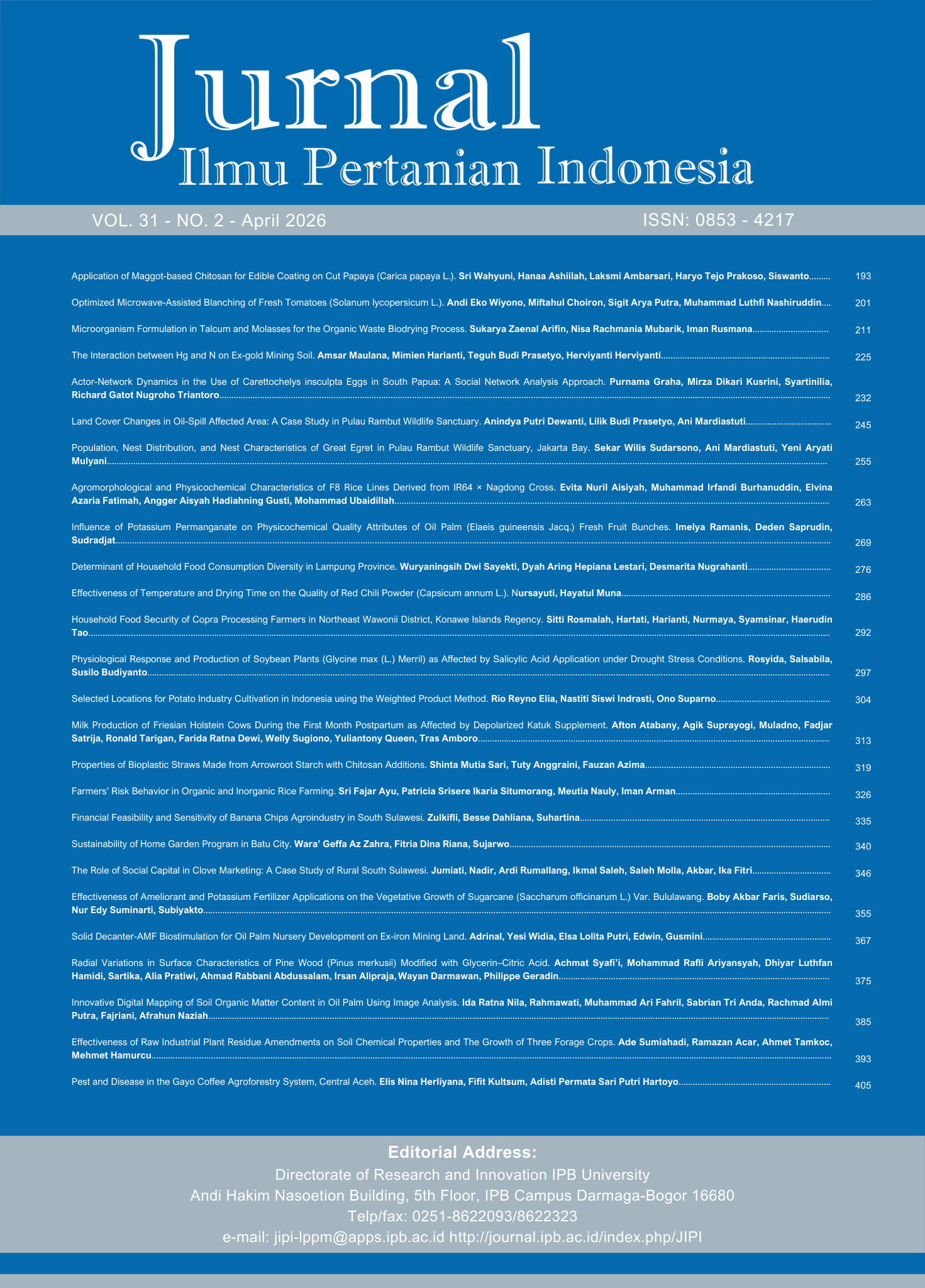
Radial Variations in Surface Characteristics of Pine Wood (Pinus merkusii) Modified with Glycerin–Citric Acid
DOI:
https://doi.org/10.18343/jipi.31.2.375Keywords:
citric acid, glycerin, modification, radial variation, surface characteristicsAbstract
Pine wood (Pinus merkusii) is a native Indonesian softwood species with high commercial value but low natural durability (class IV), limiting its use in outdoor applications. This study modified the pine wood using a 20% glycerin–citric acid solution (1:2 ratio) through impregnation with 7 bar pressure for 48 hours, followed by heat treatment at 150°C for 6 hours, to evaluate surface characteristics in radial variations (from pith to bark). Retention (57.93–85.59 kg/m³) and weight percent gain (WPG, 4.02–7.20%) decreased from pith to bark, corresponding to lower wood density near the pith (0.55 g/cm³) compared to near the bark (0.67 g/cm³). Surface roughness (Ra) varied slightly from fit to bark, however its Ra increased after modification. Surface free energy (SFE) increased significantly from 16.87 near the pith to – 27.35 mJ/m² near the bark. After modification the SFE values varied between 37.16–44.46 mJ/m² from fit to bark. Wettability (K-value) was lower near the pith (0.002) than near the bark (0.007). Glycerin–citric acid modified pine exhibited also a lower wettability values compared to the untreated wood. The surface characteristics of the modified pine wood from fit to bark indicate that its surfaces should be coated by proper varnishes or paints for further development.
Keywords: citric acid, glycerin, modification, radial variation, surface characteristics
Downloads
References
[BPS] Badan Pusat Statistik. 2023. Produksi Perusahaan Pembudidaya Tanaman Kehutanan menurut Jenis Produksi. Jakarta (ID): Badan Pusat Statistik.
Abdussalam AR. 2024. Variasi Radial Sifat Fisis dan Karakteristik Permukaan Kayu Pinus (Pinus merkusii) [skripsi]. Bogor (ID): Institut Pertanian Bogor.
Alteyrac J, Cloutier A, Zhang SY. 2006. Characterization of juvenile wood to mature wood transition age in black spruce (Picea mariana (Mill.) B.S.P.) at different stand densities and sampling heights. Wood Science Technology. 40(2): 124–138. https://doi.org/10.1007/s00226-005-0047-4
Amin S, Hutomo AP, Arifin Z. 2021. Pengawetan perendaman dingin dan panas dingin kayu trembesi (Albizia saman) menggunakan pengawet boraks. Buletin Poltanesa. 22(1): 86–94. https://doi.org/10.51967/tanesa.v22i1.470
Baldan A. 2012. Adhesion phenomena in bonded joints. Int J of Adhs and Adhsv. 38(7): 95–116. https://doi.org/10.1016/j.ijadhadh.2012.04.007
Cahyono TD, Dwianto W, Darmawan W, Sakagami H. 2022. Change in the surface roughness and surface free energy of Samama (Anthocephalus macrophyllus) after citric acid impregnation through pre-compression method. Journal Of Adhesion Science and Technology. 36(6): 654–665. https://doi.org/10.1080/01694243.2021.1934280
Candan Z, Gorgun HV, Korkut S, Unsal O. 2021. Surface roughness and wettability performance of thermally modified rowan wood as a fast-growing species. Drewno. 64(8): 1–10. https://doi.org/10.12841/wood.1644-3985.364.03
Darmawan W, Nandika D, Afaf BDH, Rahayu I, Lumongga D. 2018. Radial variation in selected wood properties of Indonesian merkusii pine. Journal of the Korean Wood Science and Technology. 46(4): 323–337. https://doi.org/10.5658/WOOD.2018.46.4.323
Delima A, Hermawan Y, Triono A, Sakura RR, Badriani RE, Hidayat MA. 2022. Analisis kekasaran permukaan dan morfologi chips pada proses drilling kayu Jati. Jurnal Stator. 5(1):18–27.
Essoua GGE, Blanchet P, Landry V, Beauregard R. 2016. Pine wood treated with a citric acid and glycerol mixture: Biomaterial performance improved by a bio-byproduct. BioResource. 11(2): 3049–3072. https://doi.org/10.15376/biores.11.2.3049-3072
Esteves BM, Pereira HM. 2009. Wood modification by heat treatment: A review. BioResources. 4(1): 370–404. https://doi.org/10.15376/biores.4.1.370-404
Fos M, Oliver VJV, Vazquez M. 2023. Radial variation in anatomical wood characteristics and physical properties of Paulownia elongata x Paulownia fortunei hybrid Cotevisa 2 from fast-growing plantations. European Journal of Wood and Wood Products. 81(4): 819–831. https://doi.org/10.1007/s00107-023-01941-8
Gaol NIL, Hidayati F, Nugroho WD, Praptoyo H, Karyanto O, Marsoem SN. 2023. Sifat fisika dan mekanika kayu Acacia aulacocarpa dari KHDTK Wanagama. Jurnal Ilmu Pertanian Indonesia. 28(4): 630–640. https://doi.org/10.18343/jipi.28.4.630
Hakim R, Widiastuti H, Rendi. 2017. Analisa hasil kekasaran permukaan kayu terhadap jenis ketam. Jurnal Integrasi. 9(2): 119–124. https://doi.org/10.30871/ji.v9i2.455
Hanifah NP, Martha R, Rahayu IS, Darmawan W, George B, Gérardin P. 2023. Surface characterization and paint bonding quality on chemically and thermally treated short rotation teak wood. International Wood Products Journal. 14(1): 13–20. https://doi.org/10.1080/20426445.2022.2138908
Hanifah NP, Wahyuningtyas I, Kutana AN, Dirna FC. 2025. Keterbasahan kayu jati cepat tumbuh termodifikasi kimia dan panas. Jurnal Perennial. 21(1): 44–51. https://doi.org/10.24259/perennial.v21i1.43479
[ISO] International Organization for Standardization. 1997. Geometrical Product Specifications (GPS) Surface Texture: Profile Method. Terms, Definitions And Surface Texture Parameters. ISO 4287–1977. Geneva: International Organization for Standardization
Jankowska A, Boruszewski P, Drożdżek M, Rębkowski B, Kaczmarczyk A, Skowrońska A. 2018. The role of extractives and wood anatomy in the wettability and free surface energy of hardwoods. BioResources. 13(2): 3082–3097. https://doi.org/10.15376/biores.13.2.3082-3097
Korkut DS, Guller B. 2008. The effects of heat treatment on physical properties and surface roughness of red-bud maple (Acer trautvetteri Medw.) wood. Bioresource technology. 99(8): 2846–2851. https://doi.org/10.1016/j.biortech.2007.06.043
Lestari AT, Chaerani N, Lestari D, Wulandari FT, Juniardi RA. 2023. Peningkatan kualitas finishing kayu pinus dan sungkai menggunakan teknik yakisugi. Tengkawang: Jurnal Ilmu Kehutanan. 13(2): 142–154.
Lestari AT. 2020. Sifat keterbasahan pada bidang tangensial dan radial kayu rajumas (Duabanga moluccana Blume). Parennial. 16(1): 7–10.
Lopes LC, Sell M, Lopes R, Esteves B. 2025. Enhancing Pinus pinaster wood durability through citric acid impregnation. Sustainability. 17(5): 1–16. https://doi.org/10.3390/su17051979
Marra AA. 1992. Technology of Wood Bonding: Principles in Practise. New York (US): Van Nostrand Reinhold.
Martha R, Dirna FC, Hasanusi A, Rahayu IS, Darmawan W. 2020. Surface free energy of 10 tropical woods species and their acrylic paint wettability. Journal of Adhesion Science and Technology. 34(2): 167–177. https://doi.org/10.1080/01694243.2019.1663009
Martha R, Mubarok M, Akong FO, George B, Rahayu IS, Gérardin C, Dumarçay S, Darmawan W, Gérardin P. 2024. Differences of technological properties on sapwood and heartwood of short rotation teak wood. Wood Material Science & Engineering. 19(1): 6–18.
Martha R. 2019. Karakteristik kayu jati cepat tumbuh termodifikasi termal [tesis]. Bogor (ID): Institut Pertanian Bogor. https://doi.org/10.1080/17480272.2023.2221678
Meena RK. 2022. Hazardous effect of chemical wood preservatives on environmental conditions, ecological biodiversity and human being and its alternatives through different botanicals: a review. Environmental Ecology. 40(3): 1137–1143.
Morais S, Fonseca HMAC, Oliveira SMR, Oliveira H, Gupta VK, Sharma B, Pereira M de L. 2021. Environmental and health hazards of chromated copper arsenate-treated wood: A review. International Journal Environmental Resources Public Health. 18(11): 1–17. https://doi.org/10.3390/ijerph18115518
Rabel W. 1971. Einige aspekte der benetzungstheorie and ihre anwendung auf die untersuchung und veränderung der oberflächeneigenschaften von polymeren. Fabre und Lack. 77(10): 997–1006.
Reinprecht L. 2016. Wood Deterioration, Protection and Maintenance. Hoboken (NJ): John Wiley & Sons. https://doi.org/10.1002/9781119106500
Reinprecht L. 2016. Wood Deterioration, Protection and Maintenance. John Wiley dan Sons, Hoboken (NJ). https://doi.org/10.1002/9781119106500
Rowell RM. 2012. Handbook of wood chemistry and wood composites. CRC Press, Taylor and Francis Group (FR). https://doi.org/10.1201/b12487
Seng OD. 1964. Berat Jenis dari Jenis-Jenis Kayu Indonesia dan Pengertian Beratnya Kayu untuk Keperluan Praktek. Bogor (ID): Lembaga Penelitian Hasil Hutan.
Shmulsky R, Jones PD. 2019. Forest Products and Wood Science: An Introduction. Ed. Ke-7. John Wiley & Sons Ltd., Chichester (UK). https://doi.org/10.1002/9781119426400
Suluh S, Sampelawang P. 2017. Studi eksperimen limbah buah pinus sebagai sumber energi alternatif ditinjau dari variasi butiran. Journal Dynamic Saint. 3(1): 444–459. https://doi.org/10.47178/dynamicsaint.v3i1.269
Talai A, Zare M, Abdolsadeh H. 2016. Effect furfurylation on physical properties and surface quality of two woody species (beech and silver fir). Iran Journal Wood Paper Industry. 7(3): 400–411.
Thygesen LG, Engelund ET, Hoffmeyer P. 2010. Water sorption in wood and treated wood at high values of relative humidity. Part I: Results for untreated, acetylated, and furfurylated Norway spruce. Hofzforschung. 64(3): 315–323. https://doi.org/10.1515/hf.2010.044
Tobing G, Sofiaturizkiyah N, Basri E, Martha R, Rahayu I, Gérardin P, Darmawan W. 2024. Mikrostruktur dan karakteristik permukaan kayu pinus scots (Pinus sylvestris L.) termodifikasi gliserol dan asam sitrat. Jurnal Ilmu Pertanian Indonesia. 29(4): 554–563. https://doi.org/10.18343/jipi.29.4.554
Tsoumis G. 1991. Science and Technology of Wood: Structure, Properties, Utilization. New York (NY): Van Nostrand Reinhold.
Wang X, Wang F, Yu Z, Zhang Y, Qi C, Du L. 2017. Surface free energy and dynamic wettability of wood simultaneously treated with acidic dye and flame retardant. Journal of Wood Science. 63(3): 271–280. https://doi.org/10.1007/s10086-017-1621-8
Yuningsih I, Rahayu IS, Dumasari L, Darmawan W. 2019. Wettability and adherence of acrylic paints on long and short rotation teaks. Wood Material Science & Engineering. 15(4): 229–236. https://doi.org/10.1080/17480272.2019.1575903
Downloads
Published
Issue
Section
License
Copyright (c) 2026 Achmat Syafi'i, Mohammad Rafli Ariyansyah, Dhiyar Luthfan Hamidi, Sartika Sartika, Alia Pratiwi, Ahmad Rabbani Abdussalam, Irsan Alipraja, Wayan Darmawan, Philippe Geradin

This work is licensed under a Creative Commons Attribution-NonCommercial 4.0 International License.
This journal is published under the terms of the Creative Commons Attribution-NonCommercial 4.0 International License. Authors who publish with this journal agree to the following terms: Authors retain copyright and grant the journal right of first publication with the work simultaneously licensed under a Creative Commons Attribution-NonCommercial 4.0 International License. Attribution — You must give appropriate credit, provide a link to the license, and indicate if changes were made. You may do so in any reasonable manner, but not in any way that suggests the licensor endorses you or your use. NonCommercial — You may not use the material for commercial purposes.
How to Cite

























 View JIPI StatsCounter