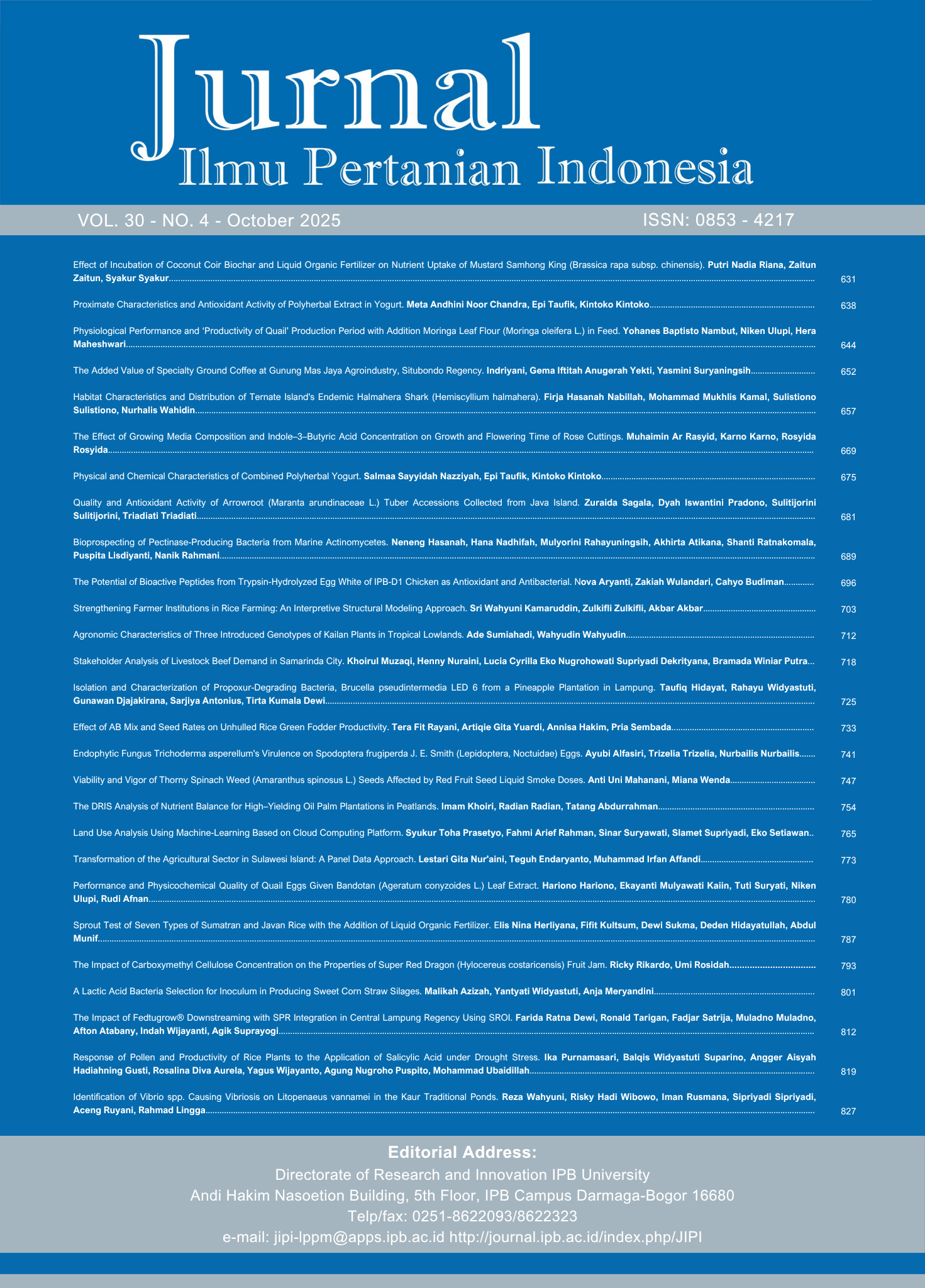
Effect of Incubation of Coconut Coir Biochar and Liquid Organic Fertilizer on Nutrient Uptake of Mustard Samhong King (Brassica rapa subsp. chinensis)
DOI:
https://doi.org/10.18343/jipi.30.4.631Abstract
Green mustard greens. Samhong King variety (Brassica rapa subsp. chinensis) is a popular vegetable in Indonesia. Green mustard greens have the advantage of being able to grow in both low and high elevations. The application of biochar in soil can help to improve its chemical qualities. The study employed a factorial randomized block design with two components. The treatment factor was the incubation duration of coconut fiber biochar at four levels: control, two weeks, four weeks, and six weeks. The amount of liquid organic fertilizer applied at four different levels: 1 mL/L water, 2 mL/L water, 3 mL/L water, and 4 mL/L water.The study found that coconut fiber biochar and liquid organic fertilizer had no significant effect on nutritional absorption in plant tissue or Samhong King mustard plants, however they did have the highest absorption of K, P, and N nutrients. The incubation period of coconut fiber biochar and liquid organic fertilizer had no significant effect on Samhong King mustard plant production, but the coconut fiber biochar treatment with a 6-week incubation period produced the highest yield, 2.96 t/ha. The treatment of liquid organic fertilizer yielded the best results.
Keywords: Brassica rapa subsp. Chinensis, mustard Samhong King, plant nutrients, soil improver
Downloads
References
[BPS] Badan Pusat Statistik. 2022. Produksi Tanaman Sayuran 2020. Statistik tanaman sayuran dan buah–buahan. Jakarta (ID): Badan Pusat Statistik.
Balai Penelitian Tanah. 2009. Kriteria Kimia Tanah. Bogor (ID): Pusat Penelitian dan Tanah Agroklimat. Departemen Pertanian.
Barker AV, Pilbeam DJ. 2007. Handbook of Plant Nutrition. Cleveland (US): CRC Press.
Costa CRG, da Silva Fraga V Da, Lambais GR, Soares KO, Prazeres Suddarth SR, Medeiros SDS. 2019. Chemical and physical quality of the entisol in a natural regeneration area in the semiarid region of Paraiba. Journal of Experimental Agriculture International.35(2): 1–7. https://doi.org/10.9734/JEAI/2017/38489 DOI: https://doi.org/10.9734/jeai/2019/v35i230202
Darusman D, Syakur S, Zaitun Z, Jufri Y, Manfarizah M. 2021. Morfologi akar tanaman jagung (Zea mays L.), serapan hara N, P, dan K akibat pemberian beberapa jenis biochar pada tanah bekas galian tambang. JIPI (Jurnal IPA and Pembelajaran IPA). 5(1): 90–100. https://doi.org/10.24815/jipi.v5i1.19968 DOI: https://doi.org/10.24815/jipi.v5i1.19968
Fahmi K, Yusnizar Y, Sufardi S. 2022. Peningkatan serapan hara nitrogen, fosfor, dan kalium tanaman sawi hijau akibat konsentrasi larutan hara AB Mix pada media sabut kelapa. Rona Teknik Pertanian. 15(2): 52–66. https://doi.org/10.17969/rtp.v15i2.25892 DOI: https://doi.org/10.17969/rtp.v15i2.25892
Habieb M. Zaitun, Sufardi. 2018. The effect of biochar and cowmanure to increase soil fertility in entisol Darussalam. International Journal of Agronomy and Agricultural Research. 13(2): 1–7.
Harahap R, Gusmeizal G, Pane E. 2020. Efektivitas kombinasi pupuk kompos kubis–kubisan (Brassicaceae) dan pupuk organik cair bonggol pisang terhadap produksi kacang panjang (Vigna Sinensis L.). Jurnal Ilmiah Pertanian (JIPERTA). 2(2): 135–143. https://doi.org/10.31289/jiperta.v2i2.334 DOI: https://doi.org/10.31289/jiperta.v2i2.334
Kavitha B, Reddy PVL, Kim B, Lee SS, Pandey SK, Kim KH, 2018. Benefits and limitations of biochar amendment in agricultural soils: A review. Journal of Eviromental Management. 227: 146–154. https://doi.org/10.1016/j.jenvman.2018.08.082 DOI: https://doi.org/10.1016/j.jenvman.2018.08.082
Luo Y, Dungait JAJ, Zhao X, Brookes PC, Durenkamp M, Li G, Lin Q. 2018. Pyrolysis temperature during biochar production alters its subsequent utilization by microorganismsin an acid arable soil. Journal Land Degrad. 29: 2183–2188. https://doi.org/10.1002/ldr.2846 DOI: https://doi.org/10.1002/ldr.2846
Mawardiana, Sufardi, Husein E. 2013. Pengaruh residu biochar dan pemupukan NPK terhadap sifat kimia tanah dan pertumbuhan serta hasil tanaman padi musim tanam ketiga. Konservasi Sumber Daya Lahan. 1(1): 16–23.
Niazi P, Monib AW, Ozturk H, Mansoor M, Azizi A, and Hassand MH. 2023. Review on surface elements and bacterial biofilms in plant–bacterial associations. Journal for Research in Applied Sciences and Biotechnology. 2(1): 204–214. https://doi.org/10.55544/jrasb.2.1.30 DOI: https://doi.org/10.55544/jrasb.2.1.30
Nurkhalifah, Haryanto H, Supeno B. 2022. Populasi dan intensitas serangan hama kumbang perusak daun (Phyllotreta vittata F.) pada empat jenis tanaman sawi. Jurnal Ilmiah Mahasiswa Agrokomplek. 1(1): 38–47. https://doi.org/10.29303/jima.v1i1.1215 DOI: https://doi.org/10.29303/jima.v1i1.1215
Quratulain, Shafiq M, Capareda SC, Bareen F. 2021. Effect of different temperatures on the properties of pyrolysis products of Parthenium hysterophorus. Journal of Saudi Chemical Society, 25 (3): 101197. https://doi.org/10.1016/j.jscs.2021.101197 DOI: https://doi.org/10.1016/j.jscs.2021.101197
Sampurno MH, Hasanah Y, Barus A. 2018. Respons pertumbuhan dan produksi kedelai varietas wilis. Jurnal Agroekoteknologi. 4(1): 1721–1725.
Sufardi. 2019. Pengantar Nutrisi Tanaman. Banda Aceh (ID): Syiah Kuala University Press.
Warzukni W, Zaitun Z, Jauharlina J. 2022. Changes in soil chemical properties due to the application of young coconut waste biochar and goat manure fertilizer on tomato (Solanum lycopersicum L.) cultivation land. Institute of Physics (IOP) Conference Series: Earth and Environmental Science.1109(1): 1–8 https://doi.org/10.1088/1755-1315/1109/1/012085 DOI: https://doi.org/10.1088/1755-1315/1109/1/012085
Yunilasari M, Sufardi, Zaitun. 2020. Effects of biochar and cow manure on soil chemical properties and peanut (Arachis hypogaea L.) yields in entisol. Institute of Physics (IOP) Conference Series: Earth and Environmental Science. 425(1): 1–9 https://doi.org/10.1088/1755-1315/425/1/012014 DOI: https://doi.org/10.1088/1755-1315/425/1/012014
Zaitun Z, Halim A, Sa’Dah Y, Cahyadi R. 2022. Surface morphology properties of biochar feedstock for soil amendment. Institute of Physics (IOP) Conference Series: Earth and Environmental Science. 951(1): 1–6. https://doi.org/10.1088/1755-1315/951/1/012034 DOI: https://doi.org/10.1088/1755-1315/951/1/012034
Zaitun Z, Yusnizar Y, Yunilasari M, Persada A. 2020. Effects of biochar residue and cow manure residue on entisol chemical properties, growth, and production of peanut (Arachis hypogaea L.) in second planting season. Institute of Physics (IOP) Conference Series: Earth and Environmental Science. 583(1): 1–7 https://doi.org/10.1088/1755-1315/583/1/012011 DOI: https://doi.org/10.1088/1755-1315/583/1/012011
Downloads
Published
Issue
Section
License
This journal is published under the terms of the Creative Commons Attribution-NonCommercial 4.0 International License. Authors who publish with this journal agree to the following terms: Authors retain copyright and grant the journal right of first publication with the work simultaneously licensed under a Creative Commons Attribution-NonCommercial 4.0 International License. Attribution — You must give appropriate credit, provide a link to the license, and indicate if changes were made. You may do so in any reasonable manner, but not in any way that suggests the licensor endorses you or your use. NonCommercial — You may not use the material for commercial purposes.
How to Cite

























 View JIPI StatsCounter