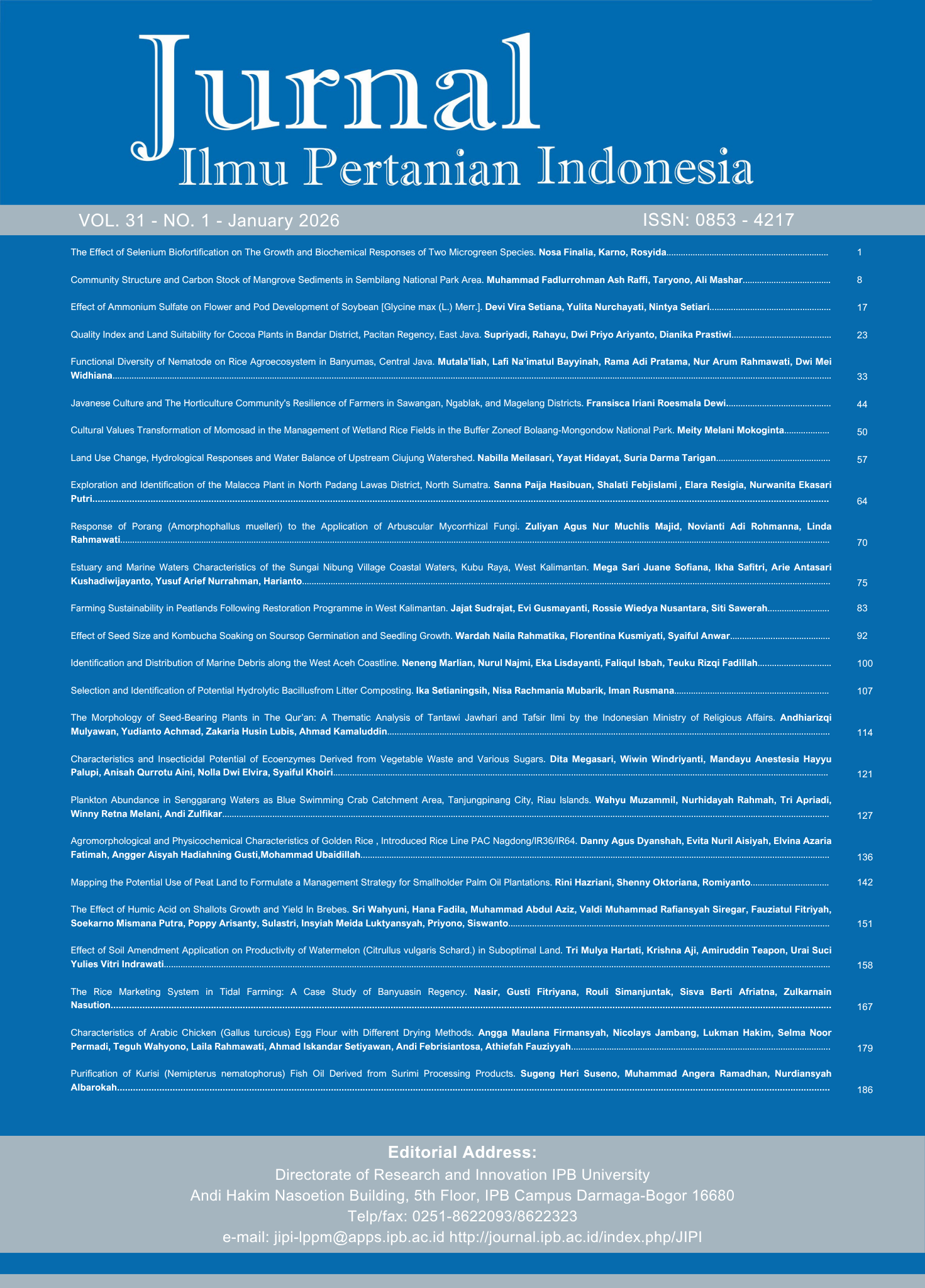
Effect of Ammonium Sulfate on Flower and Pod Development of Soybean [Glycine max (L.) Merr.]
DOI:
https://doi.org/10.18343/jipi.31.1.17Keywords:
ammonium sulfate, nitrogen, productivity, soybean, sulfurAbstract
Soybean [Glycine max (L.) Merr.] is a food crop rich in vegetable oil and protein, with increasing demand and economic worth. Increasing soybean production can be accomplished by providing nutrients nitrogen and sulfur, hence increasing the percentage of bloom development into pods. Applying ammonium sulfate at the start of planting can fulfill nitrogen and sulfur fertilizer requirements. The purpose of this study was to examine and determine the ideal concentration of ammonium sulfate for optimal flower and pod formation, as well as the percentage of flower development into pods and leaf sulfur content. Ammonium sulfate was applied in an experimental garden by mixing it into the planting material in polybags under controlled settings. This study employed a single-factor fully randomized design with four doses of ammonium sulfate. The treatments were ammonium sulfate [NH4)2SO4] at various concentrations of 0, 100, 200, and 300 kg/ha administered at the start of planting, with five replications. The research factors were the quantity of flowers, pods, percentage of flower development into pods, and sulfur level in the leaves. The sulfur content of the leaves was determined using an atomic absorption spectrophotometer. Data were analyzed using ANOVA at a significance level of 5%, followed by DMRT if the results were significant. The results revealed that ammonium sulfate 300 kg/ha produced the highest number of flowers, pods, percentage of flower development into pods, and sulfur content in leaves.
Keywords: ammonium sulfate, nitrogen, productivity, soybean, sulfur
Downloads
References
Annisa P, Gustia H. 2018. Respon pertumbuhan dan produksi tanaman melon terhadap pemberian pupuk organik cair tithonia diversifolia. Prosiding Seminar Tanpa Nama. 1(1): 104–114. https://jurnal.umj.ac.id/index.php/semnastan/article/view/2265.
Azmi K. 2020. The response of growth and yield vegetable bean generation f7 in some low light intensity. Jurnal Ilmiah Budidaya. 1(1): 186–199. https://www.cropagro.unram.ac.id/index.php/caj/article/view/546
Bagale S. 2021. Nutrient management for soybean crops. Hindawi International Journal of Agronomy. 10(1): 1–10. https://doi.org/10.1155/2021/3304634
Barczak B, Knapowski T, Kozera W, Ralcewicz M. 2014. Effects of sulphur fertilisation on the content and uptake of macroelements in narrow–leaf lupin. Romanian Agricultural Research. 31(1): 245–251.
Gyori Z. 2005. Sulphur content of winter wheat grain in long term field experiments. Communications in Soil Science and Plant Analysis. 36(1) : 373–382. https://doi.org/10.1081/CSS-200043098
Kartika JG, Suketi K, Mayasari N. 2016. Produksi biomassa dan minyak atsiri kemangi (Ocimum basilicum L.) pada berbagai dosis pupuk nitrogen dan pupuk cair hayati. Jurnal Hortikultura Indonesia. 7(1): 56–63. https://doi.org/10.29244/jhi.7.1.56-63
Lehar L, Wardiyati T, Maghfoer MD. 2016. Selection of potato varieties (Solanum tuberosum L.) in midlands and the effect of using biological agents. International Journal of Biosciences (IJB). 9(3): 129–138. https://doi.org/10.12692/ijb/9.3.129-138
Lewar Y, Hasan A, Bunga JA, Vertygo, S. 2020. Growth and productivity of inerie kidney bean in the lowlands given with NPK fertilizer and “amazing bio growth” biostimulan. Jurnal Penelitian Pertanian Terapan. 20(3): 237–246. http://www.jurnal.polinela.ac.id/JPPTeISSN2047–1781.
Liu S, Zhang M, Feng F, Tian Z. 2020. Toward a “green revolution” for soybean. Molecular Plant. 13(5): 688–697. https://doi.org/10.1016/j.molp.2020.03.002
Lošák T, Ševčík M, Plchová R, Vo Bennewitz E, Hlušek J, Elbl J, Buňka F, Polášek Z, Antonkiewicz J, Varga L, Vollmann J. 2018. Nitrogen and sulphur fertilisation affecting soybean seed spermidine content. Journal of Elementology. 23(2): 581–588. https://doi.org/10.5601/jelem.2017.22.3.1516
Mastur, Syafaruddin, Syakir, M. 2016. Peran dan pengelolaan hara nitrogen pada tanaman tebu untuk peningkatan produktivitas tebu. Perspektif. 14(2): 1–37. https://doi.org/10.21082/p.v14n2.2015.73-86
Nair RM, Boddepalli VN, Yan MR, Kumar V, Gill B, Pan RS, Wang C, Hartman GL, Silva e Souza R, Somta P. 2023. Global status of vegetable soybean. Plants. 12(3): 1-10. https://doi.org/10.3390/plants12030609
Nugroho AP, Frank. 2012. Effects of copper on lipid peroxidation, glutathione, metallothionein, and antioxidative enzymes in the freshwater mussel anodonta anatine. Toxicological & Environmental Chemistry. 94(5): 918–929. https://doi.org/10.1080/02772248.2012.675156
Pagano MC, Miransari M. 2016. The importance of soybean production worldwide. In Abiotic and Biotic Stresses in Soybean Production: Soybean Production. 1(5): 1–26. https://doi.org/10.1016/B978-0-12-801536-0.00001-3
Powlson DS, Dawson CJ. 2022. Use of ammonium sulphate as a sulphur fertilizer: Implications for ammonia volatilization. Soil Use and Management. 38(1): 622–634. https://doi.org/10.1111/sum.12733
Puja SF, Ghulamahdi M, Lubis I. 2020. Respons pertumbuhan, fisiologi, dan produksi kedelai terhadap pemberian pupuk nitrogen dengan dosis dan waktu yang berbeda. Jurnal Ilmu Pertanian Indonesia. 26(1): 24–31. https://doi.org/10.18343/jipi.26.1.24
Puspasari R, Karyawati AS, Sitompul SM. 2018. Pembentukan polong dan hasil tanaman kedelai (Glycine max (L.) Merril) dengan pemberian nitrogen pada fase generatif. Jurnal Produksi Tanaman. 6(6):1096–1102. https://doi.org/10.51852/jaa.v7i1.583
Putriantari ME. Santosa. 2014. Pertumbuhan dan kadar alkaloid tanaman leunca (Solanum americanum Miller) pada berbagai dosis nitrogen. Jurnal Hortikultura Indonesia. 5(3): 175–182. https://doi.org/10.29244/jhi.5.3.175-182
Rakesh AP, Kumari V, Shekhar D, Prasad RP. 2020. Soil sulphur status and response of crops to sulphur application in Indian soils. Journal of Pharmacognosy and Phytochemistry. 9(3): 1406–1410. https://doi.org/10.22271/phyto.2020.v9.i2w.11052
Saleem M, Elahi E, Gandahi AW, Bhatti SM, Ibrahim H, Ali M. 2019. Effect of sulphur application on growth, oil content and yield of sunflower. Sarhad Journal of Agriculture. 35(4): 23–48. https://doi.org/10.17582/journal.sja/2019/35.4.1198.1203
Saleem S, Mushtaq NU ,Rasool A, Shah WH, Tahir I, Rehman RU. 2023. Use of nanoparticles and fertilizers in alleviating heavy metals and improving nutrients uptake in plants (November 2023). https://doi.org/10.1016/B978-0-443-18675-2.00008-0
Sharma S, Kaur M, Goyal R, Gill BS. 2014. Physical characteristics and nutritional composition of some new soybean (Glycine max (L.) Merrill) genotypes. Journal of Food Science and Technology. 51(3): 551–557. https://doi.org/10.1007/s13197-011-0517-7
Sufianto. 2011. Kriteria bunga menjadi polong bernas pada beberapa varietas kacang tanah (Arachis hypogea L.). Gamma. 6(1): 137–142. http://ejou rnal.u mm.ac.id/index.php/gamma/article/view/1 43 1.
Tyner T Francis, J. 2017. Ammonium sulfate. American Chemical Society Reagent Chemicals. 1(1): 1–9. https://doi.org/10.1021/acsreagents
Wahyudi MR, Giono BRW, Herwati A. 2022. Pertumbuhan dan produksi kedelai (Glycine max L. Merill) pada aplikasi pupuk kompos dengan berbagai macam bioaktivator mol dan media tanam sekam. Jurnal Agrotan. 8(2): 17–24. http://ejournals.umma.ac.id/index.php/agrotan/article/view/1526/940.
Wang M, Shen Q, Xu G, Guo S. 2014. New insight into the strategy for nitrogen metabolism in plant cells. International Review of Cell and Molecular Biology. 310(4): 1–37. https://doi.org/10.1016/B978-0-12-800180-6.00001-3
Yue X, Wang H, Kong J, Li, B, Yang J, Li Q, Zhang J. 2020. A novel and green sulfur fertilizer from CS2 to promote reproductive growth of plants. Environmental Pollution. 263(1): 1–8. https://doi.org/10.1016/j.envpol.2020.114448
Zhang S, Zhang Y, Li K, Yan M, Zhang J, Yu M, Tang S, Wang L, Qu H, Luo L, Xuan W, Xu G. 2021. Nitrogen mediates flowering time and nitrogen use efficiently via floral regulators in rice. Current Biology. 31(4): 671–683. https://doi.org/10.1016/j.cub.2020.10.095
Downloads
Published
Issue
Section
License
Copyright (c) 2025 Devi Vira Setiana

This work is licensed under a Creative Commons Attribution-NonCommercial 4.0 International License.
This journal is published under the terms of the Creative Commons Attribution-NonCommercial 4.0 International License. Authors who publish with this journal agree to the following terms: Authors retain copyright and grant the journal right of first publication with the work simultaneously licensed under a Creative Commons Attribution-NonCommercial 4.0 International License. Attribution — You must give appropriate credit, provide a link to the license, and indicate if changes were made. You may do so in any reasonable manner, but not in any way that suggests the licensor endorses you or your use. NonCommercial — You may not use the material for commercial purposes.
How to Cite
























 View JIPI StatsCounter