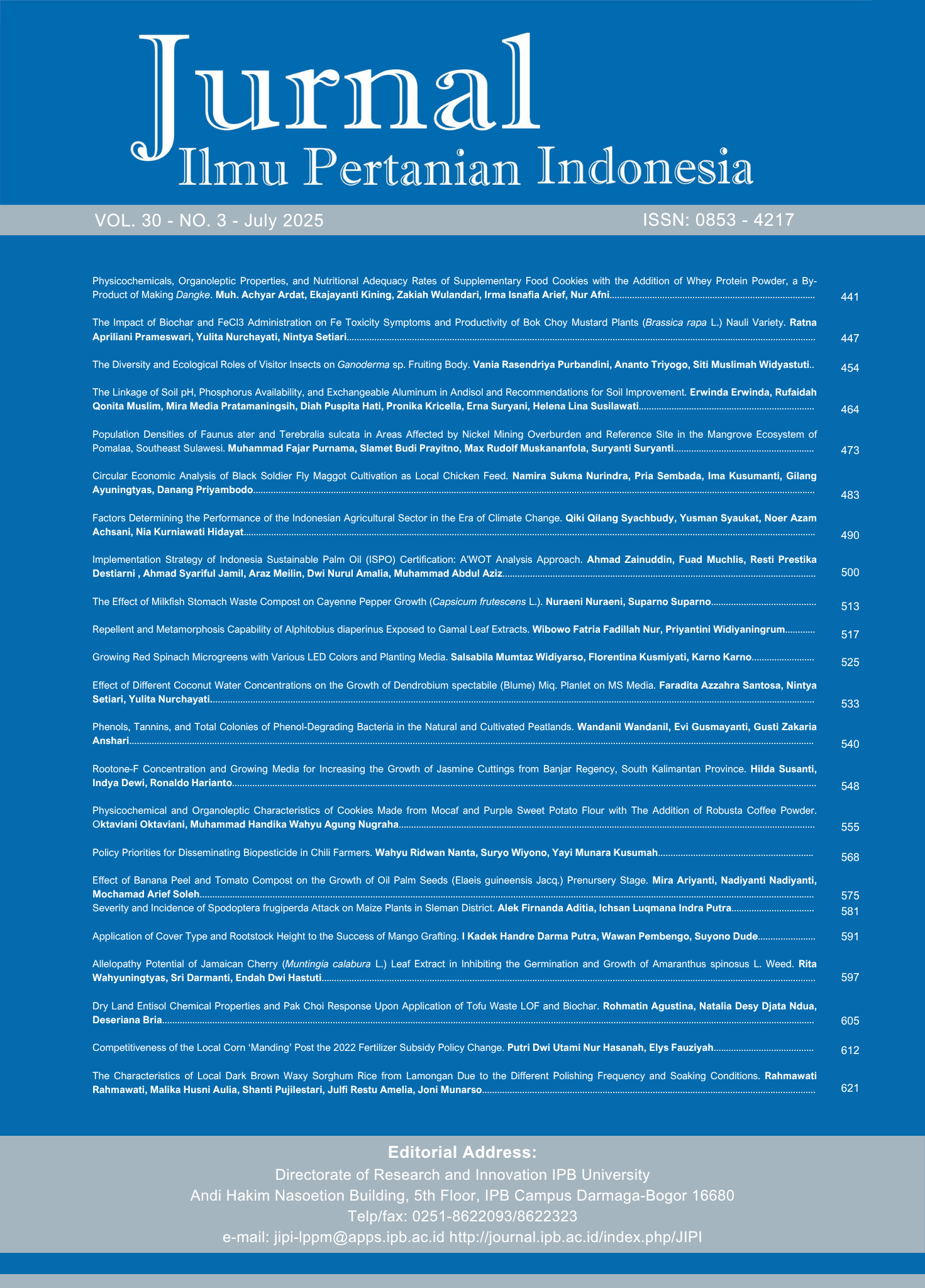
Phenols, Tannins, and Total Colonies of Phenol-Degrading Bacteria in the Natural and Cultivated Peatlands
DOI:
https://doi.org/10.18343/jipi.30.3.540Abstract
Phenols play an important role in inhibiting the decomposition rate of peats. This research compares the total phenols, tannins, and colonies of phenol-degrading bacteria in natural and cultivated peatlands. The work was conducted from September to December 2023 on the peatlands in Pontianak, West Kalimantan. Samples of 60 cm3 were collected from the peat surface. The samples were taken from 4 types of peats, namely natural peats covered by ferns (A), cultivated peat with raised beds (B), cultivated peat with raised beds ameliorated with lime and beef manure (C), and cultivated peat with raised beds ameliorated with lime, beef manure, and Jadam fertilizer (D). The total phenols content was measured using the Folin-Ciocalteu 10% method using a UV-Vis spectrophotometer at a wavelength of 765 nm. The total tannins content was measured using the Folin-Denis method using a UV-Vis spectrophotometer at a wavelength of 740 nm. Total bacterial colonies were counted using the Total Plate Count method on selective Mineral Salt Medium (MSM) agar with the addition of phenol solution. The results showed that the average total phenols and tannins content values were generally low in the cultivated peats, particularly in the raised bed (B). The results indicate that the cultivated peat accelerates the activity of phenol-degrading bacteria.
Keywords: Jadam fertilizer, phenols, phenol-degrading bacteria, peats, tannin
Downloads
References
Ayob Z, Kusai NA, Jantan NM, Law MC. 2024. Molecular approaches in assessing the soil microbial diversity of Malaysian oil palm plantations: A review. Journal of Oil Palm Research. 36(1): 158–70. https://doi.org/10.21894/jopr.2023.0037. DOI: https://doi.org/10.21894/jopr.2023.0037
Badan Standarisasi Nasional. 2008. SNI2897:2008 Metode Pengujian Cemaran Mikroba dalam Daging, Telur Dan Susu, Serta Hasil Olahannya. Jakarta (ID): BSN.
Bing W, Li X, Zhao Y, Wang Y, Zhang J, Zhang J, Liang J. 2024. collaboration of bacterial consortia for biodegradation of high concentration phenol and potential application of machine learning. Chem. Biol. Interact. 399 (May): 111153. https://doi.org/10.1016/j.cbi.2024.111153. DOI: https://doi.org/10.1016/j.cbi.2024.111153
Chahardoli A, Jalilian F, Memariani Z, Farzaei MH, Shokoohinia Y. 2020. Analysis of organic acids. Recent Adv. Nat. Prod. Anal Recent Advances in Natural Products Analysis. https://doi.org/10.1016/B978-0-12-816455-6.00026-3. DOI: https://doi.org/10.1016/B978-0-12-816455-6.00026-3
Fenner N, Freeman C. 2011. Drought-induced carbon loss in peatlands. Nature Geoscience. 4(12): 895–900. https://doi.org/10.1038/ngeo1323. DOI: https://doi.org/10.1038/ngeo1323
Freeman C, Ostle NJ, Fenner N, Kang H. 2004. A regulatory role for phenol oxidase during decomposition in peatlands. Soil Biology and Biochemistry. 36(10): 1663–1667. https://doi.org/10.1016/j.soilbio.2004.07.012. DOI: https://doi.org/10.1016/j.soilbio.2004.07.012
Fruci M, Poole K. 2016. Chapter 2.9. Bacterial stress responses as determinants of antimicrobial resistance. In Stress Environ. Regul. OfGene Expr. Adapt. Bact., edited by Frans J. de Bruijn, 115–36. New Jersey (US): John Wiley & Sons. https://doi.org/10.1002/9781119004813.ch10 DOI: https://doi.org/10.1002/9781119004813.ch10
Hadi MN, Pulunggono HB, Indriyati LT, Widiastuti H, Zulfajrin M. 2024. Factors regulating lignocellulolytic microbes, their degrading enzymes, and heterotrophic respiration in oil palm cultivated peatlands. Journal of Degraded and Mining Lands Management. 11(2): 5195–5210. https://doi.org/10.15243/jdmlm.2024.112.5195. DOI: https://doi.org/10.15243/jdmlm.2024.112.5195
Hartati FK. 2016. Evaluasi metode pengujian angka lempeng total (ALT) Menggunakan metoda petrifilm aerobic count plate terhadap metode uji SNI 01.Z332.2006 pada produk perikanan di LPPMHP Surabaya. Jurnal Teknik Industri Heuristic. 13(2): 89–105. https://doi.org/10.30996/he.v13i02.877 DOI: https://doi.org/10.30996/he.v13i02.877
Irfan M. 2014. Isolasi dan enumerasi bakteri tanah gambut di perkebunan kelapa sawit PT Tambang Hijau Kecamatan Tambang Kabupaten Kampar. Jurnal Agroteknologi. 5(1): 1–8.
Ivanov AA, Maltseva EV, Yudina NV. 2016. Composition of fulvic acids after the mechanical activation of peats. Solid Fuel Chemistry. 50(1): 7–11. https://doi.org/10.3103/S0361521916010055. DOI: https://doi.org/10.3103/S0361521916010055
Jayasekara C, Leigh C, Shimeta J, Silvester E, Grover S. 2024. Organic matter decomposition in mountain peatlands: Effects of substrate quality and peatland degradation. Plant Soil. 506(1): 639–54. https://doi.org/10.1007/s11104-024-06725-4. DOI: https://doi.org/10.1007/s11104-024-06725-4
Kamardan MIF, Marsid EA, Akhir FNM, Yuzir MAM, Othman NA, Hara H. 2022. Isolation and characterization of lignin-derived monomer degraders under acidic conditions from tropical peatland. The Journal of General and Applied Microbiology 68(3): 117–24. https://doi.org/10.2323/jgam.2021.09.004. DOI: https://doi.org/10.2323/jgam.2021.09.004
Kang H, Kwon MJ, Kim S, Lee S, Jones TG, Johncock AC, Haraguchi A, Freeman C. 2018. Biologically driven DOC release from peatlands during recovery from acidification. Nature Communications. 9(1): 1–7. https://doi.org/10.1038/s41467-018-06259-1. DOI: https://doi.org/10.1038/s41467-018-06259-1
Kim JI, Yang Y, Kang H. 2024. Fluorometric assay for phenol oxidase activity in soils and its controlling variables. Appl. Soil Ecol. 195 (Dec 2023): 105240. https://doi.org/10.1016/j.apsoil.2023.105240. DOI: https://doi.org/10.1016/j.apsoil.2023.105240
Lim TY, Lim YY, Yule CM. 2014. Bioactivity of Leaves of Macaranga species in tropical peat swamp and non-peat swamp environments. Journal of Tropical Forest Science. 26(1): 134–41.
Lobato-Ureche MA, Pérez-Rodriguez MM, Malovini E, Piccoli PN, Monasterio RP, Cohen AC. 2023. Native plant growth promoting Rhizobacteria improve the growth of pepper seedlings and modify the phenolic compounds profile 28: 100800. https://doi.org/10.1016/j.rhisph.2023.100800. DOI: https://doi.org/10.1016/j.rhisph.2023.100800
Min K, Freeman C, Kang H, Choi SU. 2015. The Regulation by phenolic compounds of soil organic matter dynamics under a changing environment. BioMed Research International. 2015. https://doi.org/10.1155/2015/825098. DOI: https://doi.org/10.1155/2015/825098
Nor Suhaila Y, Ariff A, Rosfarizan M, Latif IA, Ahmad SA, Norazah MN, Shukor MYA. 2010. Optimization of parameters for phenol degradation by Rhodococcus UKM-P in shake flask culture. In WCE 2010 - World Congr. Eng. 2010, 1:601–4.
Olchowik-Grabarek E, Sękowski S, Kwiatek A, Płaczkiewicz J, Abdulladjanova N, Shlyonsky V, Swiecicka I, Zamaraeva M. 2022. The Structural changes in the membranes of Staphylococcus aureus caused by hydrolysable tannins witness their antibacterial activity. Membranes (Basel). 12(11). https://doi.org/10.3390/membranes12111124. DOI: https://doi.org/10.3390/membranes12111124
Pind A, Freeman C, Lock MA. 1994. Enzymic degradation of phenolic materials in peatlands - Measurement of phenol oxidase activity. Plant Soil. 159(2): 227–31. https://doi.org/10.1007/BF00009285. DOI: https://doi.org/10.1007/BF00009285
Puissant J, Jones B, Goodall T, Mang D, Blaud A, Gweon HS, Malik A, et al. 2019. The pH optimum of soil exoenzymes adapt to long term changes in soil pH. Soil Biology and Biochemistry. 138 (September): 107601. https://doi.org/10.1016/j.soilbio.2019.107601. DOI: https://doi.org/10.1016/j.soilbio.2019.107601
Riyani D, Gusmayanti E, Pramulya M. 2021. Dampak pemberian pupuk hayati dan NPK terhadap emisi CO2 pada perkebunan kelapa sawit di lahan gambut. Jurnal Ilmu Lingkungan. 19(2): 219–26. https://doi.org/10.14710/jil.19.2.219-226. DOI: https://doi.org/10.14710/jil.19.2.219-226
Zeng J, Chen H, Bai Y, Dong F, Peng C, Yan F, Cao Q, Yang Z, Yang S, Yang G. 2021. Water table drawdown increases plant biodiversity and soil polyphenol in the Zoige Plateau. Ecological Indicators. 121: 107–118. https://doi.org/10.1016/j.ecolind.2020.107118. DOI: https://doi.org/10.1016/j.ecolind.2020.107118
Zhang J, Bing W, Hu T, Zhou X, Zhang J, Liang J, Li Y. 2023. Enhanced biodegradation of phenol by microbial collaboration: Resistance, metabolite utilization, and pH stabilization. Environmental Research. Res. 238 (P2): 117269. https://doi.org/10.1016/j.envres.2023.117269. DOI: https://doi.org/10.1016/j.envres.2023.117269
Zhong P, Chen Y, Sun Q, Lamit LJ, Liu J, Tian H, Wang Z. 2024. Drainage Induced carbon nitrogen loss and microbial community change were closely related and hard to be restored in subsurface peat. Applied Soil Ecology. 202 (August): 105582. https://doi.org/10.1016/j.apsoil.2024.105582. DOI: https://doi.org/10.1016/j.apsoil.2024.105582
Downloads
Published
Issue
Section
License
This journal is published under the terms of the Creative Commons Attribution-NonCommercial 4.0 International License. Authors who publish with this journal agree to the following terms: Authors retain copyright and grant the journal right of first publication with the work simultaneously licensed under a Creative Commons Attribution-NonCommercial 4.0 International License. Attribution — You must give appropriate credit, provide a link to the license, and indicate if changes were made. You may do so in any reasonable manner, but not in any way that suggests the licensor endorses you or your use. NonCommercial — You may not use the material for commercial purposes.
How to Cite

























 View JIPI StatsCounter