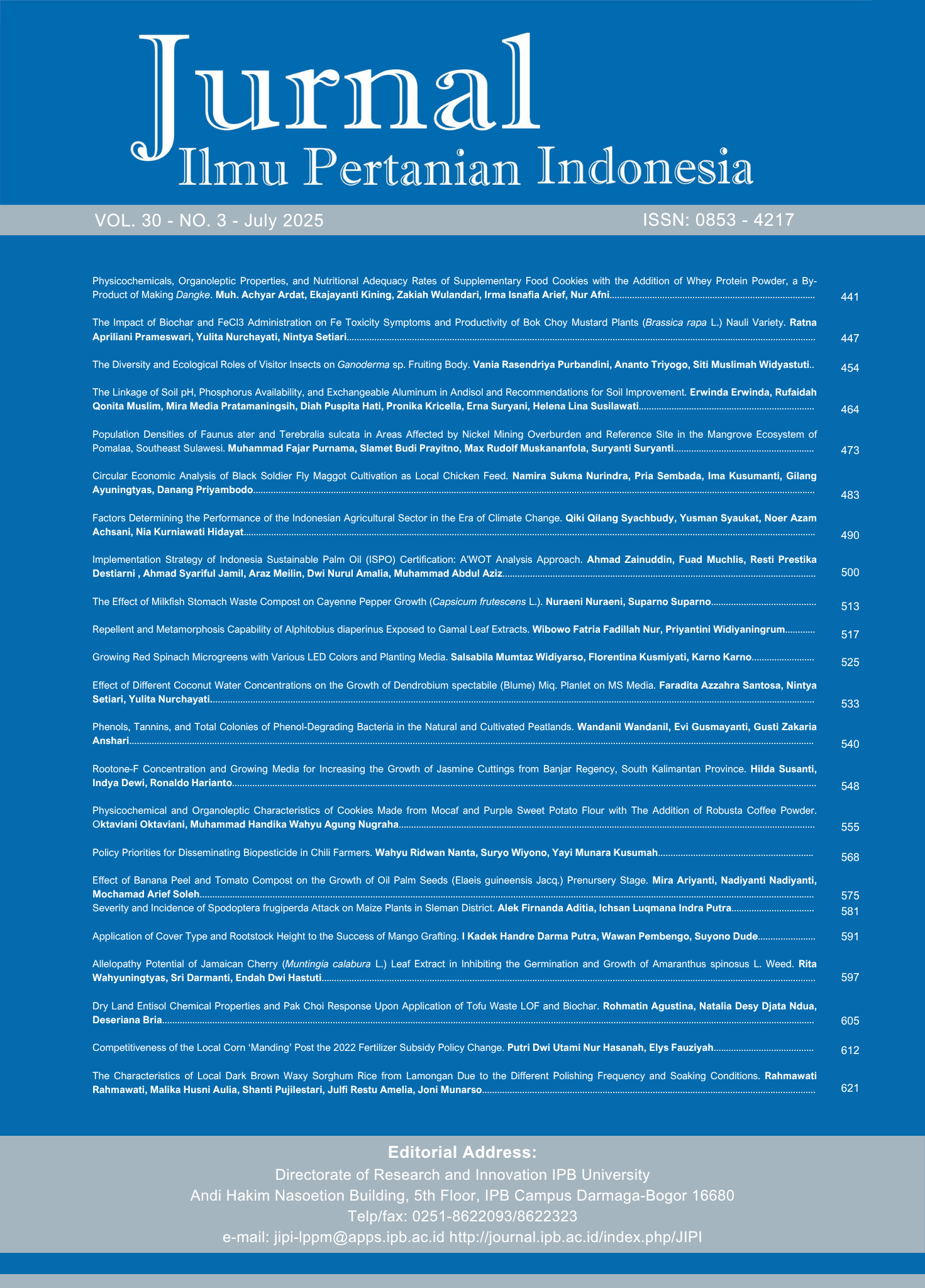
Effect of Different Coconut Water Concentrations on the Growth of Dendrobium spectabile (Blume) Miq. Planlet on MS Media
DOI:
https://doi.org/10.18343/jipi.30.3.533Abstract
Dendrobium spectabile is an orchid with unique flowers that are vulnerable to exploitation. Tissue culture is employed to conserve this orchid, where the type of medium and organic supplements significantly affect plantlet growth. Murashige and Skoog (MS) media was added with coconut water as an exogenous hormone source. This study aimed to determine the effect of adding coconut water and determine the optimal concentration to increase the growth of D. spectabile at the subculture stage. The method involved subculturing D. spectabile plantlets in vitro in MS media supplemented with coconut water at concentrations of 0%, 5%, 10%, 15%, and 20%. The research design used a completely randomized design (CRD), with coconut water concentration and ten replicates. Data were analyzed using ANOVA and Duncan's Multiple Range Test at a 5% significance level. Plantlet growth was observed for two months, and the parameters observed were the emergence of new shoots, leaves, and roots; the number of new shoots, leaves, and roots; and the length of new leaves. The results showed that the addition of coconut water to the subculture medium can increase the leaf growth of D. spectabile orchid plantlets but does not increase shoot and root growth. Coconut water 10% was the most optimal concentration for the number of new leaves and new leaf length. The addition of 15% coconut water was the most optimal concentration for plantlet new leaf emergence. Coconut water plays a vital role in in vitro culture, supporting the various growth processes of D. spectabile plantlets.
Keywords: Dendrobium spectabile, ex situ conservation, organic supplement, subculture
Downloads
References
Boyola KH, Hartati RM, Setyawati ER. 2024. Pengaruh macam dan konsentrasi zat pengatur tumbuh alami terhadap pertumbuhan stek mawar (Rosa sp.). Agroforetech. 4(2): 1676–1681.
Deswiniyanti NW. 2015. In Vitro Propagation of native orchid Dendrobium spectabile (Blume) Miq. II International Orchid Symposium. 1078: 69–73. https://doi.org/10.17660/ActaHortic.2015.1078.8 DOI: https://doi.org/10.17660/ActaHortic.2015.1078.8
Dünser K. Kleine-Vehn J. 2015. Differential growth regulation in plants—the acid growth balloon theory. Current opinion in plant biology. 28: 55–59. https://doi.org/10.1016/j.pbi.2015.08.009. DOI: https://doi.org/10.1016/j.pbi.2015.08.009
Dyarta S, Dewanti P. 2023. Optimasi pertumbuhan planlet anggrek Dendrobium gabriella surajaya menggunakan media alternatif AB Mix dan air kelapa secara in vitro. Agrin : Jurnal Penelitian Pertanian. 27(2): 124–139. https://doi.org/10.20884/1.agrin.2023.27.2.743 DOI: https://doi.org/10.20884/1.agrin.2023.27.2.743
Elfiani E, Jakoni J. 2015. Sterilisasi eksplan dan subkultur anggrek, sirih merah dan krisan pada perbanyakan tanaman secara in vitro. Dinamika Pertanian. 30(2): 117–124.
Gupta P, Sharma S, Saxena S. 2015. Biomass yield and steviol glycoside production in callus and suspension culture of Stevia rebaudiana treated with proline and polyethylene glycol. Applied biochemistry and biotechnology. 176(3): 863–874. https://doi.org/10.1007/s12010-015-1616-0 DOI: https://doi.org/10.1007/s12010-015-1616-0
Kalve S, De Vos D, Beemster GT. 2014. Leaf development: a cellular perspective. Frontiers in Plant Science. 5(362): 1–26. https://doi.org/10.3389/fpls.2014.00362 DOI: https://doi.org/10.3389/fpls.2014.00362
Lewar Y, Kumanireng KN, Hasan A. 2023. Kajian konsentrasi air kelapa muda sebagai organic priming terhadap viabilitas benih kacang merah yang terdeteriorasi. Jurnal Pertanian Terapan. 28(1): 119–130. https://doi.org/10.35726/jp.v28i1.6943 DOI: https://doi.org/10.35726/jp.v28i1.6943
Nandariyah, Mahmudah LS, Arniputri RB, Sakya AT. 2021. The effect of NAA and coconut water combination on garlic (Allium sativum L.) tissue culture. IOP Conference Series: Earth and Environmental Science. 905(1): 012036. https://doi.org/10.1088/1755-1315/905/1/012036. DOI: https://doi.org/10.1088/1755-1315/905/1/012036
Nursetiadi EKA, Yuniastuti E, Putri RBA. 2016. Pengaruh macam media dan konsentrasi BAP terhadap multiplikasi tanaman manggis (Garcinia mangostana) secara in vitro. Bioteknol. 13: 63–72. https://doi.org/10.13057/biotek/c130203. DOI: https://doi.org/10.13057/biotek/c130203
Pratama J, Nilahayati. 2018. Modifikasi media MS dengan penambahan air kelapa untuk subkultur I anggrek Cymbidium. Agrium. 15(2): 96–109. https://doi.org/10.29103/agrium.v15i2.1071. DOI: https://doi.org/10.29103/agrium.v15i2.1071
Rohmah AS, Sasmita ER, Wahyurini E. 2021. Pertumbuhan berbagai macam bahan eksplan kentang atlantik secara in vitro dengan perlakuan IAA. Agrosains: Jurnal Penelitian Agronomi. 23(2): 72–79. https://doi.org/10.20961/agsjpa.v23i2.49027 DOI: https://doi.org/10.20961/agsjpa.v23i2.49027
Saepudin A, Yulianto Y, Aeni RN. 2020. Pertumbuhan eksplan in vitro anggrek hibrida dendrobium pada beberapa media dasar dan konsentrasi air kelapa. Media Pertanian. 5(2): 97–115. https://doi.org/10.37058/mp.v5i2.2451 DOI: https://doi.org/10.37058/mp.v5i2.2451
Salamah DM, Sulandjari K, Rahayu YS. 2022. Pengaruh pemberian berbagai konsentrasi air kelapa muda terhadap pertumbuhan tunas stek batang ubi kayu (Manihot esculenta Crantz) pada varietas Gajah dan Karet. Jurnal Ilmu Pertanian. 7(1): 49–54. https://doi.org/10.35329/agrovital.v7i1.2125 DOI: https://doi.org/10.35329/agrovital.v7i1.2125
Santoso,E, Rahayu T, Hayati A. 2020. Pengaruh air kelapa (Cocos nucifera L.) dengan medium VW terhadap pertumbuhan protocorm anggrek secara in vitro. Jurnal Ilmiah Sains Alami. 3(1): 37–43. https://doi.org/10.33474/j.sa.v3i1.7208. DOI: https://doi.org/10.33474/j.sa.v3i1.7208
Singh CR. 2018. Review on problems and its remedy in plant tissue culture. Asian Journal of Biological Sciences. 11(4): 165–172. https://doi.org/10.3923/ajbs.2018.165.172 DOI: https://doi.org/10.3923/ajbs.2018.165.172
Srinivasa R, Siddiqiu N, Mishra R. 2018. Effect of additive supplements in tissue culture of Gloriosa superba L. – a medicinally important plant. Indian Journal of Applied and Pure Biology. 33(1): 75–81.
Su YH, Liu YB, Zhang XS. 2011. Auxin-cytokinin interaction regulates meristem development. Molecular Plant. 4(4): 616–625. https://doi.org/10.1093/mp/ssr007. DOI: https://doi.org/10.1093/mp/ssr007
Wang B, Smith SM, Li J. 2018. Genetic regulation of shoot architecture. Annual review of plant biology. 69: 437–468. https://doi.org/10.1146/annurev-arplant-042817-040422. DOI: https://doi.org/10.1146/annurev-arplant-042817-040422
Zhang S, Yang Y, Li J, Qin J, Zhang W, Huang W, Hu H. 2018. Physiological diversity of orchids. Plant Diversity. 40: 196–208. https://doi.org/10.1016/j.pld.2018.06.003. DOI: https://doi.org/10.1016/j.pld.2018.06.003
Downloads
Published
Issue
Section
License
This journal is published under the terms of the Creative Commons Attribution-NonCommercial 4.0 International License. Authors who publish with this journal agree to the following terms: Authors retain copyright and grant the journal right of first publication with the work simultaneously licensed under a Creative Commons Attribution-NonCommercial 4.0 International License. Attribution — You must give appropriate credit, provide a link to the license, and indicate if changes were made. You may do so in any reasonable manner, but not in any way that suggests the licensor endorses you or your use. NonCommercial — You may not use the material for commercial purposes.
























 View JIPI StatsCounter