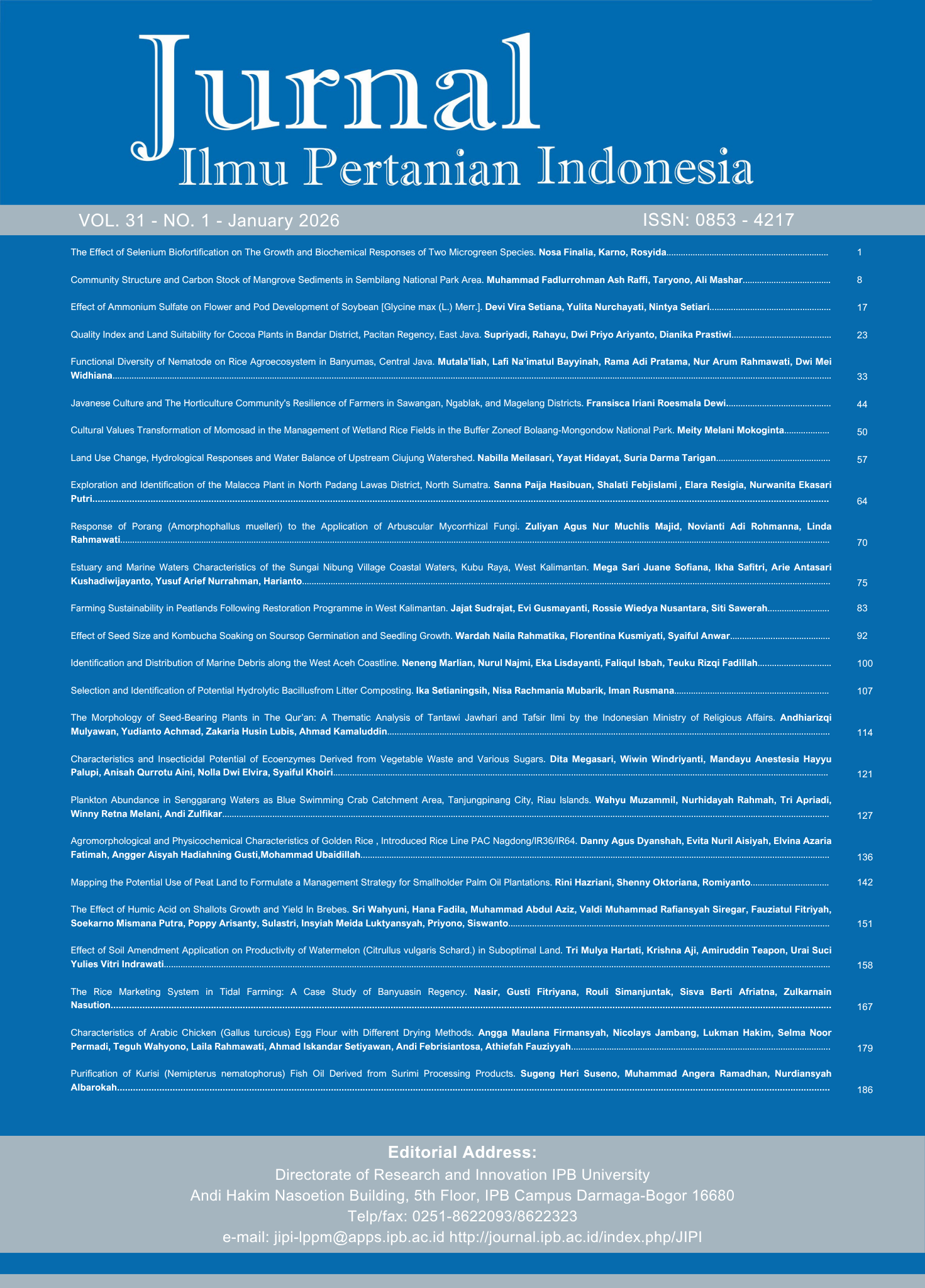
Exploration and Identification of the Malacca Plant in North Padang Lawas District, North Sumatra
DOI:
https://doi.org/10.18343/jipi.31.1.64Keywords:
indian gooseberry, Phyllanthus emblica, Phyllanthus indofischeriAbstract
The Malacca plant is well-known for its therapeutic benefits and is commonly used to make jam. It is critical to understand the existence and diversity of Malacca plants to preserve germplasm and improve attributes through plant breeding. This study sought to investigate and identify malacca plants in North Padang Lawas Regency. The study was conducted in three subdistricts: Halongonan, Padang Bolak, and Padang Bolak Julu, from May to June 2023. This study employed a survey using purposive sampling. Malacca plant samples from the generative period (flowering and fruiting) were selected. The observation included vegetative characteristics (plant height, stem bark color, leaf size, shape, and color) as well as generative characteristics (flower and fruit shape and color). The findings revealed that there were eight accessions dispersed throughout four settlements. One accession, HT1, is designated as the Phyllanthus emblica species due to changes in leaf, flower, and fruit morphology. In contrast, the remaining seven accessions are categorized as P. indofischeri. The changes can be seen in the shape of the leaf tips, stigma branching, and fruit shape and size.
Keywords: indian gooseberry, Phyllanthus emblica, Phyllanthus indofischeri
Downloads
References
Adelina R, Nasution MNH, Harahap DE, Nasution JF. 2021. Dormancy breaking of Kimalaka seeds (Phyllanthus emblica L.) at various concentrations of sulfuric acid. In: Institute of Physics Conferences Series: Materials Science and Engineering. International Conference on Applied Science, Engineering and Technology (PIC-ASET 2020), Padangsidempuan (ID), 10th Nov 2020. https://doi.org/10.1088/1757-899X/1156/1/012005
Ahmad B, Hafeez N, Rauf A, Bashir S, Linfang H, Rehman M, Mubarak MS, Uddin MS, Bawazeer S, Shariati MA, Daglia M, Wan C, Rengasamy KRR. 2021. Review: Phyllanthus emblica: A comprehensive review of its therapeutic benefits. South African Journal of Botany. 138: 278–310. https://doi.org/10.1016/j.sajb.2020.12.028
Ardiansyah, Risnita, Jailani MS. 2023. Teknik pengumpulan data dan instrumen penelitian ilmiah pendidikan pada pendekatan kualitatif dan kuantitatif. Ihsan: Jurnal Pendidikan Islam. 1(2): 1–9. https://doi.org/10.61104/ihsan.v1i2.57
Avinash PG, Hamid, Shams R, Dash KK, Shaikh AM, Ungai D, Harsanyi E, Suthar T, Kovacs B. 2024. Review: Recent Insights into the morphological, nutritional, and phytochemical properties of Indian gooseberry (Phyllanthus emblica) for the development of functional foods. Plants. 13(5): 2–19. https://doi.org/10.3390/plants13050574
Charmkar NK, Singh R. 2022. Flowering behavior studies in some selected cultivars of Amla (Emblica officinalis Gaertn.) under Vindhyan Region. Journal of Plant Science and Research. 9(2): 1–4.
Ganesan R. 2003. Identification, distribution, and conservation of Phyllanthus indofischeri, another source of Indian gooseberry. Current Science. 84(12): 1515–1518.
Hutasuhut U, Rianita R, Hafni S. 2023. The effect of level supplemented probiotics and Balakka fruit extract (Phyllanthus emblica L.) on percentage of carcass weight and carcass parts of broiler chickens. Jurnal Ilmu dan Industri Peternakan. 9(1): 74–89. https://doi.org/10.24252/jiip.v9i1.37214
Keim AP, Adi TR, Nikmatullah M, Arifa N, Akbar F, Sujarwo W. 2020. Etnobiologi kota Amlapura, Karangasem, Bali: Amla, Amlapura dan Phyllanthus emblica L. (Phyllanthaceae). Journal of Tropical Ethnobiology. 3(1): 69–80. https://doi.org/10.46359/jte.v3i1.9
Khan KH. 2009. Role of Emblica officinalis in Medicine: A review. Botany Research International. 2(4): 218–228.
Khoiriyah U, Pasaribu N, Hannum S. 2015. Distribusi Phyllanthus emblica L. di Sumatera Utara bagian Selatan. Jurnal Biosfresa. 32(2): 98–102. https://doi.org/10.20884/1.mib.2015.32.2.300
Kishore K. 2017. Phenological growth stages of Indian gooseberry (Phyllanthus emblica L.) according to the extended BBCH scale. Scientia Horticulture. 225: 607–614. https://doi.org/10.1016/j.scienta.2017.08.004
Patel SS, Goyal RK. 2012. Emblica officinalis Geartn.: A comprehensive review on phytochemistry, pharmacology and ethnomedicinal. Research Journal of Medicinal Plant. 6(1): 6–16. https://doi.org/10.3923/rjmp.2012.6.16
Pathak R. 2003. Status Report on Genetic Resoources of Indian Gooseberry–Aonla (Emblica officinalis Gaert.) in South and Southeast Asia. New Delhi (IN): IPGRI Office for South Asia.
Sangeetha N, Mercy S, Kavitha M, Selvaraj D, Sathiskumar R, Ganesh D. 2010. Morphological variation in the Indian gooseberries (Phyllanthus emblica and Phyllanthus indofischeri) and the chloroplast trn L (UAA) intron as candidate gene for their identification. Plant Genetic Resources: Characterization and Utilization. 8(3): 191–197. https://doi.org/10.1017/S1479262110000171
Sawant SS, Lee B, Song J, Seo H-J. 2022. The Indian gooseberry (Emblica officinalis) industry and cultivation in India. The Journal of the Korean Society of International Agriculture. 34(3): 199–204. https://doi.org/10.12719/KSIA.2022.34.3.199
Shukla AK, Samadia D, Shukla AK, Dhandar DG. 2005. Genetic resources of Aonla (Emblica offinalis Gaertn.). Indian Journal of Plant Genetic Resources. 18(2): 188–193.
Singh AK, Singh S, Saroj PL, Mishra DS, Singh PP, Singh RK. 2019. Aonla (Emblica officinalis) in India: A review of its improvement, production, and diversified uses. Indian Journal of Agricultural Sciences. 89(11): 1773–1781. https://doi.org/10.56093/ijas.v89i11.95288
Uji T. 2007. Review: Species diversity of indigenous fruits in Indonesia and its potential. Biodiversitas. 8(2): 157–167. https://doi.org/10.13057/biodiv/d080217
Downloads
Published
Versions
- 2025-10-30 (2)
- 2026-02-25 (1)
Issue
Section
License
Copyright (c) 2025 Sanna Paija Hasibuan, Shalati Febjislami, Elara Resigia, Nurwanita Ekasari Putri

This work is licensed under a Creative Commons Attribution-NonCommercial 4.0 International License.
This journal is published under the terms of the Creative Commons Attribution-NonCommercial 4.0 International License. Authors who publish with this journal agree to the following terms: Authors retain copyright and grant the journal right of first publication with the work simultaneously licensed under a Creative Commons Attribution-NonCommercial 4.0 International License. Attribution — You must give appropriate credit, provide a link to the license, and indicate if changes were made. You may do so in any reasonable manner, but not in any way that suggests the licensor endorses you or your use. NonCommercial — You may not use the material for commercial purposes.
How to Cite

























 View JIPI StatsCounter