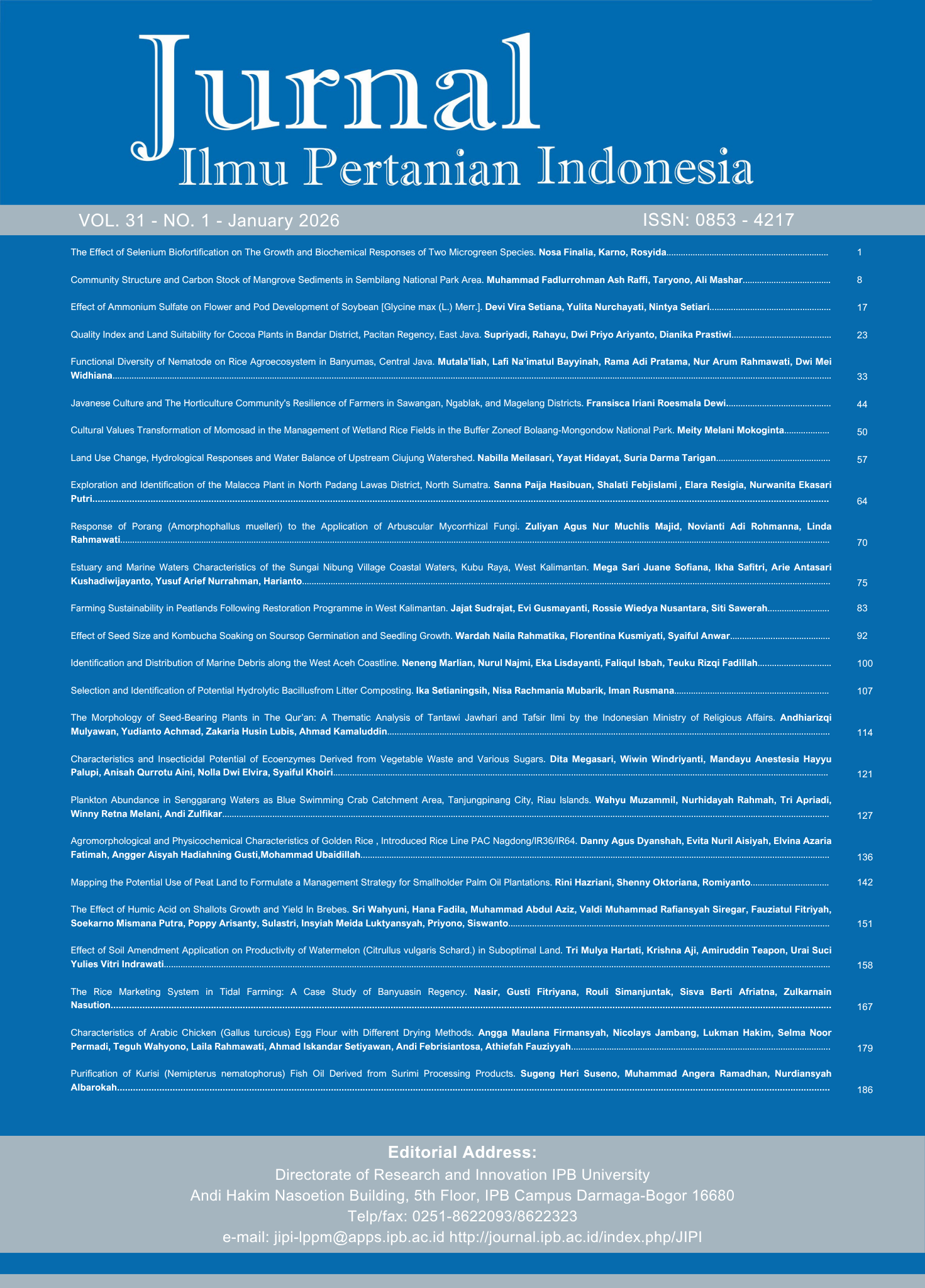
Characteristics and Insecticidal Potential of Ecoenzymes Derived from Vegetable Waste and Various Sugars
DOI:
https://doi.org/10.18343/jipi.31.1.121Abstract
Vegetable waste is the second largest category of household organic waste, following grains. Its underutilization at the household level is an environmental concern, but it also has potential as a raw material for ecoenzyme synthesis. Ecoenzymes created by fermentation may be used as environmentally friendly alternatives to chemical pesticides. However, only a few research have investigated the effect of various sugar types on the insecticidal efficiency of ecoenzymes generated from vegetable waste. The goal of this study was to create ecoenzymes from vegetable waste and assess their insecticidal properties. Ecoenzymes were prepared using a 3:1:10 ratio of vegetable waste, sugar, and water. The vegetable waste comprised of cabbage, lemongrass, and red onion peels, while the sugars were molasses, brown sugar, and granulated sugar, resulting in nine different compositions. Fermentation lasted three months. Each 10% ecoenzyme solution was tested for insecticidal activity against Crocidolomia pavonana larvae in their second instar stage. All ecoenzyme formulations exhibited physical characteristics associated with successful fermentation, such as an acidic pH (3.1−3.6), dark brown coloration, and a strong sour fragrance. Bioassays revealed that ecoenzymes had insecticidal effects through larval mortality and feeding inhibition. The mixture with lemongrass and molasses had the highest mortality (66.67%) and strongest antifeedant effect. Variations in waste type and sugar supply have a substantial impact on ecoenzyme performance. The findings demonstrate that vegetable waste may be effectively transformed into ecoenzymes with insecticidal characteristics, indicating their potential for application in sustainable pest management.
Keywords: Crocidolomia pavonana, organic waste, plant-based pesticide, sustainable agriculture
Downloads
References
Benny N, Shams R, Dash KK, Pandey VK, Bashir O. 2023. Recent trends in utilization of citrus fruits in production of ecoenzyme. Journal of Agriculture and Food Research. 13(100657). https://doi.org/10.1016/j.jafr.2023.100657
Bhardwaj D, Ansari MW, Sahoo RK, Tuteja N. 2014. Biofertilizers function as key player in sustainable agriculture by improving soil fertility, plant tolerance and crop productivity. Microbial Cell Factories. 13(1): 1–10. https://doi.org/10.1186/1475-2859-13-66
Galintin O, Rasit N, Hamzah S. 2021. Production and characterization of eco enzyme produced from fruit and vegetable wastes and its influence on the aquaculture sludge. Biointerface Research in Applied Chemistry. 11(3): 10205–10214. https://doi.org/10.33263/BRIAC113.1020510214
Górecki T, Smaga Ł. 2019. fdANOVA: An R software package for analysis of variance for univariate and multivariate functional data. Computational Statistics. 34(2): 571–597. https://doi.org/10.1007/s00180-018-0842-7
Gunwantrao BB, Bhausaheb SK, Ramrao BS, Subhash KS. 2016. Antimicrobial activity and phytochemical analysis of orange (Citrus aurantium L.) and pineapple (Ananas comosus (L.) Merr.) peel extract. Annals of Phytomedicine. 5(2): 156–160. https://doi.org/10.21276/ap.2016.5.2.22.
Hastuti D, Islamy MF. 2019. The effectiveness of acetic acid solution against brown planthopper pest (Nilaparvata lugens Stal.) of ciherang rice (Oryza sativa L). In: IOP Conference Series: Earth and Environmental Science 383 012014. The 1st International Conference on Agriculture and Rural Development (ICARD), Banten, Indonesia, 8th–9th Aug 2019. https://doi.org/10.1088/1755–1315/383/1/012014.
He Z, Fang Y, Li DC, Chen DS, Wu F. 2021. Effect of lactic acid supplementation on the growth and reproduction of Bombyx mori (Lepidopteria: Bombycidae). Journal of Insect Science. 21(2): 7; 1–6. https://doi.org/10.1093/jisesa/ieab018
Hermawan W, Madyasti FS. 2023. Pemanfaatan limbah buah dan sayur sebagai ecoenzyme alternatif pestisida sintetik di Desa Sukapura, Kecamatan Kertasari, Kabupaten Bandung. Dharmakarya: Jurnal Aplikasi Ipteks untuk Masyarakat. 12(1): 71–76. https://doi.org/10.24198/dharmakarya.v11i2.36174.
Iniyah R, Nugroho ED, Fathurrohman A, Ahwan Z, Dayat M, Wibisono M, Aji FR, Kasiman, Anam K. 2023. Formulasi insektisida nabati kombinasi daun Brugmansia suaveolens Bercht. & J. Presl dan daun Swietenia macrophylla King untuk mengendalikan hama Hypothenemus hampei Ferr. Agrikultura. 34(2): 218–227. 10.24198/agrikultura.v34i2.43158.
Islami A. 2022. Identifikasi kadar asam asetat pada ecoenzyme dari bahan organik kulit jeruk dengan metode titrasi asam basa. [Undergraduate thesis]. Padang (ID): Universitas Negeri Padang.
Larasati D, Astuti AP, Maharani ETW. 2020. Uji organoleptik produk eco–enzyme dari limbah kulit buah (studi kasus di Kota Semarang). Edusaintek. 4: 278–283.
Lubis N, Wasito M. (2023, April). Analisa unsur hara tanah akibat pemberian ekoenzim pada tanaman bawang merah (Allium ascalonicum L.). In Scenario (Seminar of Social Sciences Engineering and Humaniora), Medan, Indonesia, 24th Mar 2023.
Maryanti A, Hastuti D, Hardi NA. 2024. Effectiveness test of onion peel ecoenzyme as bioinsecticide for armyworm pest (Spodoptera litura). Jurnal Agronomi Tanaman Tropika (Juatuka). 6(2): 312–323. https://doi.org/10.36378/juatika.v6i2.3589
Megasari D, Damayanti TA, Santoso S. 2014. Pengendalian Aphis craccivora Koch. dengan kitosan dan pengaruhnya terhadap penularan Bean common mosaic virus strain Black eye cowpea (BCMV–BlC) pada kacang panjang. Jurnal Entomologi Indonesia. 11(2): 72–80. https://doi.org/10.5994/jei.11.2.72.
Megasari D, Maulana AA, Febrianti AJ, Damayanti DR, Khoiri S. 2025. Pengaruh ecoenzyme terhadap metamorfosis dan mortalitas ulat grayak Spodotera litura F. (Lepidoptera: Noctuidae). Jurnal Agrotek Tropika. 13(2): 259–264. https://doi.org/10.23960/jat.v13i2.8185.
Mulyanti M, Martunis L, Zahara A. 2023. The effect of vegetable waste compost on the growth of robusta coffee seeds (Coffea canephora). Jurnal Biologi Tropis. 23(3): 540–545. https://doi.org/10.29303/jbt.v23i3.5195.
Mursyid TA, Ginting N, Patriani P. 2022. The effectiveness of ecoenzymes to suppress the development of Sarcoptes scabiei mites in vitro. Jurnal Peternakan Integratif. 10(1): 61–70. https://doi.org/10.32734/jpi.v11i2.16757.
Natsir NI, Jayadi J, Hadijah S. 2024. Aplikasi ecoenzyme terhadap pertumbuhan dan tingkat kelangsungan hidup ikan nila (Oreochromis niloticus). Jurnal Akuakultur Nusantara. 1(2): 96–106.
Pereira V, Figueira O, Castilho PC. 2024. Flavonoids as insecticides in crop protection: A review of current research and future prospects. Plants. 13(6): 776. https://doi.org/10.3390/plants13060776.
Permadi MA, Lubis RA, Sari D. 2018. Eksplorasi cendawan entomopatogen dari berbagai rizosfer tanaman hortikultura di beberapa wilayah Kabupaten Mandailing Natal Provinsi Sumatera Utara. Agritech. 20(1): 23–32. https://doi.org/10.30595/agritech.v20i1.3419.
Qasim M, Islam W, Ashraf HJ, Ali I, Wang L. 2020. Saponins in insect pest control. In: Co–evolution of secondary metabolites. 897–924. https://doi.org/10.1007/978–3–319–96397–6_39.
Rahmaniya LP, Briawan D, Sukandar D, Swamilaksita PD. 2025. Determinant of household food waste: A direct measurement study in Tanah Sareal Subdistrict of Bogor City. National Nutrition Journal/Media Gizi Indonesia. 20(1): 53–62. https://doi.org/10.20473/mgi.v20i1.53–62.
Salsabila AZ, Agustrina R, Arifiyanto A, Saputri DA. 2024. Uji efektivitas ekoenzim berbahan dasar limbah kulit pisang kepok manado (Musa paradisiaca var. formatypica) muda sebagai antimikroba. Biosfer: Jurnal Biologi dan Pendidikan Biologi. 9(1): 70–80. https://doi.org/10.23969/biosfer.v9i1.11917.
Sutrisnawati NK, Saskara IK, Budiasih NGAN, Ardiasa IK. 2022. Pembuatan ecoenzym sebagai upaya pengelolaan limbah organik di The Jayakarta Suite Komodo Flores. Jurnal AKSES. 14(2): 1–13. https://doi.org/10.70358/jurnalakses.v14i2.959.
Tuhumury NC, Sahetapy JM, Matakupan J, Rijoly SM. 2024. Aktivitas antibakteri ecoenzyme terhadap bakteri yang diisolasi dari rumput laut terinfeksi ice-ice. TRITON: Jurnal Manajemen Sumberdaya Perairan. 20(1): 54–61. https://doi.org/10.30598/TRITONvol20issue1page54–61.
Vidalia C, Angelina E, Hans J, Field LH, Santo NC, Rukmini E. 2023. Ecoenzyme as disinfectant: A systematic literature review. International Journal of Public Health Science (IJPHS). 12(3): 1171–1180. http://doi.org/10.11591/ijphs.v12i3.22131
Downloads
Published
Versions
- 2025-11-18 (2)
- 2025-10-30 (1)
Issue
Section
License
Copyright (c) 2025 Dita Megasari, Wiwin Windriyanti, Mandayu Anestesia Hayyu Palupi, Anisah Qurrotu Aini, Nolla Dwi Elvira, Syaiful Khoiri

This work is licensed under a Creative Commons Attribution-NonCommercial 4.0 International License.
This journal is published under the terms of the Creative Commons Attribution-NonCommercial 4.0 International License. Authors who publish with this journal agree to the following terms: Authors retain copyright and grant the journal right of first publication with the work simultaneously licensed under a Creative Commons Attribution-NonCommercial 4.0 International License. Attribution — You must give appropriate credit, provide a link to the license, and indicate if changes were made. You may do so in any reasonable manner, but not in any way that suggests the licensor endorses you or your use. NonCommercial — You may not use the material for commercial purposes.
How to Cite

























 View JIPI StatsCounter