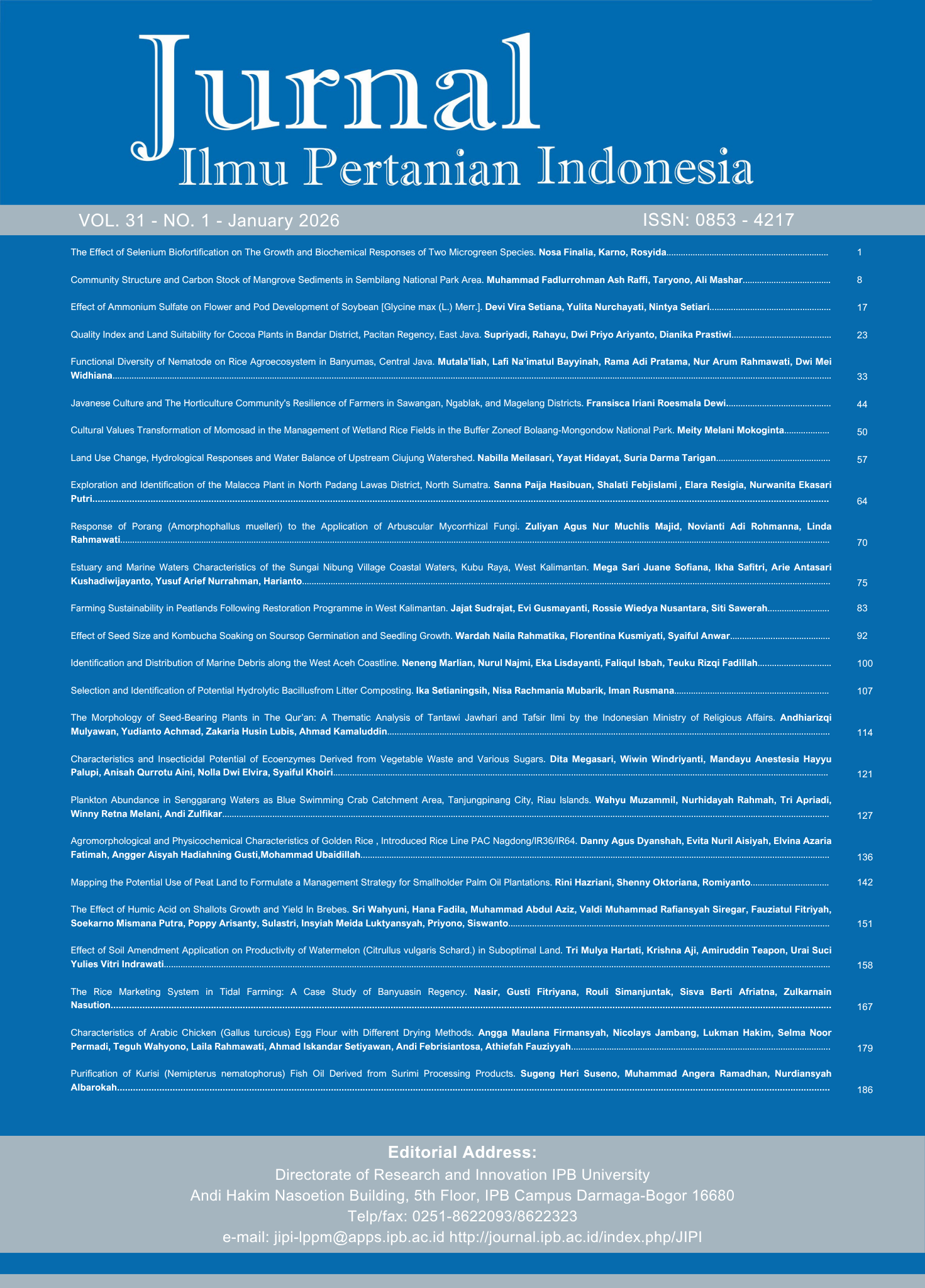
Cultural Values Transformation of Momosad in the Management of Wetland Rice Fields in the Buffer Zoneof Bolaang-MongondowNational Park
DOI:
https://doi.org/10.18343/3jipi.1.1.50Keywords:
cultural values, Momosad, transformationAbstract
Momosad is a gotong royong activity in which a group of farmers work together to maintain their land. Currently, Momosad is transitioning from a labor-based to a wage-based Momosad (commercial). The research aims are (1) to uncover Momosad's cultural values, which are still relevant today, (2) to describe the elements that influence changes in the values in land management, and (3) to examine patterns of changes in the values. This study employed a qualitative technique using the Miles and Huberman Model, involving interviews, observations, and documentation. Data was processed using the triangulation rule. The results suggest that there are three types of Momosad agricultural production activities in Dumoga. (1) Pure-Momosad has family values; (2) Semi-Momosad values unity and dependence. (3) Non-Momosad (commercial) values include agreement and dependency. There are three variables that influence Momosad's change: (1) pre-colonial, (2) colonial, (3) development, and (4) regional autonomy. Cultural contact, development period, and regional autonomy all have a significant impact on the pattern of change in the value. The pattern of change began with cultural contact between transmigration and local residents, evolved into the power to form villages during Momosad construction, and the autonomy of the region became a political commodity used to rally the masses.
Keywords: cultural values, Momosad, transformation
Downloads
References
Adro F, Franco M. 2020. Rural and agri entrepreneurial networks: A qualitative case study. Land Use Policy. 99(1): 105117. https://doi.org/10.1016/j.landusepol.2020.105117
Alexander P, Reddy A, Brown C, Henry RC, Rounsevell MD. 2019. Transforming agricultural land use through marginal gains in the food system. Global Environmental Change. 57(101932): 1–26 https://doi.org/10.1016/j.gloenvcha.2019.101932
Arifanti VB, Novita N, Tosiani A. 2021. Mangrove deforestation and CO2 emissions in Indonesia. In IOP Conference Series: Earth and Environmental Science. 874(2021): 1–9 IOP Publishing. https;//doi.org/10.1088/1755–1315/874/1/012006
Belay M, Mengiste M. 2023. The ex‐post impact of agricultural technology adoption on poverty: Evidence from north Shewa zone of Amhara region, Ethiopia. International Journal of Finance & Economics. 28(2): 1327–1337. https://doi.org/10.1002/ijfe.2479
Cánovas MA, Canovas SA, García FE. 2021. City traditional agriculture dialogues: The Huerta de Murcia case study. Land Use Policy. 111(2021): 105780. https://doi.org/10.1016/j.landusepol.2021.105780
Choi CS, Ravi S, Siregar IZ, Dwiyanti FG, Macknick J, Elchinger M, Davatzes NC. 2021. Combined land use of solar infrastructure and agriculture for socioeconomic and environmental co benefits in the tropics. Renewable and Sustainable Energy Reviews. 151(c): 111610. https://doi.org/10.1016/j.rser.2021.111610
Cui Y, Khan SU, Deng Y, Zhao M, Hou M. 2021. Environmental improvement value of agricultural carbon reduction and its spatiotemporal dynamic evolution: Evidence from China. Science of the Total Environment. 754(142170).
Dakir D. 2017. Pengelolaan budaya inklusif berbasis nilai belom bahadat pada huma betang dan transformasi sosial masyarakat dayak Kalimantan Tengah. Religió Jurnal Studi Agama. 7(1): 28–54. https://doi.org/10.15642/religio.v7i1.707
Eriksson O. 2021. The importance of traditional agricultural landscapes for preventing species extinctions. Biodiversity and Conservation. 30(5): 1341–1357. https://doi.org/10.1007/s10531–021–02145–3
Fleming A, Jakku E, Fielke S, Taylor BM, Lacey J, Terhorst A, Stitzleinv C. 2021. Foresighting Australian digital agricultural futures: Applying responsible innovation thinking to anticipate research and development impact under different scenarios. Agricultural Systems. 190(2021): 1–10. doi:10.1016/j.agsy.2021.103120
Gatti N, Baylis K, Crost B. 2021. Can irrigation infrastructure mitigate the effect of rainfall shocks on conflict? Evidence from Indonesia. American Journal of Agricultural Economics. 103(1): 211–231.
Hasan SS, Zhen L, Miah MG, Ahamed T, Samie A. 2020. Impact of land use change on ecosystem services: A review. Environmental Development. 34(100527). https://doi.org/10.1016/j.envdev.2020.100527
Ives CD, Kendal D. 2013. Values and attitudes of the urban public towards peri urban agricultural land. Land Use Policy. 34: 80–90 https://doi.org/10.1016/j.landusepol.2013.02.003
Janvry AD, Sadoule E. 2020. Using agriculture for development: Supply and demand side approaches. World Development. 133(105003). https://doi.org/10.1016/j.worlddev.2020.105003
Kassa H, Dondeyne S, Poesen J, Frankl A, Nyssen J. 2017. Transition from forest‐based to cereal‐based agricultural systems: A review of the drivers of land use change and degradation in Southwest Ethiopia. Land Degradation & Development. 28(2): 431–449. https://doi.org/10.1002/ldr.2575
Kanianska R, Kizeková M, Nováček J, Zeman M. 2014. Land-use and land-cover changes in rural areas during different political systems: A case study of Slovakia from 1782 to 2006. Land Use Policy. 36(1): 554–566. https://doi.org/10.1016/j.landusepol.2013.09.018
Kistanto NH. 2018. Transformasi sosial budaya masyarakat Indonesia. Sabda: Jurnal Kajian Kebudayaan. 13(2): 169–178. https://doi.org/10.14710/sabda.13.2.169–178
Knickel K, Ashkenazy A, Chebach TC, Parrot N. 2017. Agricultural modernization and sustainable agriculture: Contradictions and complementarities. International Journal of Agricultural Sustainability. 15(5): 575–592. https://doi.org/10.1080/14735903.2017.1373464
Pachayappan M, Ganeshkumar C, Sugundan N. 2020. Technological implication and its impact in agricultural sector: An IoT-based collaboration framework. Procedia Computer Science. 171(2020): 1166–1173. https://doi.org/10.1016/j.procs.2020.04.125
Pranadji T, Hastuti EL. 2004. Transformasi sosio budaya dalam pembangunan pedesaan. Analisis Kebijakan Pertanian. 2(1): 77–92. https://doi.org/10.21082/akp.v2n1.2004.77–92
Purcell W, Neubauer T. 2023. Digital twins in agriculture: A state of the art review. Smart Agricultural Technology. 3(100094): 1–11.
Salam S, Ahmad A. 2023. Transformasi teknologi panca usahatani dan dampaknya terhadap sistem sosial ekonomi dan budaya petani Bugis Makassar di Sulawesi Selatan. Tarjih: Agribusiness Development Journal. 3(01): 26–33. https://doi.org/10.47030/tadj.v3i01.627
Shamdasani Y. 2021. Rural road infrastructure & agricultural production: Evidence from India. Journal of Development Economics. 152(102686). https://doi.org/10.1016/j.jdeveco.2021.102686
Suamba IBS, Wiryasa NMA, Dwijendra NKA, Putra IDGAD. 2022. Characteristics and deviation patterns of agricultural land use in tourism area of Canggu, Bali, Indonesia. Caspian Journal of Environmental Sciences. 20(2): 423–430.
Yang Y, Liu Y, Li Y, Li J. 2018. Measure of urban rural transformation in Beijing Tianjin Hebei region in the new millennium: Population land industry perspective. Land Use Policy. 79(2018):595–608. https://doi: 10.1016/j.landusepol.2018.08.005
Downloads
Published
Issue
Section
License
Copyright (c) 2025 meity mokoginta

This work is licensed under a Creative Commons Attribution-NonCommercial 4.0 International License.
This journal is published under the terms of the Creative Commons Attribution-NonCommercial 4.0 International License. Authors who publish with this journal agree to the following terms: Authors retain copyright and grant the journal right of first publication with the work simultaneously licensed under a Creative Commons Attribution-NonCommercial 4.0 International License. Attribution — You must give appropriate credit, provide a link to the license, and indicate if changes were made. You may do so in any reasonable manner, but not in any way that suggests the licensor endorses you or your use. NonCommercial — You may not use the material for commercial purposes.
How to Cite

























 View JIPI StatsCounter