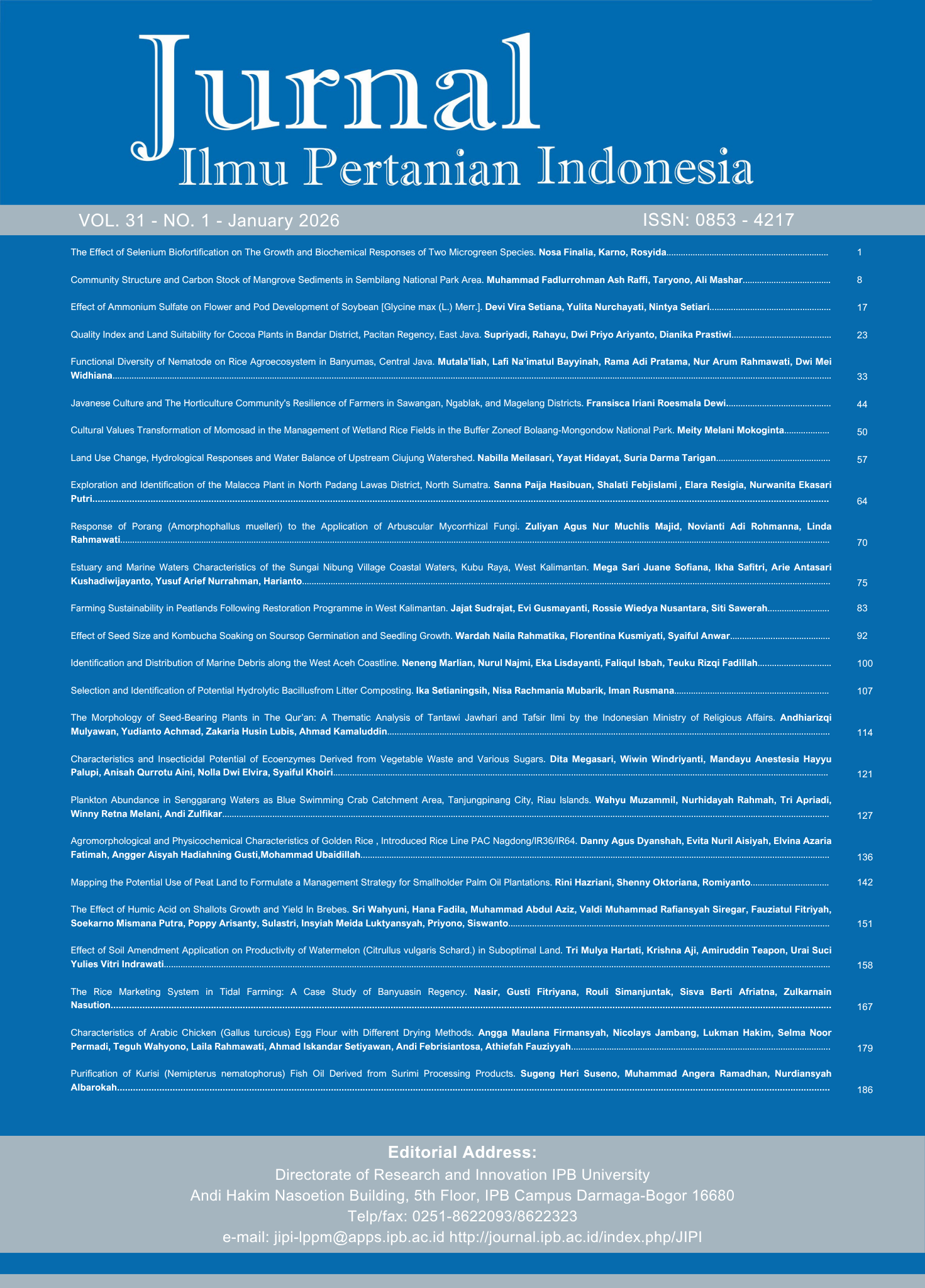
Javanese Culture and The Horticulture Community's Resilience of Farmers in Sawangan, Ngablak, and Magelang Districts
DOI:
https://doi.org/10.18343/jipi.31.1.44Keywords:
community resilience, falling prices, local wisdom, vegetable farmersAbstract
Magelang Regency region contains a plateau in the shape of a basin surrounded by mountains. The agroclimatic can generate enough agricultural products in sufficient quantity and quality to meet market demand. Horticultural agricultural activities in this area have the potential to improve food security and household income, considering technical, social, institutional, commercial, financial, and environmental issues. Horticultural growers were usually under pressure due to the drop in vegetable prices. The study examines the fight of independent horticultural farmers against adversity via the lens of community resilience. Community resilience includes community interests, institutional development, defense, and capacity building operations, as well as individual actions. The purpose of this study was to describe how resilient vegetable-growing communities are to food security concerns. Five villages in the Magelang Regency were affected: Klangon Hamlet in Sawangan District, Babadan Hamlet in Srumbung District, Wonolobo Hamlet, Krangean Hamlet, and Lodosewu Hamlet in Ngablak District. The thematic analysis approach was used to identify themes or characteristics related to the psychological and financial elements of vegetable producers. The resilience of the horticultural farming community in this area is built on trust in fellow farmers; there is hope for high prices to return; there is independence in weathering crop failures; and the local values of nrimo and gemi setiti are still practiced. The robustness of adaptive networks in the form of social capital, combined with excellent management of local capacities, increases the resilience of horticultural farming communities in this area.
Keywords: community resilience, falling prices, local wisdom, vegetable farmers
Downloads
References
Breda ADV. 2001. Resilience Theory: A Literature Review. South African Military Health Service, Pretoria (ZA): Military Psychological Institute, Social Work Research & Development.
Cancian F. 1989. Economic Behavior In Peasant Communities (S. Plattner (ed.)). Stanford (US): Stanford University Pr.
Chandra A, Acosta J, Stern S, Uscher- Pines L, Williams M, Yeung D, Garnett J, Mereduth LS. 2011. Build–ing Community Resilience to Disasters: A Ways Forward to Enhance National Health Security. Santa Monica (S): RAND Corporation. https://doi.org/10.1037/e530792011-001
Dewi A. 2007. Community-based analysis of coping with urban flooding: A case study in Semarang, Indonesia. [Thesis]. Enschede (NL): International Institute for Geo–Information Science and Earth Observation.
Ekaputri AD, Ningrum V. 2020. Strategi Petani Kecil Bertahan Di Masa Pandemi Covid–19. BRIN. https://kependudukan.brin.go.id/mencatatcovid19/strategi–petani–kecil–bertahan–di–masa–pandemi–covid–19/
Field J. 2008. Social Capital (2nd ed.). London (UK): Routledge. https://doi.org/10.4324/9780203930519
Fishwick MW. 2005. The resilient city: How modern cities recover from disaster. The Journal of American Culture. 28(4): 456. https://doi.org/10.1111/j.1542-734X.2005.00265.x
Fukuyama F. 2001. Social capital and development: The coming agenda. SAIS Review. 22(1): 23–37. https://doi.org/10.1353/sais.2002.0009
Kulig JC, Edge DS, Joyce B, Deer R. 2008. Understanding community resiliency in rural communities through multimethod research. Journal of Rural and Community Development. 3(3): 77–94.
Lestari EP, Setyowati N. 2022. An approach to determine the price volatility of red chili in Semarang Regency using ARCH-GARCH. AGRIS on-line Papers in Economics and Informatics. 14(4), 3–13.
Maguire B, Cartwright S. 2008. Assessing a community’s capacity to manage change : A resilience approach to social assessment. Social Science Program. May: 1–27.
Maguire B, Hagan P. 2007. Disasters and communities: Understanding social resilience. The Australian Journal of Emergency Management. 22(2): 16–20.
Maliati N, Chalid I. 2021. Resiliensi komunitas dan kerawanan pangan di pedesaan Aceh. Aceh Anthropological Journal. 5(1): 51–63. https://doi.org/10.29103/aaj.v5i1.4602
Norris FH, Stevens SP, Pfefferbaum B, Wyche KF, Pfefferbaum RL. 2008. Community resilience as a metaphor, theory, set of capacities, and strategy for disaster readiness. American Journal of Community Psychology. 41(1–2): 127–150. https://doi.org/10.1007/s10464-007-9156-6
Novianty A. 2015. Penyesuaian dusun jangka panjang ditinjau dari resiliensi komunitas pasca gempa. Jurnal Psikologi. 38(1): 30–39.
Paton D, Millar M, Johnston D. 2001. Community resilience to volcanic hazard consequences. Natural Hazards. 24(2): 157–169. https://doi.org/10.1023/A:1011882106373
Sulastri A. 2007. Kearifan lokal Jawa dan resiliensi terhadap trauma psikologis pada korban selamat bencana gempa bumi di Bantul. Jurnal Kajian Politik Lokal & Sosial-Humaniora. 4(1): 146–166.
Twigg J. (2009). Characteristics of a disaster-resilient community: A guidance note (Version 2). DFID Disaster Risk Reduction NGO Interagency Group. https://www.preventionweb.net/files/29078_characteristicsofadisasterresilientco.pdf
United Nations Economic and Social Commission for Asia and the Pacific (UNESCAP). 2008. Building community resilience to natural disasters through partnership. UNESCAP. https://hdl.handle.net/20.500.12870/2924
Downloads
Published
Issue
Section
License
Copyright (c) 2025 Fransisca Dewi

This work is licensed under a Creative Commons Attribution-NonCommercial 4.0 International License.
This journal is published under the terms of the Creative Commons Attribution-NonCommercial 4.0 International License. Authors who publish with this journal agree to the following terms: Authors retain copyright and grant the journal right of first publication with the work simultaneously licensed under a Creative Commons Attribution-NonCommercial 4.0 International License. Attribution — You must give appropriate credit, provide a link to the license, and indicate if changes were made. You may do so in any reasonable manner, but not in any way that suggests the licensor endorses you or your use. NonCommercial — You may not use the material for commercial purposes.
How to Cite

























 View JIPI StatsCounter